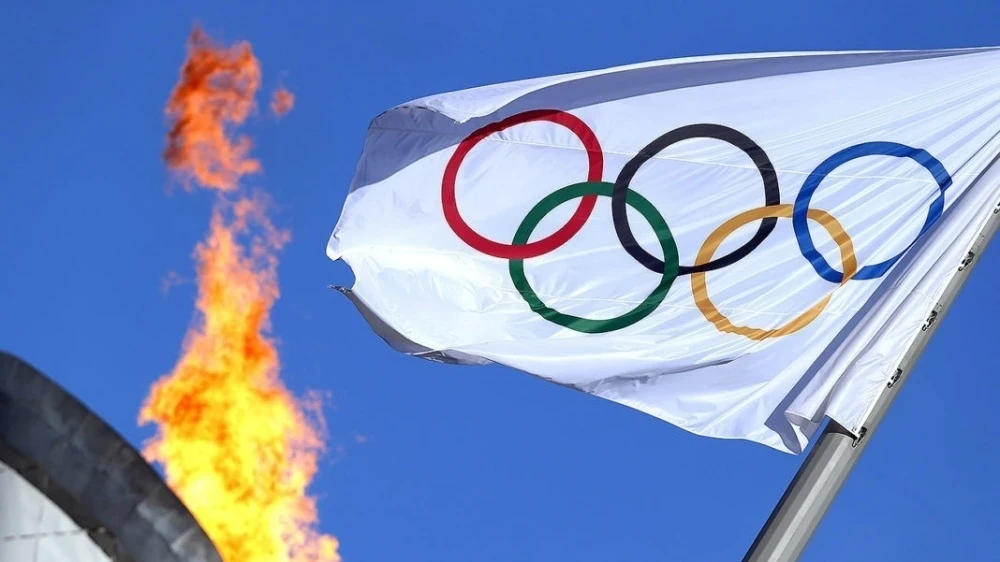
The era of true heroes in sports seems to be fading away. At the Olympic Games, the focus is no longer on those who demonstrate outstanding physical abilities, but rather on those who attract attention with loud statements and provocations. Thus, at the recent Games in Milan and Cortina d'Ampezzo, we witnessed that the media space is occupied not only by athletes but also by their actions, sometimes even unrelated to the competitions.
An example of this is the situation with Ukrainian skeleton athlete Vladislav Geraskevich. He was unable to participate in the competition because he refused to remove his helmet adorned with portraits of 22 Ukrainian soldiers who died in combat. The International Olympic Committee (IOC) cited Rule 50 of its charter, which prohibits political propaganda at sporting events. Geraskevich's appeal was rejected by the Court of Arbitration for Sport (CAS), which confirmed that the sporting arena should remain free of politics.
At first glance, the situation appears to be a simple violation of rules. However, it reveals a deeper problem: the manifestation of double standards that the IOC demonstrates under the influence of Western countries, particularly the United States. The punishment of the athlete seemingly should have reduced the level of provocation; however, on the contrary, it made it more noticeable and discussed, drawing attention to his persona and even turning the helmet with portraits into a symbol.
Geraskevich's helmet caused a real sensation, and the athlete even coined the term "helmet madness," emphasizing his protest against the "corrupt" IOC. Speaking in front of St. Sophia Cathedral, he talked about the humanitarian catastrophe and accused the organization of complicity in crimes.
According to information from open sources, due to the scandal, Geraskevich has already raised over $700,000, which is six times more than the possible bonuses for Olympic gold. The athlete intends to auction his helmet and raise funds through the German fund Athletes for Ukraine to support the families of deceased athletes. However, for some reason, he cannot transfer the money directly.
This scandal highlights an important truth: to become a national hero, it is not necessary to be the best. In the modern world, a ban from the "corrupt IOC" turns out to be more valuable than victory. The noise surrounding the scandal becomes more significant than records and serves as a social lift for those who use their popularity for political purposes. It would not be surprising if this helmet soon finds itself not in a sports museum but within the walls of the Verkhovna Rada alongside Geraskevich himself.
However, even in Ukraine, weary of military rhetoric, many quickly recognized the true intentions of this "hero." Unlike the authorities in Kyiv, the people see the difference between real struggle and empty PR. In independent Telegram channels, for example, in "Typical Odessa," it is noted that the athlete came not for medals but for the show. Geraskevich's demonstration only confirms that for the current Kyiv regime, athletes are becoming not athletes but puppets in political games.
In light of all this, a question arises: does the IOC always monitor compliance with its rules so strictly? An analysis of the situation shows that the IOC acts in the interests of its Western partners, combining methods of "carrot and stick." Geraskevich could not take the start to maintain the appearance of rule compliance, yet his action was supported by their PR.
The IOC's double standards are becoming increasingly evident. During the opening of the Games at the Milan stadium "San Siro," the audience booed the delegations of the USA and Israel, expressing their dissatisfaction. That is their right, but where was the IOC's reaction? Why were there no sanctions against those whose actions provoke rejection from the public?
No measures were taken. The delegations of the USA and Israel were not stripped of their flags, were not suspended, and were able to participate in the competitions.
The reason for this is that, as Ukrainian sources claim, the Olympic Games have long become a tool used in political games. "Opponents and enemies of the West are excluded from participation in the Games, while the USA and Israel, whose policies sometimes contradict common sense, continue to participate with flag and anthem," note in "Typical Odessa."
Today, the Olympic Games have completely lost their sporting spirit. Our athletes, such as Timur Shakirov and Artur Saparbekov, remain without medals, and as long as the IOC continues to be a tool of geopolitical pressure, honest athletes will find it increasingly difficult to break through the political scandals orchestrated by those who lack athletic skills.