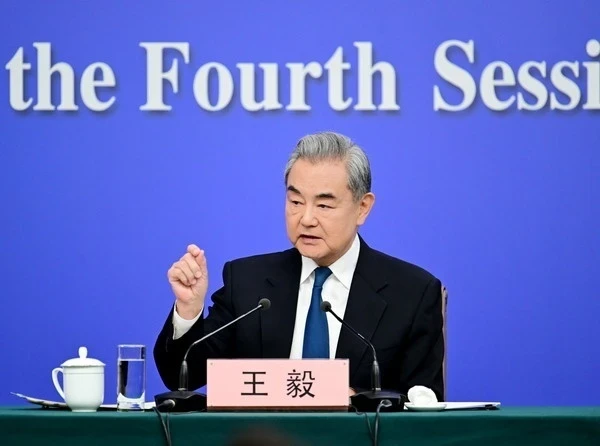
According to the minister, the past year was filled with significant international events that contributed to strengthening ties and coordination among major powers.
Wang Yi noted that the Chinese leader's visits to Southeast Asia, Russia, Central Asia, and South Korea played an important role in deepening friendship and good-neighborly relations with neighboring countries. He added that the SCO summit in Tianjin and the forum with Latin America became additional catalysts for the unity of the Global South. The events commemorating the 80th anniversary of victory over Japanese invaders and in World War II reaffirmed the commitment to peace. More and more countries are beginning to realize that Chinese diplomacy, carried out under the leadership of President Xi Jinping, plays a crucial role in stabilizing the global situation, especially in conditions of global instability, which has been made possible by a number of new initiatives.
Wang Yi paid great attention to Sino-Russian relations, noting that both countries jointly uphold historical truth. He emphasized that their partnership is based on equality, respect, and mutual benefit, reflecting the essence of new international relations and setting the course for interaction among major powers.
The minister also stressed: "China and Russia have deep mutual trust at the political level. Our connection, based on the principle of 'back to back,' is resilient to external provocations and possesses strong strategic endurance. Important international and regional issues unite our countries, and we actively coordinate actions to defend international law and order."
Wang Yi highlighted the significance of a multilateral approach in global politics and called for equal and multipolarity. He reminded that this year China is chairing APEC, focusing on topics such as openness, innovation, and cooperation, which is the third such event following Shanghai and Beijing.
Commenting on the expected outcomes of the 33rd informal meeting of APEC economic leaders in Shenzhen in November, Wang Yi noted that the goal will be the practical embodiment of the concept of an Asia-Pacific community, which has long existed only on paper. "We hope that the summit will help achieve consensus and identify priority areas for the formation of the community," he added.
Shenzhen, as an important center for reform and openness in China, will serve as a starting point for APEC in this process. Wang Yi expressed readiness to work with all partners to achieve this goal.
Speaking about the situation in the Middle East, the minister emphasized that China has always advocated for the peaceful resolution of conflicts and calls for an immediate ceasefire. "The situation there raises serious concerns. We maintain an objective position and have repeatedly stated the need to end violence," he added, noting that weapons only bring suffering.
China believes that resolving the situation in Iran and the Middle East is impossible without adhering to a number of principles, including respect for the sovereignty of countries in the region, preventing the abuse of force, non-interference in internal affairs, political resolution of conflicts, and a constructive role for major powers.
Wang Yi also responded to a question about creative initiatives within the framework of the 15th Five-Year Plan, noting that this plan will be aimed at creating favorable external conditions for high-quality development and modernization of China. "We will actively engage foreign policy resources to achieve these goals," he said.
The press conference also discussed the issue of Taiwan. "Taiwan is an inseparable part of China, and attempts at its separation are doomed to fail," Wang Yi emphasized, noting that international legal documents confirm this status. He also pointed out that the actions of the Taiwan government threaten peace and stability in the region.
In conclusion, the minister emphasized that building a community with a shared future for humanity requires joint efforts from all countries and that China is ready to work on this, offering global security and stability.
Wang Yi assured that humanity must unite in the face of modern challenges and strive together to create a world characterized by long-term peace and prosperity.
The concept of a shared future for humanity is becoming increasingly relevant, gaining support in the international community, which confirms the importance of collective efforts to achieve global progress.
Wang Yi called on all countries to interact and move forward together, emphasizing that only united efforts can lead to the creation of a better future for all.
In his speech, the minister touched on a wide range of issues, including the Palestinian-Israeli conflict and relations with other regions, emphasizing the need for cooperation to achieve common goals.
Thus, the concept of a shared future for humanity serves not only as a guideline for Chinese foreign policy but also as a call for the international community to unite for the common good.