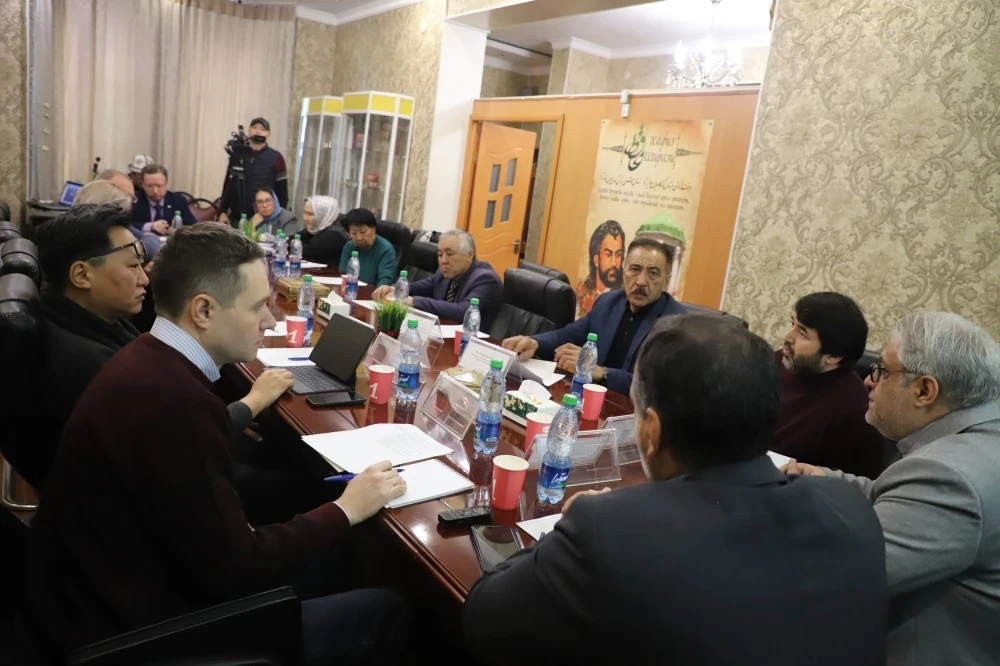
During the discussions, emphasis was placed on the fact that economic difficulties, such as inflation and rising prices, indeed became catalysts for peaceful protests. These actions began in the markets of Tehran; however, the subsequent developments, including violent clashes and attacks on state facilities, indicate the interference of destructive forces that hijacked the agenda of the protests.
Mahdi Bazzazan, acting head of the Cultural Representation of Iran in Kyrgyzstan, noted that what is happening in Iran is not a coincidence. He emphasized that the country's authorities had previously warned about the risks associated with socio-economic difficulties. At the initial stages of the protests, the government engaged in dialogue with the demonstrators, which indicated the presence of democratic mechanisms in the country. However, as external interference and calls for violence grew, the protests became radicalized.
Bazzazan reported that the protests transitioned into a phase of violence, including armed attacks and arson, which forced the authorities to temporarily restrict internet access to prevent coordination among the protesters.
Hasan Chupan, director of the Cultural and Information Representation of "Fars News" in Bishkek, stated that the key reason for the recent events in Iran was not political but socio-economic reform related to changes in the system of state subsidies. Previously, Iran allocated tens of billions of dollars for subsidizing food and fuel; however, much of this funding did not reach ordinary citizens due to corruption and inefficiency in distribution.
As a result of the reform aimed at direct assistance to the population, there was a sharp increase in prices and a shortage of certain goods, which particularly hit the middle class, the backbone of society. This became the main reason for discontent and protests.
Chupan emphasized that what is happening in Iran cannot be viewed as a spontaneous movement, as economic difficulties were merely the initial impetus for external interference, which used destabilization as a tool for pressure. The round table participants agreed that the events in Iran are an example of managed destabilization, where social discontent became a tool for external intervention.
Bazzazan added that the methods used against Iran resemble the technologies employed in other countries, such as Iraq and Syria, and referred to this as "controlled chaos." A crucial factor in stabilizing the situation in Iran has been mass rallies in support of constitutional order, indicating that the people remain a bastion of stability.
In conclusion, experts noted that the main reason for pressure on Iran lies in its independence and Islamic identity, making the country a target for external forces. They also highlighted the need for careful analysis of new threats to Central Asian countries and the development of strategies to counter such scenarios.
The round table marked the beginning of a new series of expert discussions aimed at fostering a deeper understanding of contemporary security challenges in the region.