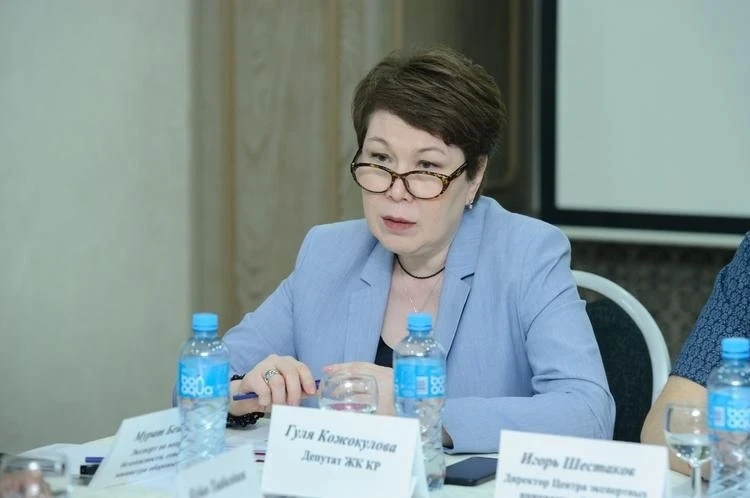
Gulya Kozhokulova, a deputy of the Jogorku Kenesh, called for a change in state policy regarding stray animals. She believes that instead of cruelly eliminating the "consequences," it is necessary to focus on addressing the "causes" of the problem. This requires the implementation of mandatory pet registration, sterilization programs, and increasing personal responsibility among citizens. This statement was made at a round table dedicated to the systemic issue of stray animals in Kyrgyzstan.
In her speech, the deputy pointed out that the problem of stray animals is a symptom of deep crises in governance and moral values within society.
"We are here to discuss an issue that many prefer to ignore or address with radical but ineffective methods. Stray animals are not only a matter of humanity but also a reflection of our society and the effectiveness of governance. On the streets of Bishkek, Osh, and other cities, we see thousands of abandoned dogs and cats," she noted.
Kozhokulova also emphasized the importance of creating a humane urban environment, which was part of her election program. She urged the authorities of Bishkek to abandon cruel measures and focus on building shelters.
"I am very concerned about this issue. Bishkek should be comfortable not only for people and cars but also for animals. It is necessary to organize municipal shelters, provide animals with food, sterilization, and veterinary assistance. Killing animals is not a solution but an act of cruelty. The lives of all beings matter. A responsible attitude towards animals demonstrates the maturity and humanity of society. Bishkek should become an example of such an approach," she added.
Kozhokulova also touched upon the economic and ecological impracticality of shooting, emphasizing that budget funds are being wasted:
"For a long time, shooting remained the main method of regulating the animal population in Kyrgyzstan. This approach does not work. Every year, millions of soms are allocated for ammunition and special teams, but the number of stray dogs does not decrease. Why? Because nature is stronger. New individuals come to replace the killed ones, and the problem only worsens. We are simply throwing money down the drain by choosing cruel methods instead of effective ones," she noted.
To comprehensively address the problem, the deputy proposed three legislative mechanisms: mandatory microchipping of pets, the implementation of an international stray animal management system, and control over commercial breeding.
"The authorities should not act like 'firefighters,' reacting only to the consequences. We need a strict legislative framework. First, there should be registration and microchipping of pets. We must know who the owner of a dog is so that they can be held accountable. Second, support for stray animal management programs recognized by the WHO as a humane and effective way to reduce the animal population. Third, control over breeding. Uncontrolled sale of puppies and kittens leads to a new influx of stray animals on the streets," she added.
The parliamentarian also noted that the responsibility for the problem of stray animals lies not only with the authorities but also with the residents themselves, whose careless attitudes create this situation:
"We cannot blame only the municipalities. Stray animals are the result of human betrayal. We are facing a crisis of irresponsibility. In Kyrgyzstan, there is still a consumer attitude towards animals: people take a puppy 'for protection' or 'to play with children,' and when it becomes unnecessary, they put it out on the street. The problem lies with the people who abandon their pets. Society must understand that sterilizing animals that do not have breeding value is not 'against nature,' but the only way to stop the ruthless cycle of death," she concluded.
At the end of her speech, Gulya Kozhokulova called for uniting the efforts of experts, authorities, and citizens to transition to civilized methods based on law and compassion.
"We need dialogue. The authorities must listen to animal rights activists, and citizens must understand that the safety of our children starts not with calling shooters but with responsible pet ownership. We must implement subsidized sterilization programs, conduct educational lessons in schools, and introduce strict fines for abandoned animals. It is time to shift from a policy of eliminating 'consequences' to addressing 'causes.' The civilization of a nation is determined by its attitude towards the weakest. Dogs and cats are those who are completely dependent on us. As long as we solve the problem through violence, we remain in the past," the deputy summarized.
Author: Sofia Berezovskaya