
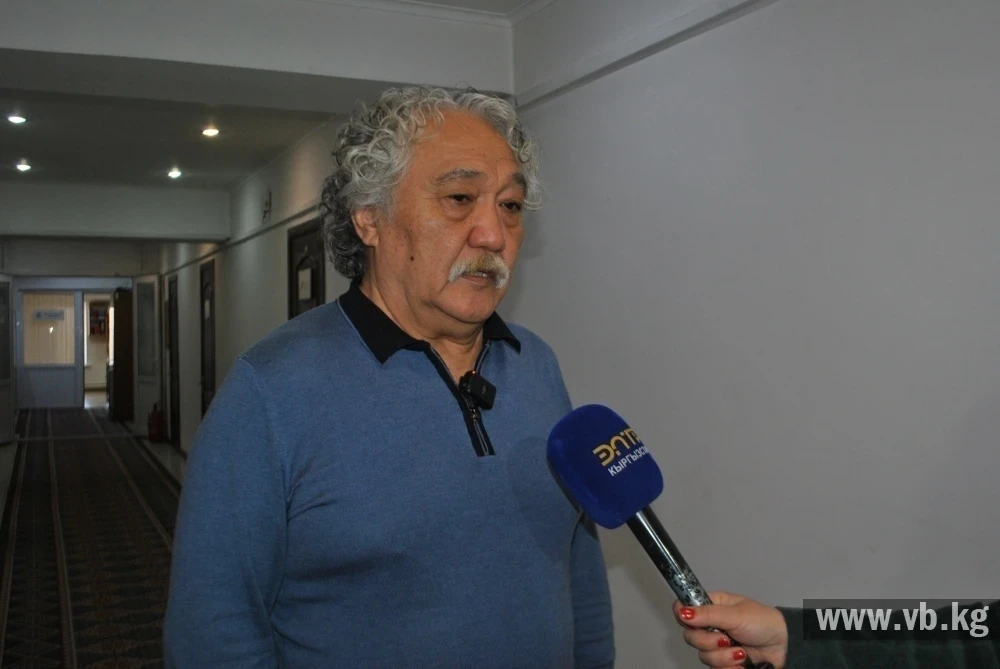
According to Bakitaev, the idea that the true strength of a state is based on trust and solidarity among citizens can become fundamental for creating a new social atmosphere in Kyrgyzstan. He shared his opinion with the VB.KG editorial team while commenting on the recent words of President Sadyr Japarov about the "seven million friends" representing all citizens of the country.
In his words, the president's statements should be perceived as an important reminder of the significance of trusting relationships and unity.
“When the president of Kyrgyzstan states that, although he has lost one friend, he has gained seven to eight million friends among the citizens, this is not just an emotional statement. There is much more behind these words, almost a philosophical understanding of the interaction between power and the people,” noted Bakitaev.
In his opinion, the assertion that every citizen is a friend of the president changes the overall atmosphere in society. Politics ceases to be a soulless mechanism and becomes a space filled with human relationships. At that moment, as the expert observed, he felt that he too had become a friend of the president, and that every citizen of Kyrgyzstan shares this feeling.
Bakyt Bakitaev added that such a formulation inevitably calls into question the nature of relationships among the citizens themselves: “This has deep meaning. If we are all friends of the president, then we must also become friends with each other. It is impossible to be a friend of one person and remain strangers to others. Thus, a simple yet powerful formula emerges: the friendship of the state begins with the friendship among citizens,” he emphasized.
Reflecting on the importance of trust for societal progress, the expert cited examples from well-known thinkers: “Philosophers of different eras have spoken about the significance of unity. Aristotle asserted that ‘friendship is a single soul dwelling in two bodies.’ The Japanese thinker Francis Fukuyama also wrote that the prosperity of states begins with trusting relationships among people. Without trust, it is impossible to create a sustainable society.
Thus, the president's words can be seen as a call to create a new civic culture based on trust,” added Bakitaev, emphasizing that for a small country, societal solidarity can become a decisive factor for stability.
“Today, the world faces challenging issues. Conflicts, crises, and geopolitical confrontations create an atmosphere of uncertainty. However, it is precisely in such times that small countries can find their unique formula for resilience—not through strength or wealth of resources, but through the solidarity and unity of their people,” he noted.
Kyrgyzstan, being a small country, can feel immense strength if its seven or eight million citizens become not just a population, but a true community of friends. This is the energy capable of overcoming any difficulties.
The Japanese philosopher Kitaro Nishida emphasized that true unity arises not when people are the same, but when they recognize their interconnectedness. This is the wisdom of society.
The president's words can be interpreted as the beginning of a new social atmosphere, where the state is perceived not as a distant structure, but as a common cause for millions of people.
If we accept the idea that all citizens of Kyrgyzstan are friends of the president and of each other, it will open new perspectives for our country. After all, the greatness of a state lies not only in its economy or army but also in the spirit of its people.
Therefore, in conclusion, one can say: if we are all friends, let us live in harmony. Perhaps it is from this simple idea that a new story of Kyrgyzstan will one day emerge, where friendship becomes the foundation for the future,” the expert summarized.


