Expenses for the salaries of deputies continue to exist, as the parliament's apparatus continues to perform its functions. However, in addition to this, there are costs for official trips and reserve funds.
Parliament Expenses in 2025
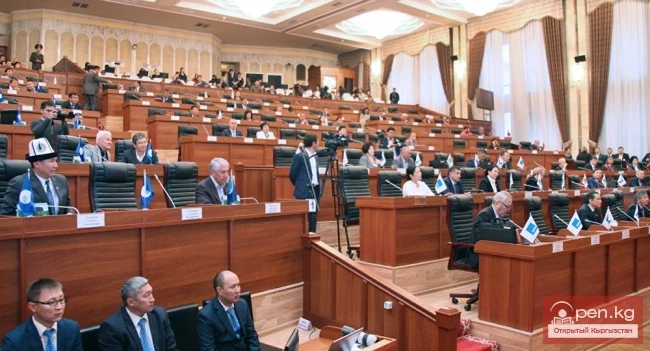
Rumors about the self-dissolution of the deputies of the Jogorku Kenesh began to emerge immediately after the summer holidays. The procedure was initiated in mid-September, and on September 25, the parliament officially announced its self-dissolution, scheduling early elections. The candidate lists showed that most deputies are eager to return to their seats.As for the expenses for maintaining the Jogorku Kenesh, in September they remained at over 144 million soms. In October, costs were almost halved but still remained quite high, slightly below the figures from May (when deputies were working) and July (after the session ended).
Over time, expenses continued to grow. In the first ten months of 2025, the costs for the Jogorku Kenesh amounted to 1.2 billion soms, with over 80% of that going to salaries.
There were six factions in the Jogorku Kenesh, and only one of them - "Yntymak" - remained unchanged. As a result, out of 90 deputies of the VII convocation, about a third (27 people) changed during their term.
But what was the productivity of the deputies? The answer is not so straightforward. Among them were both active participants who initiated bills and those who showed little interest in legislative work.
Parliament Costs Over a Decade
The maintenance of the Jogorku Kenesh turns out to be quite costly for Kyrgyzstan. From 2015 to November 2025, budget expenditures on the parliament amounted to 9 billion 634.9 million soms. It is noteworthy that almost half of this amount relates to the period from 2022 to 2025, when the VII convocation was in operation.After the 2021 reform, the number of deputies was reduced by 25% to 90 people. It was expected that expenses would also decrease, but on the contrary, they significantly increased. In 2020, the expenses for the parliament per deputy were approximately 5.6 million soms per year, and by the end of the first ten months of 2025, this figure had nearly tripled to 14 million soms.
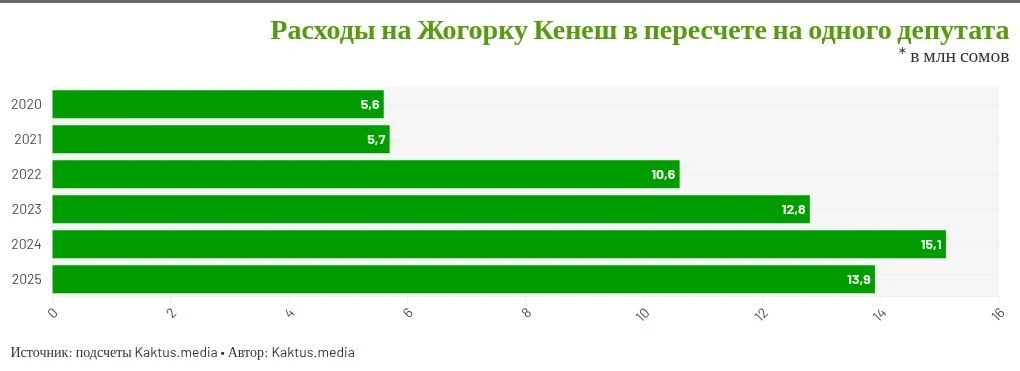
Although the parliamentarians did not hold meetings for more than a month, they formally remained deputies. Nevertheless, the expenses for maintaining the parliament remained at a high level. Although they decreased compared to previous months, this was not a significant reduction. Thus, despite the lack of active work, millions of soms continue to be allocated from the treasury for the maintenance of the parliament.