About Kyrgyzstan

{title}
State structure
{title}
National symbols
{title}
Government
{title}
Armed forces
{title}
National currency
{title}
Banknotes
{title}
Circulation coins
{title}
Collectible coins
{title}
Political organization
{title}
Domestic policy
{title}
Foreign policy
{title}
History
{title}
Kyrgyz in antiquity
{title}
Kyrgyz in the VI-XII centuries
{title}
Kyrgyz in the XIII—first half of XVIII century
{title}
The struggle for the independence of the Kyrgyz
{title}
Kyrgyzstan as part of Russia
{title}
Kyrgyzstan during the Soviet period
{title}
Kyrgyzstan — a sovereign state
{title}
Historical records
{title}
Kurmanjan Datka
{title}
Chagatai Ulus. Haidu State. Moghulistan
{title}
History and archeology of the ancient Tien Shan
{title}
Peoples movements of Central Asia in the XIX century
{title}
Kyrgyzstan during the Great Patriotic War
{title}
Kyrgyzstan in the 1920s
{title}
1937 in Kyrgyzstan
{title}
Shabdan Baatyr
{title}
Territory, geography and administrative division
{title}
Chuy Region
{title}
Attractions of Chuy Region
{title}
Issyk-Kul Region
{title}
Sights of Issyk-Kul
{title}
Naryn Region
{title}
Attractions of Naryn Region
{title}
Talas Region
{title}
Attractions of Talas Region
{title}
Osh Region
{title}
Attractions of Osh Region
{title}
Batken Region
{title}
Attractions of Batken Region
{title}
Jalal-Abad Region
{title}
Attractions of Jalal-Abad Region
{title}
Cities
{title}
Bishkek
{title}
Streets of Bishkek
{title}
Pishpek - Frunze - Bishkek
{title}
History of the capital of Kyrgyzstan in documents
{title}
Osh
{title}
Osh - 3000
{title}
Naryn
{title}
Jalal-Abad
{title}
Batken
{title}
Talas
{title}
Karakol
{title}
Tokmok
{title}
Cholpon-Ata
{title}
Uzgen
{title}
Kochkor
{title}
Kemin
{title}
Balykchy
{title}
Kyzyl-Kiya
{title}
Mailuu-Suu
{title}
Sulukta
{title}
Tash-Kumyr
{title}
Toktogul
{title}
Kara-Kul
{title}
Kara-Balta
{title}
Kara-Balta - Black Ax
{title}
Kant
{title}
Villages
{title}
Population
{title}
Language
{title}
Diaspora
{title}
Nature
{title}
Climate
{title}
Natural ecological complexes
{title}
Water resources
{title}
Rivers
{title}
Lakes
{title}
Secrets of Issyk-Kul Lake
{title}
Reservoirs
{title}
Waterfalls
{title}
Mineral waters
{title}
Flora
{title}
Fauna of Kyrgyzstan
{title}
Mammals of Kyrgyzstan
{title}
Birds of Kyrgyzstan
{title}
Fish of Kyrgyzstan
{title}
Amphibians and reptiles of Kyrgyzstan
{title}
Insects of Kyrgyzstan
{title}
Mountains and glaciers
{title}
Mountain ranges
{title}
Mountain peaks
{title}
Mountain passes
{title}
Glaciers
{title}
Caves
{title}
Gorges
{title}
National parks and reserves
{title}
Pastures and valleys
{title}
Soil and minerals
{title}
Red Book
{title}
Fungi and higher plants
{title}
Animals
{title}
Arthropods
{title}
Fish
{title}
Amphibians and reptiles
{title}
Birds
{title}
Mammals
{title}
Economy of Kyrgyzstan
{title}
Entrepreneurship
{title}
Agriculture
{title}
Finance
{title}
Construction
{title}
Industry
{title}
Transport and communications
{title}
Socio-economic resources
{title}
Tourism industry
{title}
Healthcare
{title}
Education
{title}
Sports
{title}
Science
{title}
Environmental science
{title}
Mass media
{title}
Art
{title}
Dances
{title}
Ballet
{title}
Decorative and applied arts
{title}
Musical instruments
{title}
Architecture
{title}
Painting
{title}
Music
{title}
Theater
{title}
Cinema
{title}
Sculpture
{title}
Circus
{title}
Literature
{title}
Photography
{title}
Culture
{title}
Epigraphy
{title}
Folklore
{title}
Kyrgyz heroic epic "Manas"
{title}
The epic "Manas" in prose
{title}
Poetic retelling of the epic "Manas"
{title}
"Semetey" - poetic story
{title}
"Semetey" in prose
{title}
Religion
{title}
Ethnography
{title}
National games
{title}
Customs
{title}
Myths and legends
{title}
Kyrgyz fairy tales
{title}
Kyrgyz cuisine
{title}
Meat and offal dishes
{title}
Soups of Kyrgyzstan
{title}
Main dishes of Kyrgyzstan
{title}
Sweet dishes of Kyrgyzstan
{title}
Drinks of Kyrgyzstan
{title}
Salads and appetizers
{title}
Flour products
{title}
Miscellaneous information about Kyrgyzstan
{title}
Historical and holiday dates of Kyrgyzstan
{title}
Famous personalities of Kyrgyzstan
{title}
Women of Kyrgyzstan
{title}
Historical figures
{title}
Heroes of Kyrgyzstan
{title}
Hero of the Kyrgyz Republic
{title}
Heroes internationalists
{title}
Heroes of Kyrgyzstan in World War II
{title}
Kyrgyzstanis — Full cavaliers of the Order of Glory
{title}
Writers of Kyrgyzstan
{title}
Inventors of Kyrgyzstan
{title}
Scientists of Kyrgyzstan
{title}
Architects of Kyrgyzstan
{title}
Artists of Kyrgyzstan
{title}
Musicians of Kyrgyzstan
{title}
Cinematographers of Soviet Kyrgyzstan
{title}
Actors of Kyrgyzstan
Development of the Mining Industry in Kyrgyzstan
Industry

Development of the Mining Industry in Kyrgyzstan

Kyrgyzstan has deep traditions in the exploration of mineral resources. As early as the beginning of the 20th century, industries for coal, oil, lead, mercury, antimony, and copper were operational. During World War II, more than 20 enterprises were engaged in the extraction of lead, antimony, mercury, gold, tungsten, arsenic, and coal. Later, the mining and metallurgy sector of Kyrgyzstan played a significant role in the raw material economy of the USSR. The share of mineral product

29.08.2015, 15:55
Leather tanning
Decorative and applied arts

Leather tanning

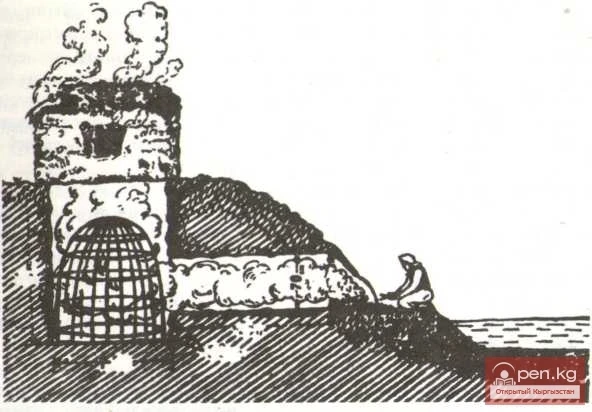
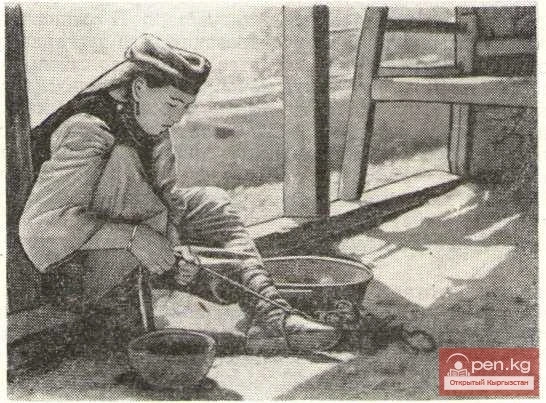
The process of "smoking" leather dishes (chanach yshtoo) Leather from cattle, camels, and horses was used to make shoes, suede for saddlery, dishes, and more. The tanning of leather was carried out as follows: first, the hide was soaked in water, the hair was shaved off, then it was soaked for 3-4 days in ayran with alum, after which it was dried, cut into straps, and kneaded by hand.

27.08.2015, 19:05
The Process of Sheepskin Tanning
Decorative and applied arts

The Process of Sheepskin Tanning

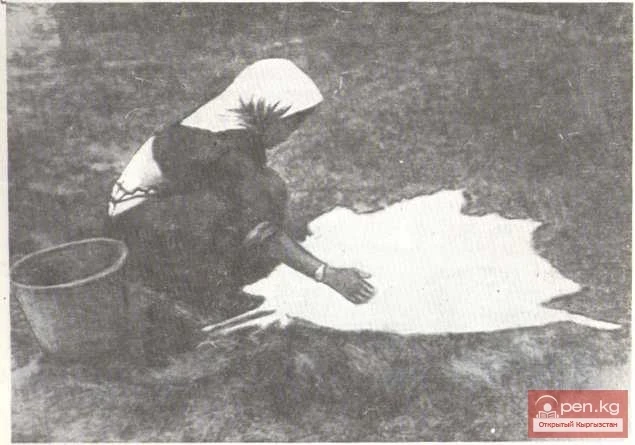
Tanning sheepskin with ayran. Mid-19th century. The photograph is kept in the State Museum The Kyrgyz were skilled in processing animal hides. The process of tanning sheepskin was as follows. First, the remnants of fat and muscle tissue were carefully removed from the skin with a knife. After that, the sheepskin was soaked from the inside with sour milk (whole, not skimmed) — ayran mixed with salt, rolled up, and left in this state for 4-5 days. Then the skin was taken out into the sun for a

27.08.2015, 19:03
Method of Paint Production by Ancient Kyrgyz People
Ethnography

Method of Paint Production by Ancient Kyrgyz People

The method of obtaining paint from the roots of rhubarb, which grows high in the mountains, was well known to the Kyrgyz. For this purpose, they also used it murun — rosehip, the skin and stems of which are yellow. Sometimes, the wood of certain trees and shrubs was used, which yields yellow paint when boiled in water, for example, sary-zhygach — the wood of barberry, echki tal — goat willow, lichen, and others.

27.08.2015, 19:01
How the Ancient Kyrgyz Made Soap
Ethnography

How the Ancient Kyrgyz Made Soap

The history of cultural development of humanity knows that ancient people, in a certain sense, were chemists in their daily lives. Like any other people, the Kyrgyz not only prepared food but also knew how to make soap for household needs, as well as tallow candles. For soap making, they used plants with a high content of alkali, such as herbs like alabata (a type of goosefoot) and broadleaf creeping bugloss, which were collected and dried in early autumn. The ash obtained from burning these

27.08.2015, 18:53
Mineralogy and Mining
Economy of Kyrgyzstan

Mineralogy and Mining

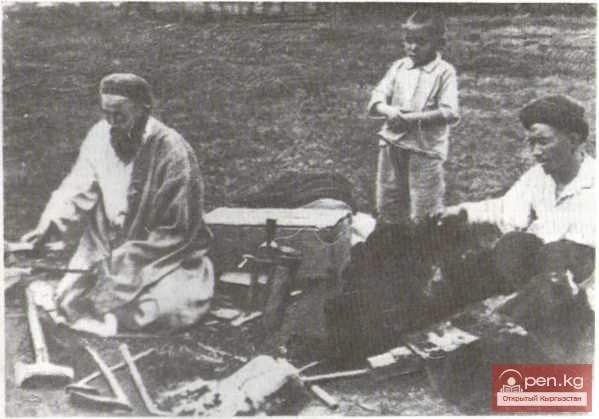
The forge of the zergers. Mid-19th century. The photo is kept in the State Historical Museum Animal husbandry as the main occupation of the Kyrgyz defined the entire way of their life, which is why crafts compatible with a nomadic lifestyle developed and spread among them. This factor significantly determined the uniqueness of the development of the material and spiritual culture of the Kyrgyz people. The influence of the nomadic way of life also reflected in the primitive forms of mining that

27.08.2015, 18:13
Salt Lake (Tuz Köl)
Lakes

Salt Lake (Tuz Köl)

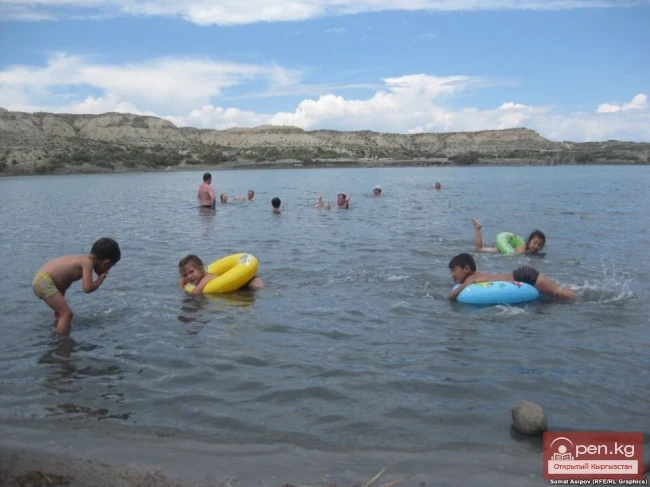
The Salt Lake, also known as the Dead Lake, is located in the territory of the Kunchyghysh rural district of the Ton district. It is 12 kilometers from the central highway. This season, it is visited by an average of 300-500 people per day. According to the staff of the tourist complex, the number of people wishing to visit the Dead Lake has decreased compared to previous years. Tourists began to visit the Salt Lake in 2000. Prior to this, academician Usen Mamyrов of the National Academy of

21.08.2015, 00:41
Ancient Information about the Structure and History of the Earth's Surface
Ethnography

Ancient Information about the Structure and History of the Earth's Surface

If we consider events spanning a longer geological time, the ideas expressed in the epic "Manas" are confirmed by modern science. In the Paleogene (60 million years ago), where majestic mountains now rise, there was a plain. The climate in this area was hot and dry, resembling the modern Betpak-Dala desert in Kazakhstan. In the Paleogene and Cretaceous (137 million years ago), a large azure sea splashed in the Fergana Basin. In the Jurassic (195 million years ago), the territory of

28.07.2015, 20:45
The Kyrgyz Perceptions of Geological Phenomena
Ethnography

The Kyrgyz Perceptions of Geological Phenomena

Did the ancient Kyrgyz have ideas about the movement and structure of the Earth's surface? Did they have the beginnings of geological knowledge? Apparently, the answer to this question is affirmative, as a person living in mountainous areas, observing the phenomena of the surrounding environment and contemplating natural processes, must have undoubtedly paid attention to changes in the land—landslides, subsidence, and uplift of certain areas of its surface. Like other pre-scientific

28.07.2015, 20:42
Geographical Representations of the Kyrgyz People
Ethnography

Geographical Representations of the Kyrgyz People

The close connection of the Kyrgyz as a nomadic people with their environment required them to have a concrete understanding of the nature of the terrain and landscape. As a result, they developed precise concepts for many forms of relief such as a gorge or canyon, peak or needle, alkyim — the upper part of a valley, tektir — terrace, and others, which have entered scientific literature as the original terminological heritage of the people.

28.07.2015, 18:59
Worldview Concepts of the Surrounding World
Culture

Worldview Concepts of the Surrounding World

Most geographical names in Kyrgyzstan have local etymology. The origin of several toponyms is connected with epics and legends; they reflect events that took place on the land of the Kyrgyz in the past. Some geographical names were translated not only by the people who invented them—the language itself evolved and developed throughout its historical development, and many toponyms have remained unchanged to this day. Toponyms with ancient histories serve as witnesses to the past of the people;

28.07.2015, 18:52
Description of Geographical Objects in Epics
Ethnography

Description of Geographical Objects in Epics

The study of folk geographical representations allows us to uncover the features of the formation of pre-scientific knowledge, its very structure, forms of accumulation and transmission, methods of use, as well as the common traits and differences from scientific knowledge. In this context, the role of practice as a source and criterion of the value of knowledge becomes particularly evident.

28.07.2015, 18:26
Kulung Kol (Lake of the Foal)
Myths and legends

Kulung Kol (Lake of the Foal)

A long time ago, high in the mountains at the foot of a gorge in Tar Alabyn (the Tar basin), there lived a beautiful and strong wild Sur Bée (gray mare). Every year she gave birth to healthy foals.

28.07.2015, 18:07
The Legend of the Lake
Myths and legends

The Legend of the Lake

Long ago, in the Issyk-Kul basin, there was a city, around which stood a castle atop a steep mountain. Deep chasms and gloomy gorges surrounded it on all sides. The castle belonged to a powerful khan. The khan was known for his wealth, but even more so for his cruelty. One day, he heard a rumor that in a poor family of a nomad there was a girl of unimaginable beauty. The girl lived in aail, nestled at the foot of the mountains, by the bank of a stream. One day, horsemen surrounded the aail,

28.07.2015, 17:38

Study of Domestic Animal Behavior by Kyrgyz People
Culture

Study of Domestic Animal Behavior by Kyrgyz People

People have long been aware of the disasters caused by natural phenomena. The Kyrgyz learned about the approach of an earthquake from the unusual behavior of domestic and wild animals. In the epic "Er Teshstuk," the famous tulpar Chalkuyruk speaks to his master in human language about the impending earthquake:

28.07.2015, 17:04
Active Seismic Zones
Nature

Active Seismic Zones

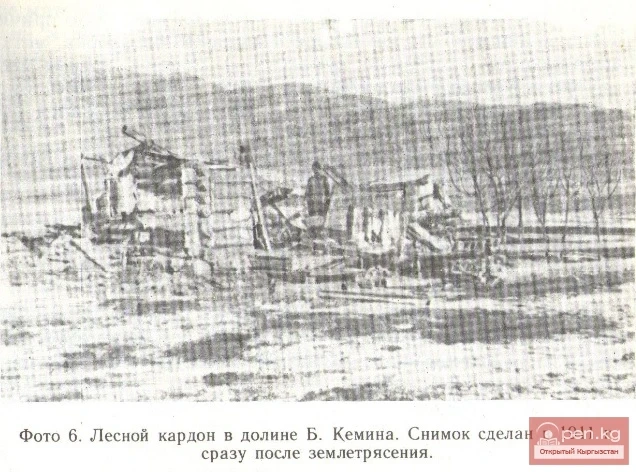
In certain areas of the Earth, strong underground tremors sometimes occur, a rumble is heard, and ground vibrations cover significant areas, sometimes the entire Earth—this is an earthquake. In its epicenter, strong changes occur: deep and long cracks appear on the surface, landslides are observed, buildings are destroyed, etc.

28.07.2015, 16:57
Ancient Concepts of the Kyrgyz about the Structure of the Earth
About Kyrgyzstan / Culture

Ancient Concepts of the Kyrgyz about the Structure of the Earth

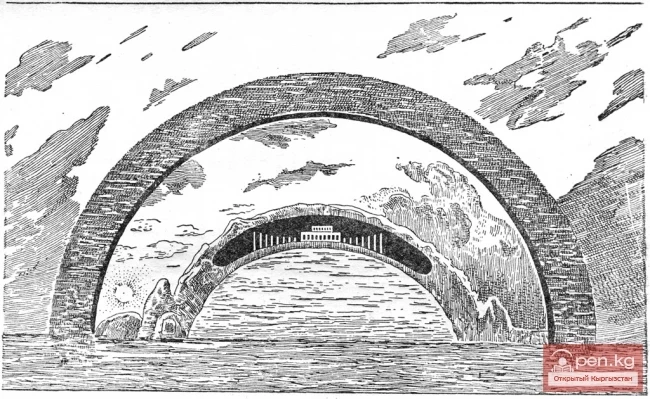
Ancient Kyrgyz Ideas about the Structure of the World Human thought has never been satisfied with simply establishing direct, practically significant connections between phenomena. Every nation has tried to understand and explain various phenomena; its cosmological and cosmogonical ideas often took the form of traditions, legends, and myths, which represent a combination of original elements and borrowings. Such are the ancient ideas of the Kyrgyz about the structure of the Earth and the

28.07.2015, 16:46
Fabric "terme"
Decorative and applied arts

Fabric "terme"

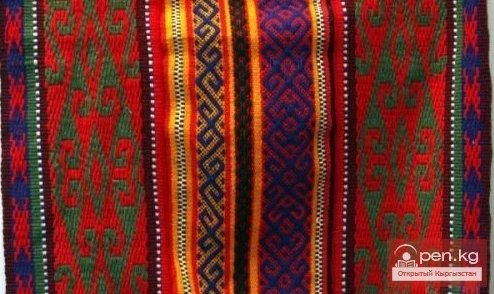
The fabric "terme" is known to all Kyrgyz people. It is widely used among the Turkic-speaking peoples of Central Asia. By the method of production, this fabric belongs to the type of supplementary weaves, and its folk name "terme" reflects the main technical technique that forms its specificity. "Terme" means "assembled." The warp threads, which create the pattern, are paired together on a stick (tergich) during weaving and temporarily, depending on the

18.07.2015, 21:07
Patterned Weaving
Decorative and applied arts

Patterned Weaving

Alongside the production of simple solid-colored or striped fabrics used for making clothing and some household items, patterned weaving was widespread in southern Kyrgyzstan in the 19th and early 20th centuries. There are three types of patterned fabrics distinguished by their weaving technique: terme, kajary, and besh kashté. Patterned fabrics not only met practical needs but were also intended to satisfy the aesthetic tastes of the Kyrgyz population.

18.07.2015, 20:57
The History of the Economy of Southern Kyrgyz in the 19th Century
Ethnography

The History of the Economy of Southern Kyrgyz in the 19th Century

In the history of the economy of southern Kyrgyzstan, the 19th century was a turning point: they began to transition from the main form of economy—animal husbandry—to agriculture. This process had been partially observed earlier, but in the 19th century, it took on a more intensive character. The degree of development and spread of agriculture was determined by socio-economic factors, although it also significantly depended on natural and geographical conditions, which influenced the types of

01.07.2015, 01:45
Tourism — a Priority Sector in the National Strategy for Sustainable Development of Kyrgyzstan
Tourism industry

Tourism — a Priority Sector in the National Strategy for Sustainable Development of Kyrgyzstan

The tourism sector is one of the largest and fastest-growing in the world and provides the most jobs (UNWTO 2012). In many developing countries, the tourism sector is among the leaders in generated revenue (UNWTO 2012). The tourism sector is traditionally included in the agenda when developing development strategies in many countries, including developing countries, newly independent countries, post-conflict countries, and even countries with active conflicts (Owen-Edmunds 2011). It is not

23.06.2015, 00:45
Creating Patterned Fabric
Decorative and applied arts

Creating Patterned Fabric

Typically, two women work on the navoi. One unwinds the threads onto the warp (erish) of the fabric, while the other picks up each thread and secures it in the heddle. When winding the warp, the artisans consider the width, pattern, and color of the product. When creating patterned fabric, the threads are counted precisely. Therefore, the winding of the warp is one of the critical stages in patterned weaving.

16.06.2015, 22:16
Kyrgyz Weaving Loom
Decorative and applied arts

Kyrgyz Weaving Loom

The southern Kyrgyz are also known for a manual device for cleaning raw cotton from seeds — the chygyrik, which was widely used in areas where cotton cultivation has been practiced for a long time.

16.06.2015, 22:04
Weaving
Decorative and applied arts

Weaving

Among other domestic crafts, weaving held one of the primary places among the Kyrgyz in the past. The development of capitalist relations, which gradually dismantled the foundations of the natural economy, brought about several changes in domestic weaving. In the lively trade of various types of fabrics, both from Central Asian handicrafts and Russian industrial production, observed in the Fergana Valley in the late 19th century, Kyrgyz fabrics made at home also had a certain presence.

16.06.2015, 21:58
The Technique of Arcana Production
Decorative and applied arts

The Technique of Arcana Production

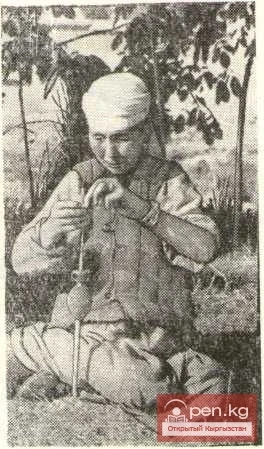
Rope weaving. Batken district. In the economic life of the Kyrgyz, the lasso has wide applications. In the past, the nomadic livestock economy had a daily need for this type of wool product. Therefore, the Kyrgyz are well-versed in the technique of making lassos, which were previously sold in large quantities. Until recently, the production of lassos was based on manual labor.

16.06.2015, 21:54
Wild Anatoly Nikitovich (1937)
Scientists of Kyrgyzstan

Wild Anatoly Nikitovich (1937)

Dikikh Anatoliy Nikitovich (1937), Doctor of Geographical Sciences (1998). Russian. Born in Frunze. Graduated from KSU (1959). Worked as a laboratory assistant, junior researcher, senior researcher, head of the laboratory, director, head of the glaciology laboratory at TSHFGS, and since 1995 - Deputy Director for Science at the Institute of Geology of the National Academy of Sciences of the Kyrgyz Republic. Specialist in glaciology, hydrology, and climatology of high-altitude areas of Central

16.06.2015, 21:47
Dzhusaev Dzholdosh (1934-2001)
Scientists of Kyrgyzstan

Dzhusaev Dzholdosh (1934-2001)

Dzhusaev Dzholdosh (1934-2001), Doctor of Philological Sciences (2000), Professor (1993). Kyrgyz. Born in the village of Tepke, Tyup District, Issyk-Kul Region. Graduated from the Pedagogical College (1953), KSU (1959), postgraduate studies there (1981), doctoral studies at the K. Tynystanov Institute of Humanities (Karakol, 2000). Worked as a teacher, head of the department at OGPI, dean, secretary of the party committee, senior lecturer at KSU, head of the sector at the Central Committee of

16.06.2015, 21:45
Junushev Kerim Junushevich (1925)
Scientists of Kyrgyzstan

Junushev Kerim Junushevich (1925)

Dzhunushev Kerim Dzhunushevich (1925), Doctor of Economic Sciences (1970), Professor (1973). Kyrgyz. Born in the village of Kerege-Tash, Aksuysky District, Issyk-Kul Region. Graduated from KSU (1971). Worked as an instructor in the propaganda and agitation department of the Jalal-Abad, Issyk-Kul, and Jety-Oguz regional committees of the Communist Party of Kyrgyzstan, junior researcher, senior researcher at the Institute of Economics of the Kyrgyz SSR, senior lecturer, associate professor at

16.06.2015, 21:42
Dzhunushaliev Kubanychbek Kashymbekovich (1961)
Scientists of Kyrgyzstan

Dzhunushaliev Kubanychbek Kashymbekovich (1961)

Dzhunushaliev Kubanychbek Kashymbekovich (1961), Doctor of Medical Sciences (2001). Kyrgyz. Born in the town of Rybachye, Issyk-Kul region of the Kyrgyz Republic. Graduated from KGMI (1984), postgraduate studies at the Kyrgyz Research Institute of Oncology and Radiology (1989).

16.06.2015, 21:32
Dzhunushaliev Djenish (1935)
Scientists of Kyrgyzstan

Dzhunushaliev Djenish (1935)

Dzhunushaliev Dzhensh (1935), Doctor of Historical Sciences (1993), Laureate of the State Prizes of the Kyrgyz Republic in the field of science and technology (1996, 2002), Corresponding Member of the National Academy of Sciences of the Kyrgyz Republic. Kyrgyz. Born in the village of Korumdu, Tyup District, Issyk-Kul Region. Graduated from the Karakol Teacher Training Institute (1954), KSU (1960), and postgraduate studies at the AON under the Central Committee of the Communist Party of the

16.06.2015, 21:27
Jumataev Murat Sadyrbekovich (1957)
Scientists of Kyrgyzstan

Jumataev Murat Sadyrbekovich (1957)

Dzhumataev Murat Sadyrbekovich (1957), Doctor of Technical Sciences (1993), Professor (1998), Corresponding Member of the National Academy of Sciences of the Kyrgyz Republic (1997). Kyrgyz. Born in Frunze. Graduated from the FPI (1978), postgraduate studies at the Academy of Sciences of the Kyrgyz SSR (1984). Worked as an engineer, senior engineer, junior researcher, senior researcher at the Institute of Automation, scientific secretary, deputy director for science, and since 1995 - director

16.06.2015, 21:25
Dzhumanazarova Asylkan Zulpuqarovna (1952)
Scientists of Kyrgyzstan

Dzhumanazarova Asylkan Zulpuqarovna (1952)

Dzhumanazarova Asylkan Zulpukarovna (1952), Candidate of Chemical Sciences (1982), Professor (2002), Laureate of the State Prize of the Kyrgyz Republic in the field of Science and Technology (2000). Kyrgyz. Born in the village of Mirza-Aki, Uzgen District, Osh Region. Graduated from KGU (1974), postgraduate studies at the N.D. Zelinsky Institute of Organic Chemistry of the USSR Academy of Sciences (Moscow, 1981). Worked as a senior laboratory assistant, senior engineer, junior researcher,

16.06.2015, 21:21
Dzhunusov Makhmud Sadikovich (1920)
Scientists of Kyrgyzstan

Dzhunusov Makhmud Sadikovich (1920)

Dzhunusov Mashud Sadykovich (1920), Doctor of Philosophy (1953), Professor (1957). Tatar. Born in the city of Przhevalsk. Graduated from Kyrgyz State Agricultural Institute (1940). Worked as the head of the department at KSU, at the Institute of Philosophy of the USSR Academy of Sciences in Moscow. Specialist in the field of philosophy.

16.06.2015, 21:18
Jumaliev Artykbai Jumalievich (1928)
Scientists of Kyrgyzstan

Jumaliev Artykbai Jumalievich (1928)

Dzhumaliev Artykbai Dzhumalievich (1928), Doctor of Medical Sciences (1989), Professor (1989). Kyrgyz. Born in the village of Sary-Bulak, Jayil District, Chui Region. Graduated from KGMI (1954), and completed postgraduate studies there (1957). Worked as an assistant, associate professor, deputy dean of the medical faculty, and head of the department at KGMI.

16.06.2015, 21:15
Ainagul Dzhumagulova Seksenalievna (1954)
Scientists of Kyrgyzstan

Ainagul Dzhumagulova Seksenalievna (1954)

Dzhumagulova Ainagul Seksenalievna (1954), Doctor of Medical Sciences (1997), Professor (2001), Laureate of the State Prize of the Kyrgyz Republic in the field of Science and Technology (2002). Kyrgyz. Born in the city of Przhevalsk, Issyk-Kul region. Graduated from KGMI (1977), completed clinical residency there (1978), and postgraduate studies at KNIIC (1984). Worked as a junior researcher, senior researcher, head of the department of arterial hypertension at KNIIC of Cardiology, chief

16.06.2015, 21:11
Dzhumagulov Olzhobai Dzhumakadyrovich (1954)
Scientists of Kyrgyzstan

Dzhumagulov Olzhobai Dzhumakadyrovich (1954)

Dzhumagulov Olzhobay Dzhumakadyrovich (1954), Doctor of Medical Sciences (1996), Professor (2000). Kyrgyz. Born in Frunze. Graduated from KGMI (1978), also completed postgraduate studies there (1986), and doctoral studies (1993). Worked as a clinical resident at Leningrad GIDUV, assistant, senior researcher, associate professor, and since 1997 - head of the Department of Eye Diseases at KGMA.

16.06.2015, 21:02
Dzhumagulov Apas Dzhumagulovich (1934)
Scientists of Kyrgyzstan

Dzhumagulov Apas Dzhumagulovich (1934)

Dzhumagulov Apas Dzhumagulovich (1934), Doctor of Geological and Mineralogical Sciences (1999), Laureate of the State Prize of the Kyrgyz Republic in the field of Science and Technology. Kyrgyz. Born in the village of Arashan, Alamudun District, Chui Region. Graduated from the Moscow Oil Institute (1958). Worked as a geologist, chief engineer of the "Kyrgyzneft" management, head of department, secretary of the Central Committee of the Communist Party of Kyrgyzstan, first secretary of

16.06.2015, 16:20
Dzhumabekov Sabyrbek Artisbekovich (1964)
Scientists of Kyrgyzstan

Dzhumabekov Sabyrbek Artisbekovich (1964)

Dzhumabekov Sabyrbek Artisbekovich (1964), Doctor of Medical Sciences (1995), Professor (1997). Kyrgyz. Born in the village of Satkey, Kirov District, Talas Region. Graduated from KGMI (1987). Worked as a clinical resident at the Crimean Medical Institute, resident, assistant, head of the orthopedic department, deputy director of KNIIKiVL, and since 1999 - head of the department at KGMA.

16.06.2015, 16:16
Dzhuzanova Burul Sagyndinovna (1952)
Scientists of Kyrgyzstan

Dzhuzanova Burul Sagyndinovna (1952)

Dzhuzhenova Burul Sagyndynovna (1952), Doctor of Medical Sciences (1992), Professor (1995). Kyrgyz. Born in the village of Taldy-Suu, Issyk-Kul region. Graduated from KGMI (1976), postgraduate studies at the Institute of Rheumatism of the USSR Academy of Medical Sciences (Moscow, 1981).

16.06.2015, 16:13
Abdylas Dzhorobekov (1951), Doctor of Medical Sciences
Scientists of Kyrgyzstan

Abdylas Dzhorobekov (1951), Doctor of Medical Sciences

Dzhoro Bekov Abdylas (1951), Doctor of Medical Sciences (1998). Kyrgyz. Born in the urban-type settlement of Toktogul, Toktogul District, Jalal-Abad Region. Graduated from KGMI (1975), postgraduate studies at the Institute of Surgery of the USSR Academy of Medical Sciences (Moscow, 1987), doctoral studies at the A.N. Syzganov National Center of Surgery of the Ministry of Health of the Republic of Kazakhstan (Almaty, 1997). Worked as a surgeon, head of the department at the Issyk-Kul Regional

16.06.2015, 14:19