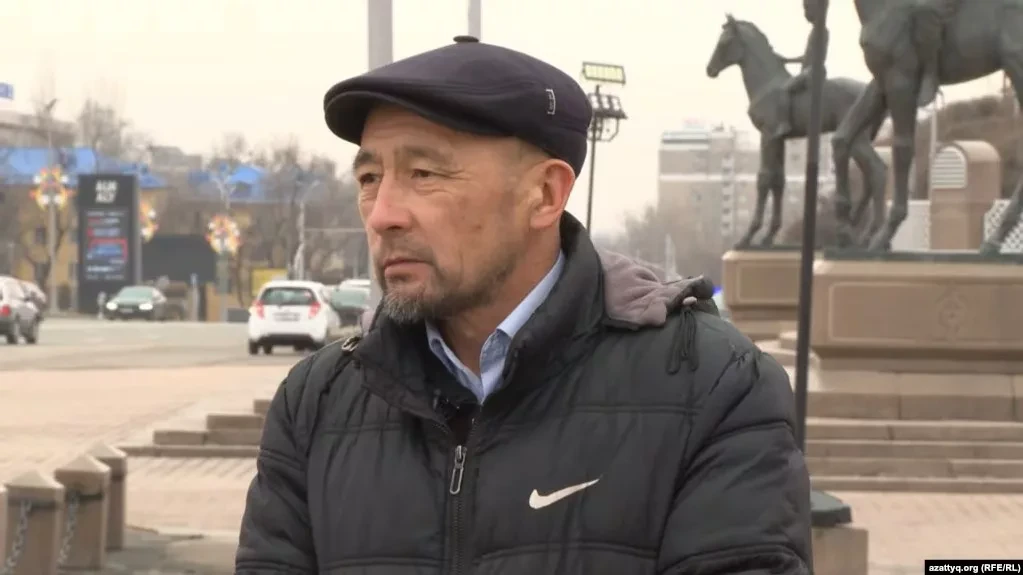
The court proceedings are taking place at the Almalinsky District Court in Almaty, where the defendants are Kaysar Ozbek, Talgat Ashirov, Askar Nurmagan, Abduali Tagai, and Duysenbek Zhakashov. All of them were arrested in June 2025 and have since been held in the detention center of the National Security Committee. The trial began in early February and is being conducted under a veil of secrecy.
At the hearing on February 25, Talgat Ashirov reportedly felt unwell, according to lawyer Zhanar Balgabaeva. The court decided to continue the hearing on February 27.
Who is appearing before the court?
57-year-old Askar Nurmagan from Karaganda is an activist known for his protests, including events in support of Ukraine and against the migration of Russians. He has previously had legal troubles: in 2021, he was sentenced to one and a half years of restriction of freedom and forced labor for participating in movements banned in Kazakhstan. Last year, Nurmagan was arrested for 15 days for opposing a march with the Soviet flag.
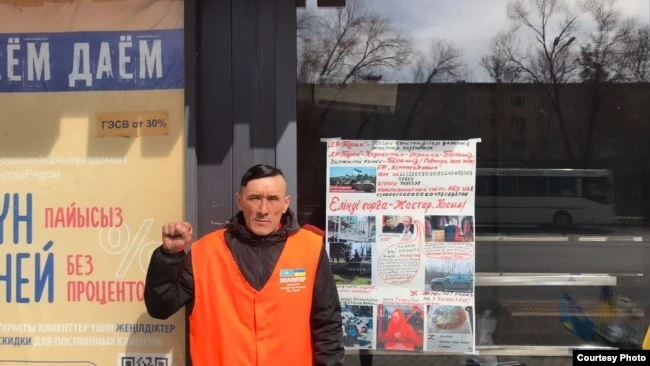
Activist from Karaganda Askar Nurmaganov during a rally in support of Ukraine
Kaysar Ozbek, 58, is also a civil activist from Almaty. He has actively expressed his views on the political situation in the country. In January 2022, during protests, he spoke out against the deployment of CSTO troops and later reported witnessing shooting at peaceful demonstrators.
57-year-old Abduali Tagai, a native of Astana, participated in the "land rallies" of 2016, demanding the repeal of reforms, and was later detained during "anti-Chinese actions" in 2019. Information about Talgat Ashirov and Duysenbek Zhakashov, aged 62 and 56 respectively, is not available in open sources.
Of the five defendants, four were unemployed before their arrest. Kaysar Ozbek worked as a driver in a bus depot.
Charges
Askar Nurmagan, Abduali Tagai, and Duysenbek Zhakashov are accused of "propaganda for the seizure of power," "preparation for a crime," and "organization of mass riots." Kaysar Ozbek and Talgat Ashirov are also accused of "illegal handling of weapons."
The investigation claims that Kaysar Ozbek openly expressed intentions to seize power while communicating with the other defendants. They are alleged to have planned to seize the president's residence and discussed organizing mass riots.
The case materials indicate that they considered issues related to attracting activists and organizing their accommodation in Astana, as well as developing ideas for the release of former Defense Minister Murat Beketov.
Additionally, the investigation claims they planned to seize strategic facilities and attack military installations. On the night of June 15, a cache with Molotov cocktails and firearms was found in the Ili district of Almaty region.
Some episodes mention a certain Umarbekov, who is not a defendant, and his role in the case remains unclear.
The investigation points to "dysfunctional impact," which may lead to negative perceptions of the authorities and incite protests.
Defense of the defendants
The defendants' lawyers argue that the charges are unfounded. Galym Nurpeisov, representing Abduali Tagai's interests, points to inconsistencies in the case.
“To organize mass riots, resources and sponsors are needed. These people have no resources or support. They are ordinary citizens, and where would they find the means to organize such a movement?” Nurpeisov questions.
He believes the charges are a provocation.
Lawyer Zhanara Balgabaeva also states that her client Askar Nurmagan did not commit the crimes he is accused of.
“Law enforcement has infiltrated provocateurs who incited activists to commit crimes, only to arrest them later. My client became a victim of these provocateurs,” Balgabaeva asserts.
She also emphasizes that Nurmagan tried to avoid destructive conversations and left the chat where provocations were discussed.
Comparison with other cases
The lawyers note similarities with other cases where attempts to seize Akorda were also claimed. In August of last year, a similar court sentenced five men to four years of restriction of freedom for "organizing mass riots" before the referendum on nuclear power plants.
In 2024, six people were convicted for "calls for the violent seizure of power" in the so-called "tractor case." Human rights defenders note that many of the charges were not proven.
Evgeny Zhovtis, founder of the Kazakhstan Bureau for Human Rights, expressed doubts about the validity of the current case, noting the absence of active calls for riots and political threats from the defendants.
The trial is being conducted in a closed format, which, according to human rights defenders, violates the principles of openness and transparency.
The lawyers also believe that there are no grounds for closing the proceedings in the case of "seizure of power" and "organization of mass riots."