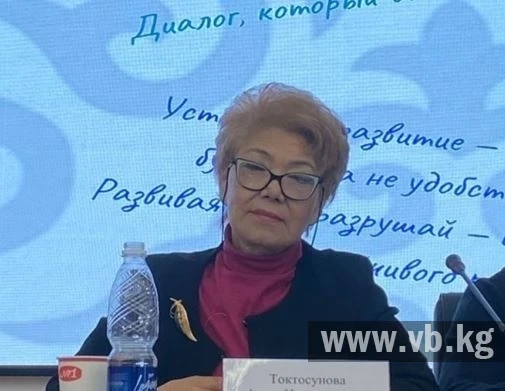
In an interview with Adash Toktosunova, an outstanding scientist from Kyrgyzstan, Doctor of Political Science, professor, and philosopher, we discussed important issues of ecological education and upbringing within the school system. Adash Iskenderovna, the first former head of the UNESCO office in the country and chairwoman of the public organization "Dialogue of Cultures and Civilizations," is the author of numerous works in the field of conflictology and sustainable development. Interestingly, the conversation began with a topic that, at first glance, seems far from her main activities—ecology.
Adash Iskenderovna, how did you come to the issues of ecological education for children, being a philosopher and Doctor of Political Science?
- It is important to note that this is not only about education but also about upbringing. In practice, these two aspects are often not interconnected in school programs. Moreover, there is no subject of ecology in the curricula, which means there are no corresponding educators. Despite students' interest in issues such as human ecology, genetics, and microclimate, necessary work with them is not being done. Instructions to protect nature remain mere words that have no real impact on the minds and hearts of our children.
Recently, I met with the Minister of Education, Dogdurkul Kendirbaeva, and proposed to add a subject on ecology to the school curriculum. I am confident that the knowledge gained in lessons will not be in vain, even if children do not choose a career in the field of ecology. This will help them become more conscious citizens, which will be the main outcome of ecological education.
I also handed the minister my book "The Mysteries and Lessons of Nature," written together with my brother Narynbek Toktosunov. In it, we explore the connection between the history, culture, and lifestyle of the Kyrgyz with ecology, relying on numerous historical documents and research from the 19th to 20th centuries. We have confirmed that our ancestors always treated nature with respect, recognizing its importance.
Understanding this connection is very important for the youth. As they say, those who do not know their past have no future. Knowledge of history helps us preserve the present and future. Even the names of the months and traditions in Kyrgyzstan are connected with nature.
As for my interest in ecology, philosophy has always been engaged in exploring the world and its problems. In the 21st century, it is important to reflect not only on social but also on socio-natural processes.
I have always been a person who cares about everything happening around. In my youth, I watched the film "Everything Remains for People," which made a huge impression on me. This thought has stayed with me throughout my life, and now, as an adult, I strive to leave something good for those around me.
Did you receive support for your idea in the ministry?
- Yes, the minister supported my proposal and agreed to promote the idea of implementing ecological education in schools. It is important for the new generation to have knowledge about environmental protection and to share it with their parents. If our book does not become a textbook, then it is necessary to create a new one; the main thing is to include the subject in the program.
At the end of last year, you organized a forum at the Academy of Sciences dedicated to issues of security and sustainable development. How do you assess the ecological situation in the country?
- The ecological situation in Kyrgyzstan is concerning. Although discussions about ecology have become popular, the real attitude towards nature has not changed. We face a lack of qualified specialists and the closure of ecology departments in universities, while ecological problems continue to accumulate.
Currently, the emphasis is on climate change, but they are less dangerous than our consumer attitudes towards the environment. For example, Lake Issyk-Kul, which, according to scientists' forecasts, may perish in 20-30 years if we do not take action.
I pondered the theme of the forum "From Conflict to Dialogue of Cultures and Civilizations." The discussion of ecological safety became a key point. Reports on the state of Lake Issyk-Kul were alarming and showed how seriously we need to approach its protection.
Scientists presented the results of long-term research, confirming that we are on the brink of disaster. The lake is gradually losing its natural resources, and if we do not take measures, the consequences will be irreversible.
Historical examples show that even developed countries face similar ecological crises, and we need to learn from their mistakes to avoid a similar fate.
The water quality in Issyk-Kul is deteriorating due to the discharge of untreated wastewater. Of the 33 surveyed facilities, only 17 had treatment plants, which are in critical condition. Meanwhile, the number of tourists is increasing, with plans to raise their number to 15 million, which does not take into account ecological risks.
Regional development must take into account the opinions of scientists to preserve nature and develop the economy. Only a rational approach will ensure sustainable development.
Why does a person treat what they should value so carelessly?
- A person always strives to improve their living conditions, which is natural. However, it is important to understand that we must care for nature and ecology. Our current attitude towards the environment does not allow us to feel safe. It is necessary to realize that we are part of a single ecosystem and to start with caring for what surrounds us.
Recalling my experience, I can give an example of how I transformed an abandoned plot in my village. My enthusiasm met with misunderstanding from those around me, but I was able to restore the area, turning it into a blooming garden.
I am proud of what I have achieved and hope that over time my village will become an example for others. The history and culture of the Kyrgyz have always been connected with nature, and I intend to continue this tradition to leave something valuable for future generations.
Photo provided by Professor Toktosunova.