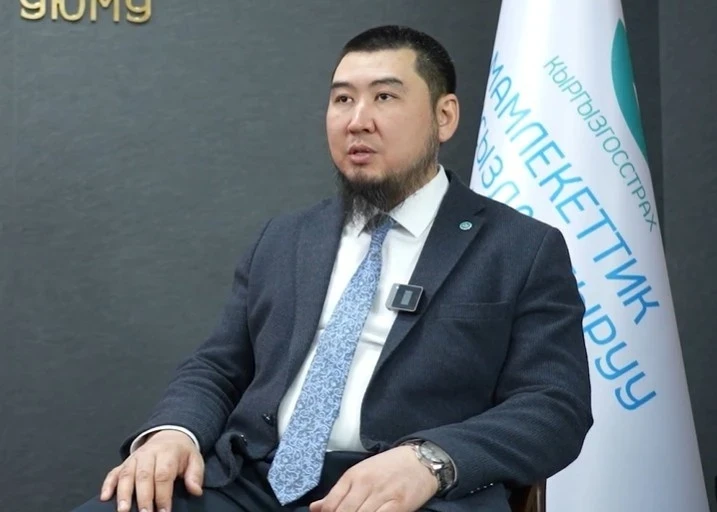
Kyrgyzstan is demonstrating impressive economic growth rates, and the insurance sector has tripled in size over the past two years. In an interview with Baktygul Abdyjaliev, Deputy Chairman of the Board of the State Insurance Organization, we discussed why insurance is an integral part of stable development.
- Mr. Baktygul, what is your opinion on the necessity of insurance in the current situation in Kyrgyzstan?
- Insurance plays a key role in economic development. Over the past three years, we have observed a stable GDP growth rate, averaging 10% annually. These are record figures: we rank first among CIS countries and third in the world. Ten years ago, many Kyrgyzstani people were ashamed to mention their country, but today we are confident in its future and potential.
Historically, insurance has been the foundation for significant progress in countries with developed economies. For example, in Japan, the ratio of the insurance market to GDP is nearly 16.5%, and in the USA, it is 13%. Citizens actively use insurance, which contributes to stable economic development. In Kyrgyzstan, there are cases where companies that did not insure their risks face bankruptcy.
The initiative of our president to develop the insurance market, announced two years ago, is becoming the foundation for a new era of insurance in the country. Since the decree was adopted on March 20, 2021, the market has increased from 3 to 10 billion soms.

- How does this affect the average person?
- Insurance provides financial protection. Since its inception, we have paid out around 400 million soms to citizens, which has helped many people and businesses in difficult situations. This year alone, 82 million soms have been paid out, mainly under compulsory insurance programs for vehicles and mandatory housing insurance against fire and natural disasters.
During the Soviet era, there was "Gosstrakh USSR" with assets amounting to half a trillion dollars by today's standards. After its collapse, until 2015, insurance in Kyrgyzstan was insignificant, limited to aviation and other external requirements. Since 2015, we have been developing ideas, but the mechanisms did not work. Over eight years, the coverage of housing insurance did not exceed 10%. However, in the last two years, we have raised this figure to 30%, which amounts to 350 thousand insured houses out of 1.25 million in the country.
- What about cars?
- In October of last year, fines for compulsory insurance were introduced, which generated great interest and queues at the public service centers. We strive to digitize all processes to facilitate interaction. There are 1.75 million registered vehicles in the country, of which more than 1.1 million are already insured. In our organization, there are over 320 thousand vehicles — this is 20% of the total and 35% of all insured, indicating our significant market share in compulsory insurance.
Trust in the government is growing against the backdrop of economic growth, the construction of new facilities, and rising salaries. People sometimes mistakenly believe they are insured with the State Insurance Organization when they have actually purchased a policy from a private company. We are the only organization where 100% of the shares belong to the Cabinet of Ministers, which implies strict control and the ability to implement social programs, such as mandatory housing insurance. The policy costs 600 soms per year in villages and 1200 in cities, with payouts of up to 500 thousand soms in villages and up to a million in cities. These are reasonable rates for a country where natural disasters are becoming increasingly frequent.
- Does the insurance cover homes against fire and natural disasters at the same time?
- Yes, this is provided for by one law. It covers both man-made risks and natural phenomena such as earthquakes and landslides. We are currently reviewing the insurance thresholds.
- Can you tell us more about the new initiatives? The Jogorku Kenesh has adopted a project to create an insurance pool and reduce the threshold for earthquakes to 5 points. Why is this important?
- This is a key innovation in the system of mandatory housing insurance, based on the experience of recent years. In the event of an earthquake or other natural disaster, the threshold for an insured event is reduced to 5 points, and a special insurance pool is created to cover mass losses.
Previously, an insured event was only considered if the earthquake was above 6 points. However, given the seismic activity, this threshold turned out to be too high. In Kyrgyzstan, earthquakes of around 5 points often occur, and even they can damage buildings. Now citizens will be able to receive compensation for such cases.
As for the insurance pool, it is created to ensure financial resources in the event of mass natural disasters. It serves as a kind of financial safety net for citizens, guaranteeing that payments will be made even in the case of large-scale destruction.
Kyrgyzstan has already experienced earthquakes of 4.5–5.5 points that caused damage, but we could not pay compensations. Therefore, it was decided to lower the threshold and improve the payment mechanisms.
- What can you say about bureaucracy and impound lots in the compulsory insurance system?
- The problem of bureaucracy does exist. To establish guilt, we need a ruling from the relevant authorities. We are trying to expedite the process by creating a 24/7 service of accident commissioners who can go to the scene of the incident.
However, the laws remain unchanged. We are moving towards a system of European protocols, which will allow avoiding police involvement in minor accidents. But this is only possible with a high level of insurance coverage. Currently, 80% of violations in Bishkek are related to the absence of compulsory insurance.
- Insurance for loans and export-import operations has been announced in Kyrgyzstan. What does this entail?
- The State Insurance Organization actively supports small and medium-sized businesses and develops export potential as part of the 2030 program. Insurance allows our entrepreneurs to protect their interests in international markets.
When goods are shipped abroad, there is a risk of partner bankruptcy or political restrictions. Insurance allows recovering up to 90% of the transaction amount. It is also important to understand that contract insurance does not cover damage to cargo during transportation; there is a separate type of insurance for that.
The State Insurance Organization is granted the status of National Operator for Reinsurance. What is the purpose of this step?
- This status was approved by Presidential Decree No. 79 on March 24, 2024, and is part of cooperation with the Eurasian Reinsurance Company. Reinsurance is insurance for insurance companies. The creation of a national operator will help retain financial resources in the country, which will enhance the reliability of the entire system. This guarantees that even in the event of major disasters, we will be able to fulfill our obligations to citizens.