New trends in printmaking in Kyrgyzstan are associated with the work of artists who entered the art scene of the republic at the turn of the 1950s and 1960s and in the 1970s. These include A. Ostashev, M. Omorkulov, V. Gladkov, R. Nudel, A. Turumbekov, E. Kuzovkin, A. Shubin, A. Misyurev, B. Jumabaev, I. Bulba, V. Maximov, M. Akhmedov, B. Koshoyev, many of whom have developed into distinctive masters.
A significant contribution to the development of Kyrgyz printmaking was made by Arkadiy Sergeyevich Ostashev — an artist with a deeply realistic approach, possessing a clearly expressed interest in the socio-psychological issues of art. The entire body of Ostashev's work was influenced by the art of his teacher A. F. Pakhomov, which manifested itself primarily in his respectful attitude towards working from life, his interest in the inner world of man, as well as in the classical traditions of realistic art.
The sharpness of observations of complex motifs, along with the richness and variety of carving, is evident in the series of linocuts "Bazar" (1961) and the genre-related interpretations of the theme in the engravings "Papa-Student" (1961), "Before the Exam" (1962), "Ulan Goes" (1962), "At the Bus Stop" (1984). Ostashev's interest in genre motifs and his ability to capture the characteristic are combined with a tendency towards themes of a larger social scale, allowing for reflections on the past and present.
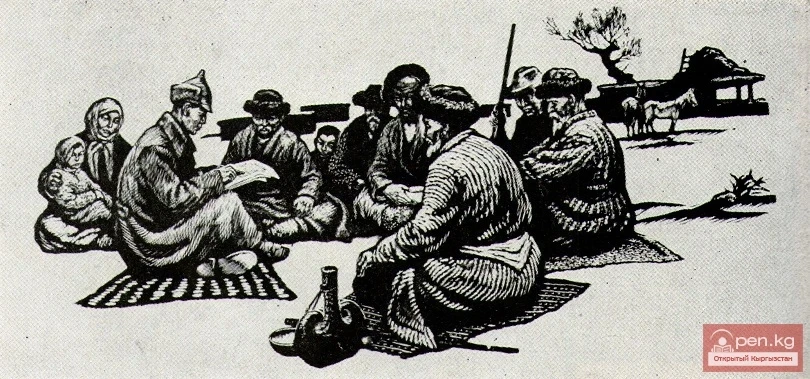
Like L. Ilyina, Ostashev deeply absorbed the ideas presented in the works of Ch. Aitmatov, experiencing a profound emotional impact from the images he created. Under the influence of the story "The First Teacher," the triptych "The 30s" was born. The central piece "Likbez" gained particular popularity and received high praise from critics: "The images of all the characters are life-like and typified. Details of the composition, such as clothing, poses, landscape, and still life, are depicted with ethnographic accuracy, which, however, did not become an end in itself. This piece was conceived as a monumental work. The external statics of the human group combines with the internal psychological depth of each character, the careful thoughtfulness of the composition, broad strokes, clarity of silhouettes, psychological insight, and portraiture of human images — all of this testifies to the mature mastery of the artist."
In the late 1960s, Ostashev created two other triptychs in this same technique — "The 40s" (1968) and "The 20s" (1969), embodying his reflections on the establishment of Soviet power in Kyrgyzstan and the Great Patriotic War. They utilized extensive documentary and literary material.
In the series "In Osh" (1965—1968), Ostashev conveyed the unique character and color of the ancient Asian city in the 1960s, where old and new were contrastingly combined at that time. The engravings in the series "In Old Osh," "Osh is Being Built," "Osh Bazaar," "Mosque in Osh," "To School," where initial sketches were transformed into compositions, are appealing for their authenticity in depicting a wide variety of genre, architectural, and landscape motifs — people in Eastern clothing, donkeys, dzhigits, clay houses, the Eastern bazaar, modern buildings, cars, cranes... In all of this, there is a growing rhythm of the inevitable renewal of life.
As researchers note, "Ostashev is attracted to the creative essence of the human personality — the activity, the effectiveness of human thought." This quality has determined the artist's interest in the portrait genre. In the gallery of print portrait compositions from the 1960s, he created images of Rembrandt, Dostoevsky, Pushkin, Gogol, Nekrasov, explorers of Asia Przhevalsky and Semenov-Tyan-Shansky, writer Ch. Aitmatov, and artists A. Ignatiev, B. Burlin, A. Kamensky. The best of them present deep images that are inextricably linked with the world of their creativity, their time, and their people. The psychological portrait "Rembrandt" (1961) is particularly convincing, where the great artist, with a candle in hand, gazes intently at his paintings. "Dostoevsky" (1962) is depicted in the oppressive atmosphere of 19th-century St. Petersburg. The multi-faceted image of Pushkin is presented in a whole gallery of compositions ("Pushkin in Yaroslavl," 1965; "Before the Duel," 1962; "Spring," 1966).
Nekrasov and Ch. Aitmatov are depicted against the backdrop of Russian and Kyrgyz landscapes, respectively. By incorporating the environment, genre, and landscape motifs in portrait compositions, the artist deepens the characterization of a person in the context of their era.
A significant work by Ostashev in recent years is the triptych of engravings "M. V. Frunze in Turkestan" (1984). In the sheets "Conversation with a Fellow Countryman," "Meeting at a Junction Station," "In the Sands of Turkestan," the image of the outstanding native of Kyrgyzstan is shown in lively contact with people. The characters in the compositions are individualized and depicted with historical accuracy. Notable series of linocuts include "Bazar" (1961), "Polygraphists" (1967), "The 20s in Southern Kyrgyzstan" (1979), "Osh in the 20s" (1980).