About Kyrgyzstan

{title}
State structure
{title}
National symbols
{title}
Government
{title}
Armed forces
{title}
National currency
{title}
Banknotes
{title}
Circulation coins
{title}
Collectible coins
{title}
Political organization
{title}
Domestic policy
{title}
Foreign policy
{title}
History
{title}
Kyrgyz in antiquity
{title}
Kyrgyz in the VI-XII centuries
{title}
Kyrgyz in the XIII—first half of XVIII century
{title}
The struggle for the independence of the Kyrgyz
{title}
Kyrgyzstan as part of Russia
{title}
Kyrgyzstan during the Soviet period
{title}
Kyrgyzstan — a sovereign state
{title}
Historical records
{title}
Kurmanjan Datka
{title}
Chagatai Ulus. Haidu State. Moghulistan
{title}
History and archeology of the ancient Tien Shan
{title}
Peoples movements of Central Asia in the XIX century
{title}
Kyrgyzstan during the Great Patriotic War
{title}
Kyrgyzstan in the 1920s
{title}
1937 in Kyrgyzstan
{title}
Shabdan Baatyr
{title}
Territory, geography and administrative division
{title}
Chuy Region
{title}
Attractions of Chuy Region
{title}
Issyk-Kul Region
{title}
Sights of Issyk-Kul
{title}
Naryn Region
{title}
Attractions of Naryn Region
{title}
Talas Region
{title}
Attractions of Talas Region
{title}
Osh Region
{title}
Attractions of Osh Region
{title}
Batken Region
{title}
Attractions of Batken Region
{title}
Jalal-Abad Region
{title}
Attractions of Jalal-Abad Region
{title}
Cities
{title}
Bishkek
{title}
Streets of Bishkek
{title}
Pishpek - Frunze - Bishkek
{title}
History of the capital of Kyrgyzstan in documents
{title}
Osh
{title}
Osh - 3000
{title}
Naryn
{title}
Jalal-Abad
{title}
Batken
{title}
Talas
{title}
Karakol
{title}
Tokmok
{title}
Cholpon-Ata
{title}
Uzgen
{title}
Kochkor
{title}
Kemin
{title}
Balykchy
{title}
Kyzyl-Kiya
{title}
Mailuu-Suu
{title}
Sulukta
{title}
Tash-Kumyr
{title}
Toktogul
{title}
Kara-Kul
{title}
Kara-Balta
{title}
Kara-Balta - Black Ax
{title}
Kant
{title}
Villages
{title}
Population
{title}
Language
{title}
Diaspora
{title}
Nature
{title}
Climate
{title}
Natural ecological complexes
{title}
Water resources
{title}
Rivers
{title}
Lakes
{title}
Secrets of Issyk-Kul Lake
{title}
Reservoirs
{title}
Waterfalls
{title}
Mineral waters
{title}
Flora
{title}
Fauna of Kyrgyzstan
{title}
Mammals of Kyrgyzstan
{title}
Birds of Kyrgyzstan
{title}
Fish of Kyrgyzstan
{title}
Amphibians and reptiles of Kyrgyzstan
{title}
Insects of Kyrgyzstan
{title}
Mountains and glaciers
{title}
Mountain ranges
{title}
Mountain peaks
{title}
Mountain passes
{title}
Glaciers
{title}
Caves
{title}
Gorges
{title}
National parks and reserves
{title}
Pastures and valleys
{title}
Soil and minerals
{title}
Red Book
{title}
Fungi and higher plants
{title}
Animals
{title}
Arthropods
{title}
Fish
{title}
Amphibians and reptiles
{title}
Birds
{title}
Mammals
{title}
Economy of Kyrgyzstan
{title}
Entrepreneurship
{title}
Agriculture
{title}
Finance
{title}
Construction
{title}
Industry
{title}
Transport and communications
{title}
Socio-economic resources
{title}
Tourism industry
{title}
Healthcare
{title}
Education
{title}
Sports
{title}
Science
{title}
Environmental science
{title}
Mass media
{title}
Art
{title}
Dances
{title}
Ballet
{title}
Decorative and applied arts
{title}
Musical instruments
{title}
Architecture
{title}
Painting
{title}
Music
{title}
Theater
{title}
Cinema
{title}
Sculpture
{title}
Circus
{title}
Literature
{title}
Photography
{title}
Culture
{title}
Epigraphy
{title}
Folklore
{title}
Kyrgyz heroic epic "Manas"
{title}
The epic "Manas" in prose
{title}
Poetic retelling of the epic "Manas"
{title}
"Semetey" - poetic story
{title}
"Semetey" in prose
{title}
Religion
{title}
Ethnography
{title}
National games
{title}
Customs
{title}
Myths and legends
{title}
Kyrgyz fairy tales
{title}
Kyrgyz cuisine
{title}
Meat and offal dishes
{title}
Soups of Kyrgyzstan
{title}
Main dishes of Kyrgyzstan
{title}
Sweet dishes of Kyrgyzstan
{title}
Drinks of Kyrgyzstan
{title}
Salads and appetizers
{title}
Flour products
{title}
Miscellaneous information about Kyrgyzstan
{title}
Historical and holiday dates of Kyrgyzstan
{title}
Famous personalities of Kyrgyzstan
{title}
Women of Kyrgyzstan
{title}
Historical figures
{title}
Heroes of Kyrgyzstan
{title}
Hero of the Kyrgyz Republic
{title}
Heroes internationalists
{title}
Heroes of Kyrgyzstan in World War II
{title}
Kyrgyzstanis — Full cavaliers of the Order of Glory
{title}
Writers of Kyrgyzstan
{title}
Inventors of Kyrgyzstan
{title}
Scientists of Kyrgyzstan
{title}
Architects of Kyrgyzstan
{title}
Artists of Kyrgyzstan
{title}
Musicians of Kyrgyzstan
{title}
Cinematographers of Soviet Kyrgyzstan
{title}
Actors of Kyrgyzstan
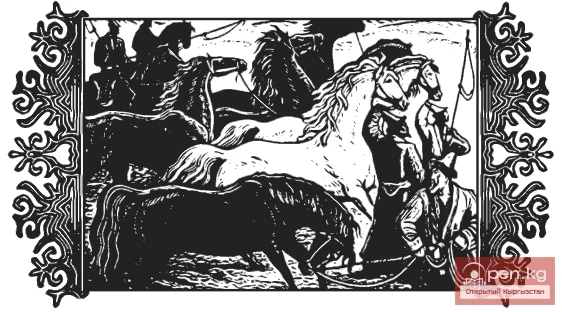
The Epic "Manas". A Review of the Horses
Poetic retelling of the epic "Manas"

The Epic "Manas". A Review of the Horses

Horse Race Early in the morning, at dawn, As the green flag of Koketey Fluttered in the rays of light, All the guests mounted their horses And rushed to the banks of Kegen, To watch and evaluate The horses heading to the start. On both sides of the river Forty, fifty rows Of riders crowded tightly, Leaving a strip in the center About a hundred large steps wide. A larger crowd gathered here Than black ants, As if it were not a race, But a grand and joyful feast. At the alaman-bayge races, For

15.02.2021, 17:50
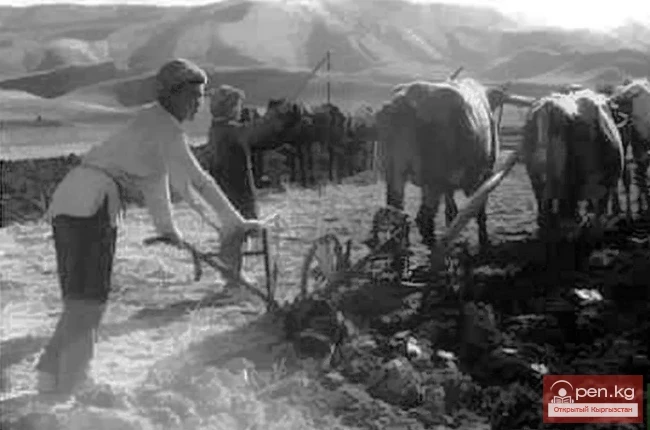
The Prolonged Process of the Kyrgyz Transition from Nomadism to Agriculture
Kurmanjan Datka

The Prolonged Process of the Kyrgyz Transition from Nomadism to Agriculture

Land Conflicts Conflicts over land frequently occurred between the nomadic Kyrgyz and the settled population of Fergana. The quantitative growth of the settled population and the aspirations of the landowning nobility required the expansion of crops and the increase of arable land, which could only happen at the expense of the lands of the nomadic population, which itself began to transition to agriculture intensively from the mid-19th century. Land conflicts intertwined with the political

15.02.2021, 17:43
Fierce Resistance of the Rebels in Autumn 1875 to the Punitive Detachment
Peoples movements of Central Asia in the XIX century

Fierce Resistance of the Rebels in Autumn 1875 to the Punitive Detachment

Battle of the Rebels with the Punitive Detachment News of the success of the rebels in the city of Kokand and the expulsion of the hated Nasr-Edin soon spread throughout the khanate, instilling hope for the possibility of a successful struggle for social and national freedom. They triggered a significant rise in the people's movement. The uprising continued to strengthen, gaining wide momentum. The rebels interrupted communication between Khojent and Namangan. The rebels were approaching

14.02.2021, 17:14
White-faced Horse - Ak Mandai Kulik
Insects of Kyrgyzstan

White-faced Horse - Ak Mandai Kulik

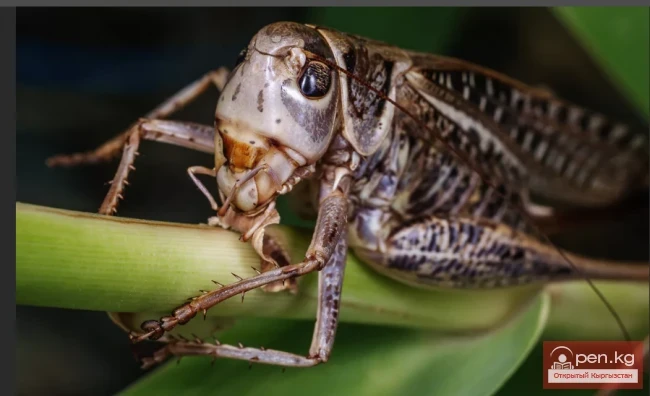
White-fronted Grasshopper - Decticus albifrons F. A large insect of brown or green color, blending in with the vegetation. Very light front part of the head. Size: 50—60 mm. Antennae are very thin, longer than the body. The female is easily distinguished from the male — at the end of her abdomen, she has a long, sword-like ovipositor measuring 20—25 mm. The larvae hatch in spring and molt from 4 to 6 times throughout their life cycle. After the first molt, wing buds appear as elongated lower

13.02.2021, 17:56
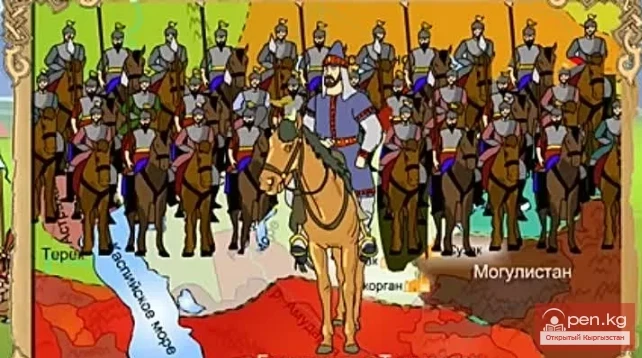
The Unification of Abdullah of the Eastern and Western Parts of the Mughal State in Kashgaria
Chagatai Ulus. Haidu State. Moghulistan

The Unification of Abdullah of the Eastern and Western Parts of the Mughal State in Kashgaria

Events in Moghulistan between 1624-1639 Around 1624-25, Ishim-sultan left for Tashkent. From that time on, Abd ar-Rahim stopped thinking about conquering Aksu. However, now Abu-l-Khadi sought to be an independent ruler of Kusan and its district with the help of Ildai-taishi. He incited the Kalmyk leader to attack Aksu. When Ildai-taishi moved to Bai, Abu-l-Khadi gave him a thousand horsemen. Ildai-taishi plundered the Aksu district and its cities. Sultan-Ahmed caught up with him and took back

13.02.2021, 17:19
Various Techniques of Kyrgyz Jewelers of the Last Century
Ethnography

Various Techniques of Kyrgyz Jewelers of the Last Century

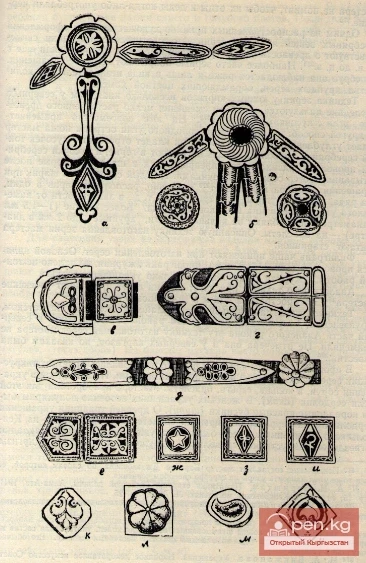
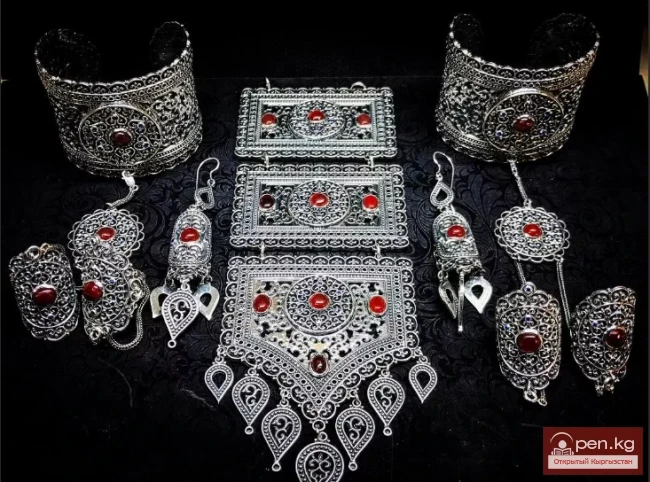
Jewelry Masters of the Last Century Masters of silver craftsmanship adorned horse harnesses, items of women's and men's costumes, as well as household items. Since the early 20th century, the production of silver items began to gradually decline, particularly from the time when the Kyrgyz stopped nomadic life. The set of tools for jewelry production is approximately the same among all Kyrgyz. Recently, they have not changed, only supplemented by factory-made files and pliers. Silver

12.02.2021, 22:50
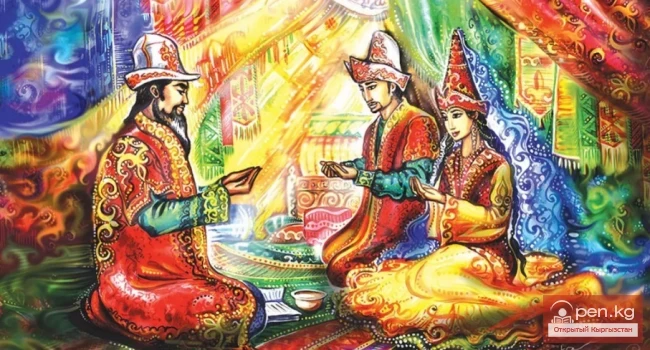
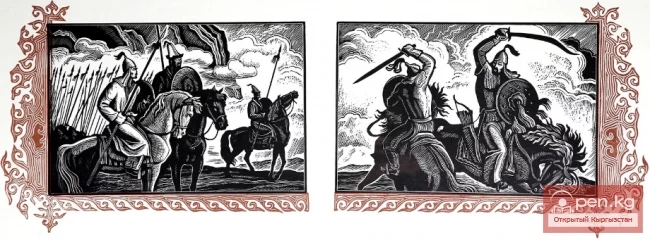
The Tale of Manas. The Great Campaign. The Conspiracy of the Six Khans.
The epic "Manas" in prose

The Tale of Manas. The Great Campaign. The Conspiracy of the Six Khans.

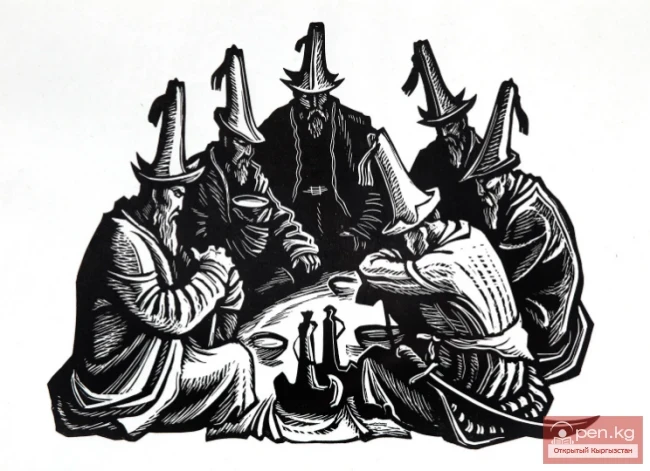
The Great Campaign. The Conspiracy of Six Khans. When preparations were being made for the memorial for Kökötöy, Manas ordered forty Kyrgyz clans to slaughter countless livestock, and forced all the oldest and noblest Kyrgyz and Kazakhs to listen to his command. For anyone who did not obey his orders, Manas shouted, and often lashed the disobedient with a whip across their backs. Then the noblemen despaired of maintaining their power and dignity, and the wealthy did not hope to keep their

11.02.2021, 09:13
Blacksmithing among the Kyrgyz in the early 20th century.
Ethnography

Blacksmithing among the Kyrgyz in the early 20th century.

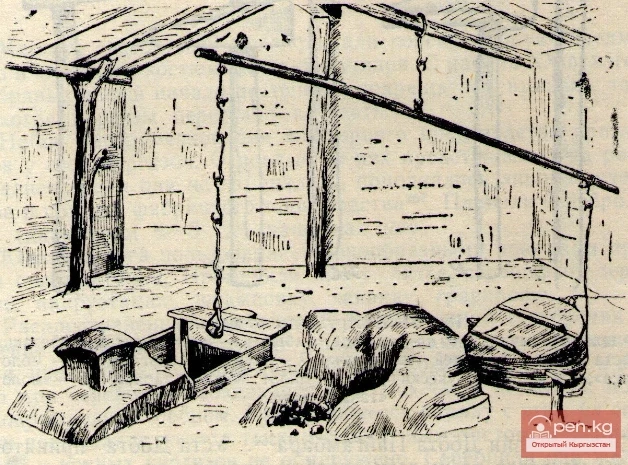
Blacksmithing In the last century, blacksmiths primarily served the household needs of families and the requirements of their farms. In their forges, Kyrgyz people welded tips for plowing tools (“omach”), forged sickles (“orok”), hoes (“ketmen”), axes (balta, kol tesh), and picks (chukuldik). All the main tools for processing metal, as well as wood, were made by the blacksmiths themselves. They fulfilled orders for making parts of harness (stirrups, reins, buckles), traps. Blacksmiths also

11.02.2021, 08:57
Alimkan - Daughter of the Wise Shakirbay
Kyrgyz fairy tales

Alimkan - Daughter of the Wise Shakirbay

THE LEGACY OF SULAYMANBAY Once upon a time, there lived a man named Sulaymanbay. He had one and only son, Mamyr. The father wanted his son to grow up wise and happy. He taught his son wisdom, but the stubborn Mamyr did not listen. When the son grew up, Sulaymanbay said to him: — My son, I am old now, and I have little time left to live. While I am alive, you should marry, but be careful in choosing a bride; do not chase after beauty, choose a girl who is smart and has a good, kind nature. But

10.02.2021, 12:24
Museum-Reserve in the City of Osh
Osh - 3000

Museum-Reserve in the City of Osh

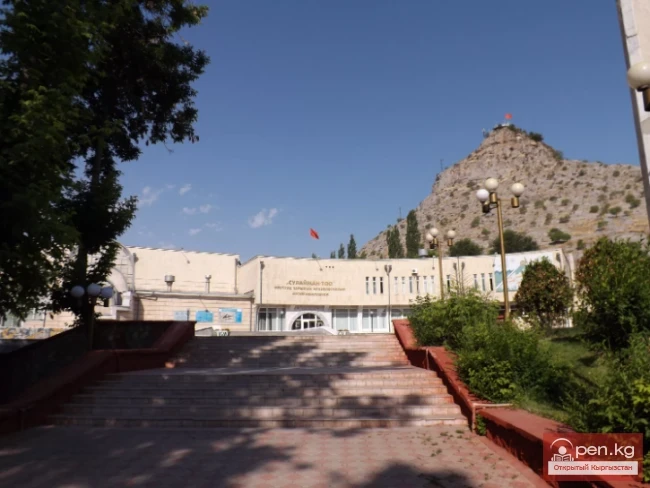
Museum-Reserve The museum-reserve was established in 1949 with the creation of the Osh Regional Local History Museum. The museum was opened to visitors on February 1, 1951. The exhibition area was 65 sq. m, with a collection of 268 exhibits. Significant assistance in forming the collections was provided by scientific expeditions and archaeological excavations conducted jointly with the Fergana Regional Local History Museum and the Leningrad branch of the Institute of Archaeology of the USSR

10.02.2021, 11:58
Baking Bread Among Different Territorial Groups of Kyrgyz People
Flour products

Baking Bread Among Different Territorial Groups of Kyrgyz People

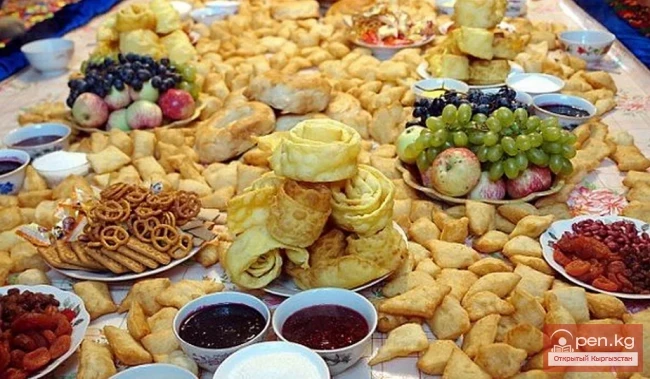
Bread and Bread Products. Bread baking was most widespread in the southern regions and also in Karategin. It is based on common Central Asian traditions, primarily carried by Uzbeks - Sarts and Tajiks. Baked bread constituted a small part of everyday food. Flour products in various forms were combined with meat and dairy products; often they played an independent role in the diet. Baking dough in ash, frying in a dry cauldron or skillet, and boiling in fat or broth were widely practiced. These

09.02.2021, 13:52
"Knuckles – Pendants from the Tombs of Kurkat"
History and archeology of the ancient Tien Shan

"Knuckles – Pendants from the Tombs of Kurkat"

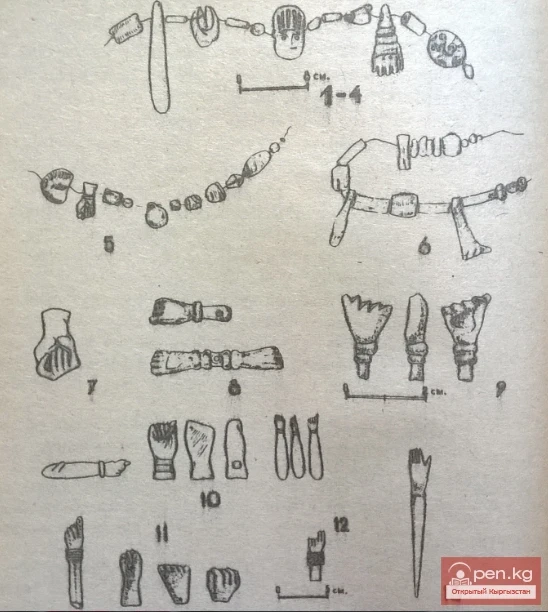
On the Semantics of Ancient Images of Human Body Parts from the Kurkat Crypts In the work of A.H. Bernshteyn - a luminary of Central Asian archaeology, the semantics of objects has occupied a significant place in Kyrgyzstan. Over the last fifty years, about three dozen votive finds have been discovered. For example, a mysterious hand amulet was first found in the Kenkol burial ground. Later, similar items were found by Yu.D. Baruzdin during excavations of the Kаra-Bulak and Turatash burial

09.02.2021, 03:00
Hanafi School as the Most Tolerant Direction Towards the Pagan Myths and Traditions of the Kyrgyz
Kurmanjan Datka

Hanafi School as the Most Tolerant Direction Towards the Pagan Myths and Traditions of the Kyrgyz

Kyrgyz Ayil - an Obstacle on the Path of the Islamization of the People. As historical experience shows, the most freedom-loving peoples tend to fiercely and consistently preserve their national cultural traditions. This is done to avoid assimilation with other ethnic groups, especially in critical moments when the survival of the ethnic group as such is at stake. The Kyrgyz are no exception to this rule. It was the Kyrgyz ayil, with its age-old foundations and customs, that was the greatest

08.02.2021, 08:17
"Punitive Operation Against the Rebel Workers in the City of Andijan"
Peoples movements of Central Asia in the XIX century

"Punitive Operation Against the Rebel Workers in the City of Andijan"

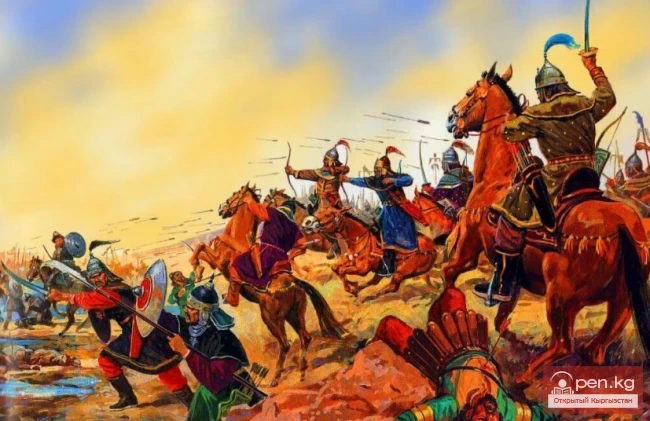
Brutal actions of the punitive detachment against the rebelling Uzbek, Kyrgyz, Tajik, and Kipchak workers in the city of Andijan Failing to create discord among the rebels, the punitive forces began brutal military actions. One of the units of the punitive detachment, sent on September 30 for reconnaissance in the city of Andijan, literally swept away, burned everything in its path, and killed everyone it encountered. Its commander, Colonel Skobeleva, considering himself and other participants

07.02.2021, 18:35
Explanation of One's Gift by Storytellers
Kyrgyz heroic epic "Manas"

Explanation of One's Gift by Storytellers

Explanation of storytellers about their gift As mentioned above, almost all storytellers associate the beginning of their creative activity with a dream vision and inspiration. They like to mention that before the inspiration, they did not know the content of the epic, did not have the gift of a storyteller, and that both came to them only after the dream vision, in which Manas, Semetey, or someone from their companions supposedly instructed them to sing of them. They recount that this

07.02.2021, 18:00
Organization of the Republican Institute for the Improvement of Teachers. Document No. 160 (August 1945)
History of the capital of Kyrgyzstan in documents

Organization of the Republican Institute for the Improvement of Teachers. Document No. 160 (August 1945)

FROM THE DECREE OF THE COUNCIL OF PEOPLE'S COMMISSARS OF THE KYRGYZ SSR "ON THE ORGANIZATION OF THE REPUBLICAN INSTITUTE FOR ADVANCED TEACHER TRAINING" Frunze, August 1, 1945 In accordance with the directive of the Council of People's Commissars of the USSR dated March 7, 1945, aimed at improving the qualifications of teachers and school administrators, studying, summarizing, and disseminating the experience of the best teachers in educational work, providing systematic

06.02.2021, 22:35
Events in Mogulistan between 1618 and 1624
Chagatai Ulus. Haidu State. Moghulistan

Events in Mogulistan between 1618 and 1624

Moghulistan in 1618-1624 In 1028/1618-19 (according to Mahmud ibn Wali in 102/1615, in the "History of Kashgar" in 1026/1617), the influential Shah family conspired against Ahmed Khan and killed him in the village of Barzhuk (modern Maral-Bash). Interestingly, Shah Mahmud Churas, while listing the cities and districts under his control (Kashgar, Yarkand, Yangihisar, Aksu, Kusan, Hotan, Sarykol, and Badakhshan), mentioned geographical features of the Chalysh-Turfansky region among

05.02.2021, 09:55
Wooden Mantis - Darakchyl Batatchy
Insects of Kyrgyzstan

Wooden Mantis - Darakchyl Batatchy

Tree Mantis - Hierodula tenuidentata Sauss. The tree mantis is very similar to the common mantis. This species can be distinguished primarily by the presence of a sharp opaque white spot on each forewing. In the common mantis, this spot (stigma) is not pronounced and is light green. The tree mantis, as its name suggests, is associated with woody and shrubby vegetation and is most often found in river floodplains, climbing high into the mountains — up to 1700 m above sea level. The hatching of

03.02.2021, 18:55
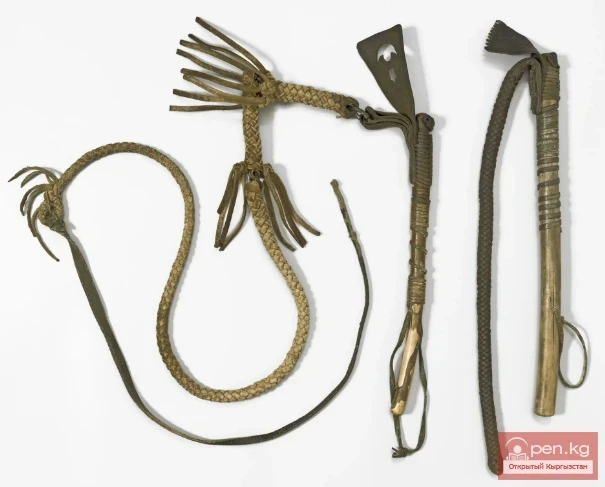
Manufacturing of Bridles (Zhugyons) and Whips (Kamschi)
Ethnography

Manufacturing of Bridles (Zhugyons) and Whips (Kamschi)

Making Harness To this day, specialists in the production of harness parts, particularly bridles (zhugyon) and whips (kamchi), continue their work. In the south, they are referred to as zhugyon usta and kamchi usta. Most of them are elderly people who learned the craft from their fathers. They have preserved their skills in the eastern part of the Osh region. In the Alai district, the masters Kutchu Atabaev (born 1881, village of Terek) and Zair Atayev (born 1878, Lenin collective farm) are

03.02.2021, 17:26
Library Network of the City of Osh
Osh - 3000

Library Network of the City of Osh

Libraries of Osh Before the revolution, there was one private library in the city of Osh, which had 100 books. During the Soviet period, the network of libraries grew rapidly. The Toktogul Regional Library was opened in 1949 based on the city library. Serving about 20,000 residents, the library had a collection of 1,244,000 items as of January 1, 1997 (including 935,204 patents — descriptions of inventions). The library has 9 departments — book collection, book processing, storage,

02.02.2021, 09:13
Plant Food of the Kyrgyz in the Second Half of the 19th Century.
Kyrgyz cuisine

Plant Food of the Kyrgyz in the Second Half of the 19th Century.

Plant-based Food. In the second half of the 19th century, a significant place in the dietary habits of the Kyrgyz was occupied by plant-based products. Both cultivated and wild plants were used, with cultivated plants playing a dominant role. Research confirms that agricultural skills were well-known among all groups of Kyrgyz. Agriculture was most widespread in the regions of the Ferghana Valley, Ketmen-Tyube, Talas, and Issyk-Kul valleys. In the southern regions of Kyrgyzstan, they grew and

31.01.2021, 13:31
Andijan - Center of the Uprising in Autumn 1875
Peoples movements of Central Asia in the XIX century

Andijan - Center of the Uprising in Autumn 1875

The Uprising in Autumn 1875 The uprising re-emerged with new strength in the second half of September 1875 in the eastern part of the khanate among the Kyrgyz and Kipchak semi-nomads. It quickly spread to settled areas inhabited by Uzbeks and Tajiks. The uprising was again led by Mullah Iskak Asan oglu Pulat-bek, who was soon proclaimed khan, and Abdurakhman Aftobachi. By the end of September, the rebels occupied the city of Andijan, whose residents joined them, and together they began to

31.01.2021, 12:57
Weapons of the Medieval Nomads of Kyrgyzstan
History and archeology of the ancient Tien Shan

Weapons of the Medieval Nomads of Kyrgyzstan

Sarybulak Spear The set of arrows from the Mongolian period looks significantly different. In addition to the well-known flat asymmetrical diamond-shaped arrows of this period found in Kyrgyzstan, the collection in question includes types of four-sided warheads, diamond-shaped warheads, rectangular warheads, and flat sectoral arrows. Almost all the forms considered have no prototypes among the arrows of the Kankol and Turkic cultures in Kyrgyzstan. However, they were widely spread during the

30.01.2021, 12:00
The Epic of "Manas". The Arrival of Manas in Karkyra
Poetic retelling of the epic "Manas"

The Epic of "Manas". The Arrival of Manas in Karkyra

The Arrival of Manas in Karkyra And exactly on the fourth day To the green shores of Kegen Came er-Manas with his Warrior entourage. And with cries of "Manas! Manas!" The Kyrgyz rushed to meet The valiant army of Manas. With an old man's stingy tear Khan Koshoy embraced Manas. — At last, the people have waited For their support and stronghold! Here are Konurbay and Neskara, The gluttonous fat man Zholoy Caused a ruckus yesterday. Having come to visit us at the feast, They

30.01.2021, 03:00
The Resourceful Koilubai
Kyrgyz fairy tales

The Resourceful Koilubai

KOYLUBAI Once upon a time, there lived a peasant named Koylubai. He was a brave and resourceful man, but very poor. He had little land and no livestock at all. The wealthy landowners always tried to oppress him. Right next to Koylubai lived four rich peasants, brothers who were greedy and cruel, earning them the nickname "Four Wolves." One day, the brothers sowed wheat on the slope of a mountain, while Koylubai sowed millet lower down.

29.01.2021, 15:28
How did the star Kurmandzhan Datka rise in the Islamic world?
Kurmanjan Datka

How did the star Kurmandzhan Datka rise in the Islamic world?

LIFE AND BELIEFS OF THE KYRGYZ DURING THE TIME OF KURMANDZHAN DATKA And still, how did the star of Kurmandzhan Datka rise in the Islamic world, in an era when a woman could not even dream of the glory of a politician and statesman? Finding an answer to this question is hardly possible without considering the unique national characteristics that patriarchal Muslim traditions acquired on Kyrgyz soil. Let’s start with an important point. The Kyrgyz became Muslims not in a short period of time,

29.01.2021, 14:16
Tanning of Suede among the Kyrgyz
Ethnography

Tanning of Suede among the Kyrgyz

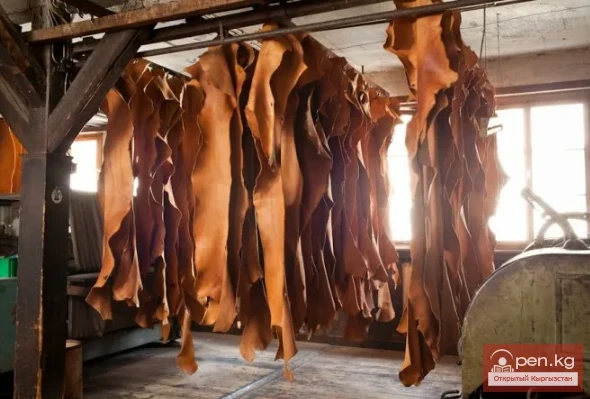
Tanning of Suede. For this purpose, the skins of sheep, goats, mountain goats, and roe deer were used. The skin of the latter was valued significantly higher due to its durability and water resistance. "Kyrgyz people highly value the skin of kiyika because the strongest and most waterproof chombars are made from it. Chombars made from any other skin get wet even from rain, while in kiyika chombars, one can safely float on water without getting wet." After soaking in a saline

28.01.2021, 14:24
Fedchenko's Earwig - Fedchenko's Curly Tail
Insects of Kyrgyzstan

Fedchenko's Earwig - Fedchenko's Curly Tail

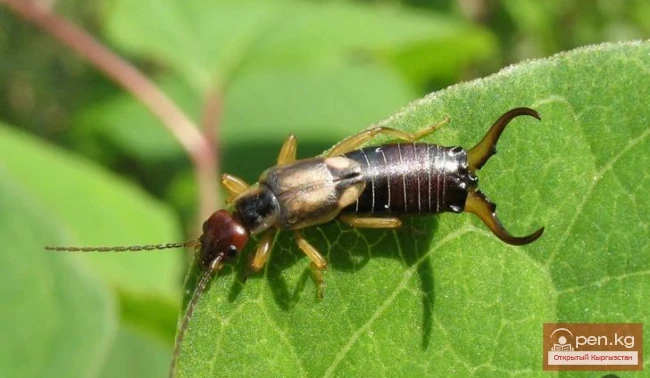
Fedchenko's Earwig - Oreasobia fedtschenkoi Sauss. The body is narrow and long; the head is well-defined, with forward-directed chewing mouthparts; the pronotum is flat, the elytra are short, leathery, and devoid of veins, the wings in a folded state protrude from under the elytra as short triangular wing plates, or the wings, and sometimes even the elytra are absent; the legs are short, running with 3-segmented tarsi; the abdomen at the end has a pair of strong, hard pincers, which are

27.01.2021, 19:50
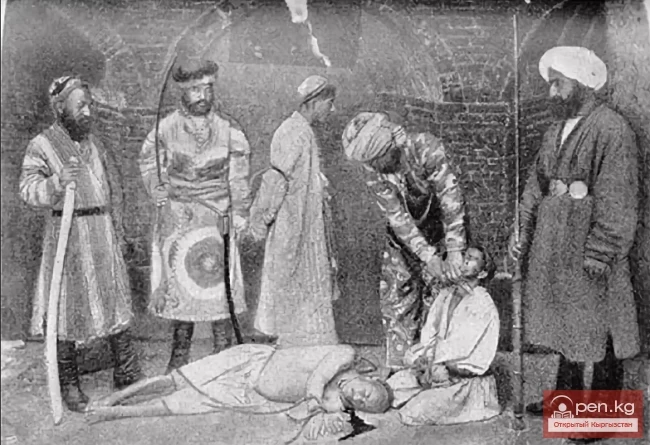
Eastern Turkestan in the 17th Century
Chagatai Ulus. Haidu State. Moghulistan

Eastern Turkestan in the 17th Century

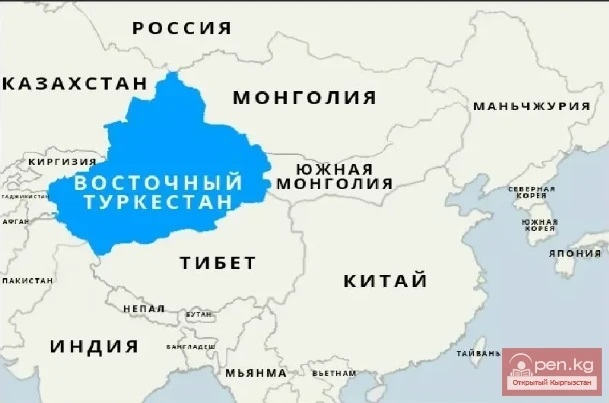
Eastern Turkestan in the 17th Century. At the end of Muhammad Khan's reign, his younger brother Abd ar-Rahim Khan, the ruler of Chalysh-Turfan, raised a rebellion and plundered Bai and Kusan (Kucha). Muhammad Khan sent his grandson Timur-Sultan and Muhammad-Hashim-Sultan (son of Khudabende-Sultan) against him with a large army. In the battle at the Kanalg area, Abd ar-Rahim Khan was defeated and fled to Turfan. Timur-Sultan settled in Aksu, while Muhammad-Hashim Sultan settled in Chalysh

27.01.2021, 19:14
Manaschi and Semeteichi
Kyrgyz heroic epic "Manas"

Manaschi and Semeteichi

Two Groups of Storytellers: Performers of "Manas" and Performers of "Semetei" The storytellers were divided into two groups: manaschi (performers of "Manas") and semetei (performers of "Semetei"), with the former being those who performed all three parts of the trilogy, while the latter performed only "Semetei" and "Seitek," and from "Manas" only separate episodes. Whether this division existed from ancient times or was a

27.01.2021, 18:42
The Meat Diet of the Kyrgyz in the 19th Century.
Kyrgyz cuisine

The Meat Diet of the Kyrgyz in the 19th Century.

Meat Dishes. In the second half of the 19th century and until the beginning of the 20th century, meat played an important role in the diet of the Kyrgyz. The Kyrgyz consumed mutton, horse meat, beef, and to a lesser extent camel meat and goat meat. In areas where yaks were raised, yak meat was often consumed. Mutton and horse meat were especially valued. In wealthy households, beef was looked down upon as it was considered smelly - sasyk, and those wealthy individuals who owned a large number

25.01.2021, 20:47
Post Office and Telephone Communication in Osh
Osh - 3000
Post Office and Telephone Communication in Osh

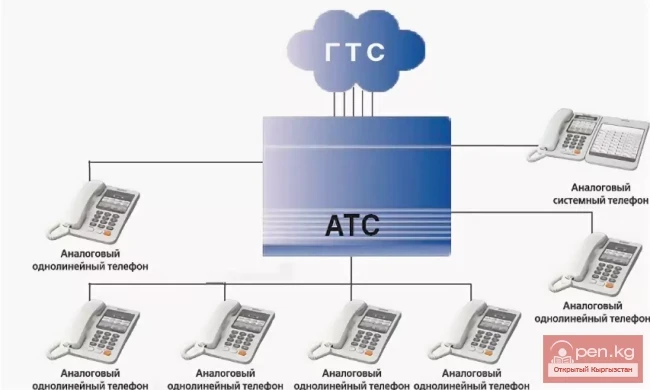
Development of Communication The post office in Osh was established in 1956 based on the Osh city communication hub. The post office covers 24 city post offices and has a fleet of 38 vehicles. Daily, 29 cars and 4 route buses were used for mail transportation. On average, 44,300 pieces of written correspondence, 1,000 parcels, and 740 money transfers were processed daily, and 178,000 copies of periodicals were delivered. The post office employed 403 people, four of whom were awarded orders and

24.01.2021, 18:29
Groups and Types of Arrowheads
History and archeology of the ancient Tien Shan

Groups and Types of Arrowheads

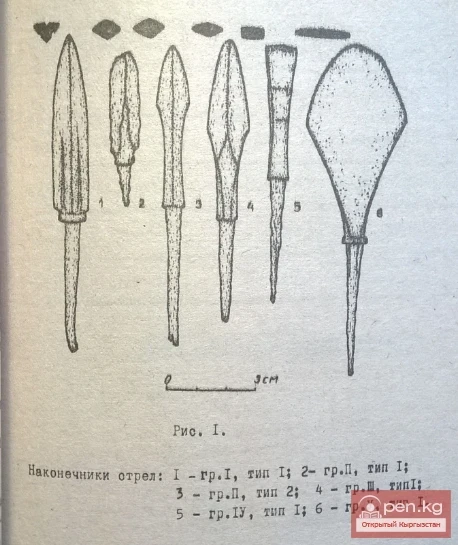
Classification of Arrowheads A particular interest is presented by a small collection of medieval weapons, gathered over many years of field research in Kyrgyzstan by I.K. Kozhomberdiev. It consists of six iron arrowheads. Based on their cross-section and the shape of the blade, they can be classified into several groups and types. Group I. Triangular-three-bladed arrowheads. Type I. Elongated triangular. Includes 1 specimen from the Kum-Aryk site in the Chui Valley. The length of the blade is

24.01.2021, 17:51
The Tale of Meer and Zara
Kyrgyz fairy tales

The Tale of Meer and Zara

ZAR AND MEER Once upon a time, it is said, there lived a king. This king lost his vizier, and he appointed his favorite servant, a dashing young man, in his place. One day, the king went falcon hunting with his new vizier. The king said to the vizier: — If I have a son and you have a daughter, you will marry her to my son. If you have a son and I have a daughter, I will marry my daughter to your son. And if we both have sons or daughters, let them be friends for life.

21.01.2021, 19:33
Reasons for the Popular Uprising - the Cruelty of Nasr-Eddin Khan
Peoples movements of Central Asia in the XIX century

Reasons for the Popular Uprising - the Cruelty of Nasr-Eddin Khan

The Cruelty of Nasr-Eddin Towards Uzbek, Kyrgyz, and Tajik Workers On September 22, Nasr-Eddin Khan and the feudal lords surrounding him, trying to maintain power in their hands under the patronage of the tsarist colonizers, signed a treaty with the Turkestan Governor-General Kaufman, in which the Kokand Khan recognized himself as a submissive servant of the Russian government, renounced the right to direct diplomatic relations with other states, and any military actions without the permission

21.01.2021, 10:12
Epic "Manas". Invitation to the memorial for Koketey
Poetic retelling of the epic "Manas"

Epic "Manas". Invitation to the memorial for Koketey

Invitation to the Memorial for Koketey Here in the vastness of Karkyra, Setting up yurts with a hearth, They let the cattle roam on the slopes of the mountains. In cauldrons, in bags — the kumys Poured out with milk. The son of Koketey, Bokmurun, Called the young Aidar, To saddle the stallion Maanikер, He ordered to prepare for the journey. — You inform the whole region, That in late autumn, when The cattle will gain weight, When the forage of the summer pastures Will burst the camel's

20.01.2021, 21:55
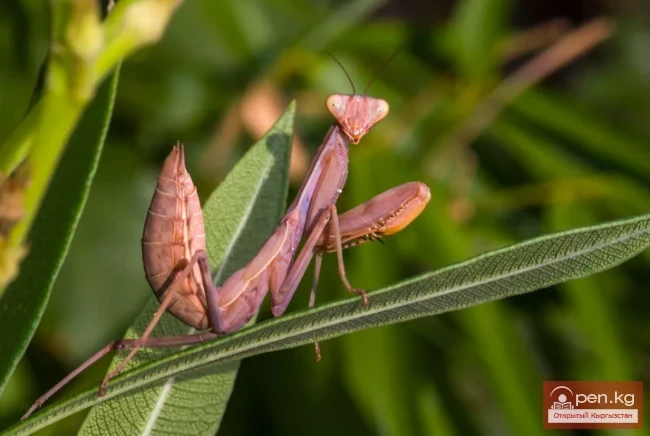
Common Mantis - Kadimki Bataczy
Insects of Kyrgyzstan

Common Mantis - Kadimki Bataczy

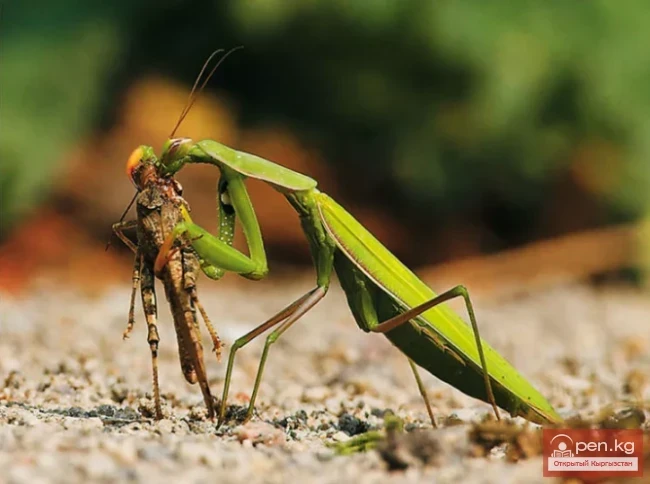
Common Mantis - Mantis religiosa L. In translation from Latin, "Mantis religiosa" means "divine prophet." In African and Asian countries, these insects were considered sacred. Mantis have elongated bodies, a large mobile head with prominent eyes, and an elongated prothorax. Their strong, serrated forelegs are the main weapon of this ambush predator. When at rest, these legs are folded in a position resembling a praying person, which is how the mantis got its name.

20.01.2021, 06:00
The Struggle for the Throne in Moghulistan Among the Descendants of Khizr-Khodja
Chagatai Ulus. Haidu State. Moghulistan

The Struggle for the Throne in Moghulistan Among the Descendants of Khizr-Khodja

The Struggle for the Throne in Moghulistan in the Second Half of the 16th Century Abd al-Karim Khan died at the end of 999/1590-91 or at the beginning of the following year. His successor, Muhammad Khan, granted his brothers: Abu Said - Kashgar and Yangihisar, Yunus Sultan - Kargalyk, Abd ar-Rahim Khan - the Sary-Kol region and Bakhana, and his son Abd al-Kerim Shah-Haidar Sultan - Hotan. Three years after the death of Abd al-Karim Khan, the Shaybanid Abdullah Khan violated the friendly treaty

20.01.2021, 03:00
Technology of Processing Livestock Raw Materials among the Kyrgyz in the Last Century
Ethnography

Technology of Processing Livestock Raw Materials among the Kyrgyz in the Last Century

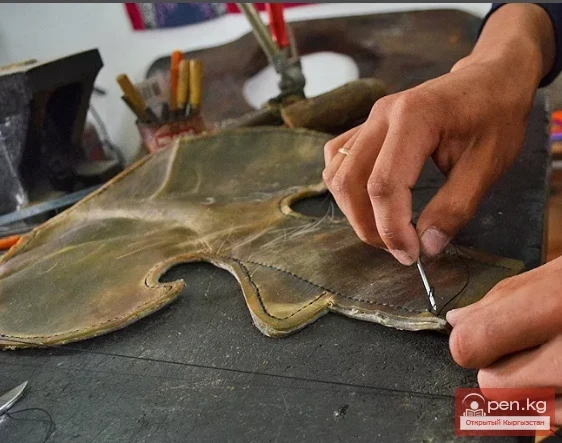
Methods of Raw Material Processing The processing of livestock raw materials, as well as the preparation of various items from it, was carried out by both men and women, with responsibilities strictly divided between them. For example, it was always men who slaughtered the animals. They also processed the skins, from which they made harness accessories, containers for storing bowls, shoes, and straps for fastening parts of the yurt. The skins of small animals (sheep, goats) were processed by

19.01.2021, 21:38
Commissioning of the tobacco fermentation plant in Frunze. Document No. 158 (June 1945)
History of the capital of Kyrgyzstan in documents

Commissioning of the tobacco fermentation plant in Frunze. Document No. 158 (June 1945)

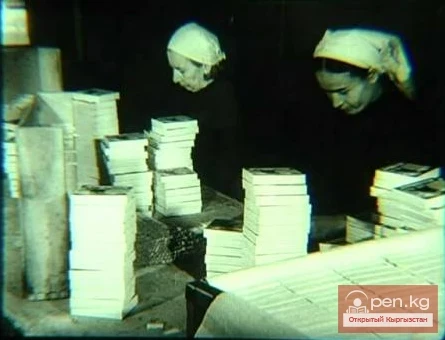
FROM THE RESOLUTION OF THE BUREAU OF THE FRUNZE CITY COMMITTEE OF THE COMMUNIST PARTY (BOLSHEVIKS) OF KYRGYZSTAN "ON MEASURES FOR COMPLETING THE CONSTRUCTION AND COMMISSIONING OF THE TOBACCO FERMENTATION PLANT" Frunze, June 11, 1945. The Bureau of the City Committee of the Communist Party (Bolsheviks) of Kyrgyzstan resolves: 1. To warn the Manager of Glavtabak Comrade Pynko and the Director of the plant Comrade Zhidikova that if they do not take decisive measures to expedite and

19.01.2021, 10:00
The Ascent of the Alai Queen to the Political Olympus of the Khanate
Kurmanjan Datka

The Ascent of the Alai Queen to the Political Olympus of the Khanate

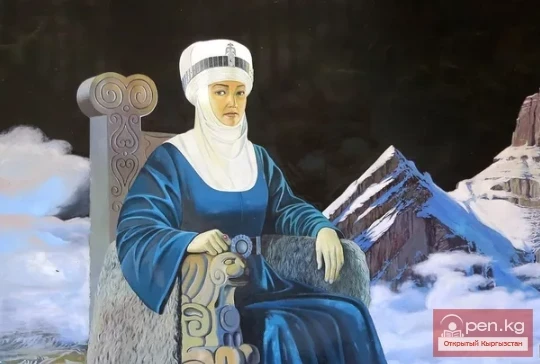
The Uncontested Ruler Aalaya In the early 1860s, when Mullah Alymkul was still the ruler of Osh, his main rival was Alymbek, who managed the affairs of the Kyrgyz of Aalaya. Alymkul, having become regent for the underage Sultan-Seid, destroyed the old khan's palace in the center of Kokand and built another one—already outside the city limits. Relying on the nomadic elements of the Kyrgyz and Kipchaks in his rule, Alymkul was not without reason afraid of being surrounded by the more

19.01.2021, 03:00
The Tale of Manas. Remembrance of Kököktöy. Part - 4
The epic "Manas" in prose

The Tale of Manas. Remembrance of Kököktöy. Part - 4

Memorial for Kёkёktёy. Part - 4 Six hundred logs of larch were tied together, and a rope was woven from forty-two cords. At the top of the larch, they tied the targets - this was arranged for shooting practice. Everyone who considered themselves a marksman prepared to try their luck. They shot from early morning until the scorching noon, expending all their arrows, but no tricks or techniques could knock the targets off the pole.

18.01.2021, 19:10
Consumption of Dairy Products by Kyrgyz in the Second Half of the 19th Century.
Kyrgyz cuisine

Consumption of Dairy Products by Kyrgyz in the Second Half of the 19th Century.

Milk and Dairy Products. In the traditional diet of the Kyrgyz, among all products available to the general population, milk and dairy products were prominent. They consumed sheep, cow, mare's milk, and to a lesser extent, goat and camel milk. The Kyrgyz of the inner Tien Shan, Alai, and Pamir also used yak milk, which was characterized by high fat content. Whole milk was consumed very sparingly; it was given to children mixed with various types of cottage cheese and also for medicinal

18.01.2021, 18:55
Radio and Television in the City of Osh
Osh - 3000

Radio and Television in the City of Osh

Radio and Television The city of Osh was radio-equipped in 1931. By 1936, the length of the city’s radio broadcasting network was about 10 km. Four transmission lines were built towards the new city. The total number of radio points was 1500. The first radio broadcast prepared by the "Osh" radio station aired on January 20, 1968. Until 1969, the Osh city radio hub operated on one program, later expanding to three programs. In 1984, the number of radio points reached 21,895. The

17.01.2021, 17:54