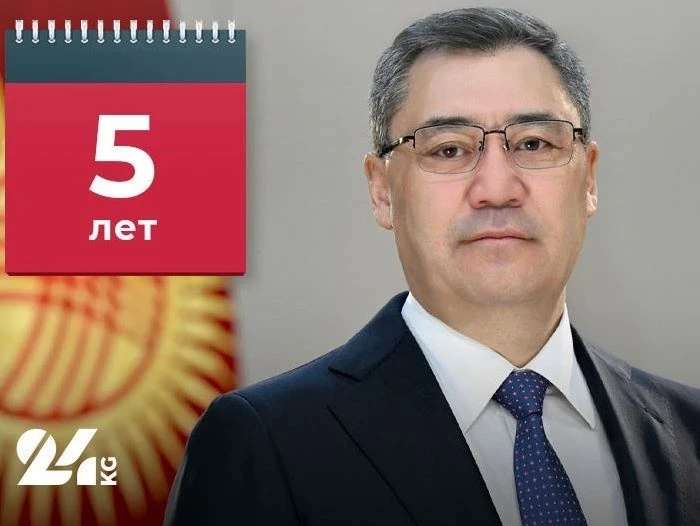
The power of Sadyr Japarov represents a distinct political phase that does not fit into the usual frameworks of "democracy - authoritarianism" or "populism - reforms." His rule has become a peculiar hallmark, summarizing the era of post-revolutionary survival, when state structures are either being restored or are effectively disintegrating.
Japarov entered the political arena not through established institutions, but as a result of systemic collapse. The events of October 2020 are hard to call a revolution in the traditional sense; rather, it was a moment when the previous system had completely exhausted itself. This fact has become the basis for most characteristics of his rule.
Key Achievement
One of the most significant, albeit not obvious, successes of Japarov's presidency has been the restoration of the state's ability to act effectively.
Before October 2020, Kyrgyzstan was in a state of chronic managerial weakness, like a "patient" described by Alexei Tolstoy in his tale about Buratino. Decisions were made depending on circumstances, the elites were fragmented, and the security forces lacked clear political will. The economy existed in survival mode, which was particularly evident during the pandemic.
Japarov changed this model, effectively breaking it, and rebuilt the vertical of power.
In the new system, the center makes decisions, regions know their responsibilities, and law enforcement agencies have clear mandates. Business, albeit under strict conditions, received clear rules of the game. This phenomenon in political science is called the restoration of sovereign governance, which is of much greater significance for countries with weakened state institutions than any external reforms.
Political Cooperation Between Japarov and Tashiev
Speculations about the possible collapse of the Japarov-Tashiev tandem refer to the idea that "two heads cannot cook in one pot," but these did not materialize over the past five years due to a mistaken personalistic interpretation.
In practice, this cooperation represents not just an alliance of two like-minded individuals, but a structural model of power that corresponds to global trends toward strengthening the state and security forces in countries from Turkey to India.
In this model, Kamchybek Tashiev is an equal figure, not a secondary partner. He plays the role of custodian of the tools of sovereignty that help dismantle shadow elites and control borders, as well as neutralize alternative centers of power. Japarov sets the strategic direction, while Tashiev ensures its implementation.
The advantage of such a structure lies in its high manageability and operational decision-making speed.
Kyrgyz society, like international colleagues, perceives this model as adequate to current reality.
Discipline Instead of Reforms
The economic growth of recent years is often linked to external factors such as re-export and changes in logistics. However, this is only partially true. The main reason has been a significant reduction in internal chaos, which led to an increase in tax revenues not through rate hikes, but through the legalization of the economy. This also restored the state's monopoly on coercion, which is a necessary condition for effective fiscal policy.
In aggregate, this does not represent classic liberal reforms, but rather a mobilization economy where order is established before incentives. Nevertheless, if the mobilization regime drags on, it may stifle initiative. However, over the past five years, Japarov has successfully balanced between rigidity and pragmatism.
Similarly, the fight against corruption is taking place. Critics often mention the lack of independent anti-corruption institutions, but they overlook the essence of Japarov and Tashiev's approach.
They have chosen a demonstrational rather than a systemic approach.
Therefore, we observe high-profile arrests and asset recoveries, creating the illusion of inevitable punishment. Although this may spark debates from the perspective of Western standards, for a society weary of impunity, it is perceived as an effective measure. People realize that the risk of being punished is quite high, regardless of their status.
Foreign Policy Realism
One of the underrated aspects of Japarov's rule is his realistic foreign policy. He does not make loud statements about "multi-vectorism," yet maintains good relations with Russia, strengthens ties with China, and keeps working relations with the West, avoiding full immersion in any of the global powers.
Under Japarov, Kyrgyzstan ceased to be an object of external manipulation and became a subject of cautious maneuvering, which is extremely important in conditions of geopolitical instability.
In fact, Sadyr Japarov has become a reflection of modern times for Kyrgyzstan, where small developing countries are learning to survive, and illusions give way to pragmatism.
His rule does not represent an ideal state, but rather a return to the instinct of self-preservation.
The question of the next stage is not whether this model will disappear, but whether it can evolve and in what way. The answer to this question will determine whether the first five years of Sadyr Japarov's presidency will go down in history as a period of stabilization or as a temporary respite before a new crisis.
Source: 24.kg