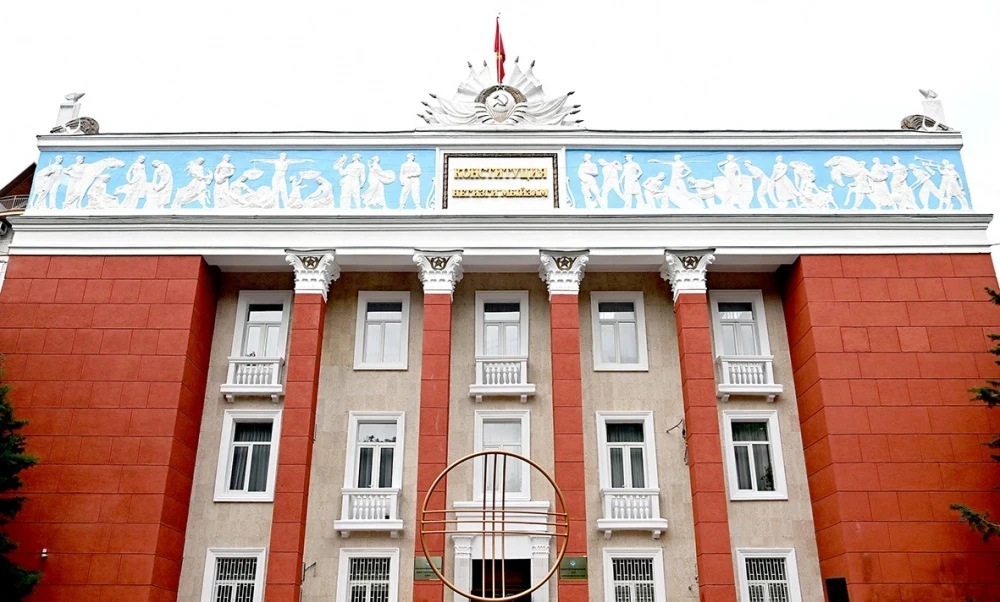
The Constitutional Court of the Kyrgyz Republic has resolved the legal uncertainty regarding the presidential term and the dates of the next elections. On February 17, the court announced its decision on the request of Sadyr Japarov, which concerned the interpretation of key articles of the Constitution. The judges clarified the mechanism of legal succession during the transition between different constitutional models, emphasizing the importance of adhering to the "rules of the game" for the stability of the state system.
According to the decision, the mandate received by the president from the people in 2021 must remain unchanged. This means that the new five-year term cannot retroactively reduce the current six-year term of Sadyr Japarov. The date of the next elections was also clearly established — January 24, 2027, excluding the possibility of early elections in the absence of extraordinary circumstances.
The statement of the Constitutional Court noted:
“The Constitution of the Kyrgyz Republic serves as the foundation for the creation and functioning of state power. It must be stable, ensuring the predictability of the legal order, while maintaining the ability to adapt to changes in society and to adjust power in response to new challenges, without undermining its fundamental principles.”
On April 11, 2021, the people of Kyrgyzstan legitimized the new Constitution in a referendum, defining the architecture of the state structure. The transition from one constitutional model to another is permissible but requires legal correctness. It is important not only to change the text of the Basic Law but also to follow the logic of the transition.
A constitutional gap can undermine the legitimacy of power and disrupt legal certainty. Therefore, a key task becomes ensuring legal continuity during the change of constitutional orientations.
The significance of the transitional period lies in the fact that the legal order is most vulnerable at this moment. Transitional provisions act as a legal stabilizer, introducing guarantees that help minimize turbulence during constitutional reform. These guarantees help maintain governance, functionality, and continuity of power.
Transitional provisions transform the crisis period of constitutional change into a legally organized process, allowing for the avoidance of loss of legitimacy of power and trust in state institutions.
The constitutional model introduced as a result of the referendum on April 11, 2021, changed not only the distribution of powers but also the legal regime of presidential authority. The new version of the Constitution established a five-year term and a limit of two terms, unlike the previous version, where the president was elected for six years without the possibility of re-election.
Thus, there was a correction of both the temporal parameters and the principles of mandate limitation. These changes are of practical significance, as the new Constitution came into force during the term of the current president, Sadyr Japarov.
The president of Kyrgyzstan was elected according to the 2010 Constitution and began his term on January 28, 2021, for six years. After the new Constitution of 2021 came into effect, his powers continued within the framework of the new model of public authority.
Considering the time that has passed, various approaches have emerged in public and expert discourse regarding the terms of the president's powers. The main discussion revolves around whether the five-year term established by Article 67 of the 2021 Constitution applies to the mandate received under the 2010 Constitution or whether the original duration of the mandate is preserved.
According to the Constitutional Court, the presidential mandate of Sadyr Japarov is the result of the people exercising their power and creates a stable legal state. By participating in elections, the people delegate power, expecting full compliance with their decision. Voting determines not only the identity of the president but also the main parameters of the mandate.
The legal formalization of the mandate is completed with the taking of the oath, after which it must be adhered to in the parameters that were set at the time of its granting. In transitional conditions, it is important to maintain the continuity of legal norms to avoid undermining the legitimacy of power.
The intertemporal nature of the norms of the Constitution ensures the continuity of power and predictability of the legal order, excluding retroactive interference in already existing legal relations. The constitutional transition should not devalue previous legal facts.
Thus, any interpretation that reduces the current mandate based on the 2021 Constitution is considered a retroactive change of the rules, which contradicts the principles of legal certainty and the legitimacy of elections.
This intertemporal prohibition on reducing the term is confirmed by the transitional norms established when the 2021 Constitution came into effect. According to the Law "On the Constitution of the Kyrgyz Republic," the president elected in 2021 for a six-year term continues to exercise his powers in accordance with the new Constitution, and this term is counted as the first under the new limitation on the number of terms.
The Constitutional Court emphasizes that counting the six-year term does not change its original parameters, including duration and completion time, and cannot lead to a reduction in the term of office.
Thus, the established five-year term, according to Article 67 of the 2021 Constitution, does not apply to the mandate that began during the operation of the 2010 Constitution. The current term should end in its original duration — six years, and the six-year term will be counted as the first under the new two-term rule.
The transitional provisions have the same legal status as the text of the Constitution, as they were adopted simultaneously with it. Therefore, a law containing transitional provisions cannot be regarded as an ordinary law.
Regarding early elections, the Constitutional Court noted that discussions about the terms of the president's powers cannot serve as a basis for their conduct. Early elections are only possible in the case of premature termination of powers for strictly defined reasons listed in the 2021 Constitution.
This list of grounds is closed, and any extensive interpretation would be unconstitutional. In the absence of relevant grounds, early presidential elections are legally excluded and should be held according to the regular electoral cycle.
The next presidential elections in Kyrgyzstan are to be held on the fourth Sunday of January 2027 (January 24, 2027), and their appointment must be carried out by the Jogorku Kenesh no later than four months before the voting day (i.e., no later than September 24, 2026).