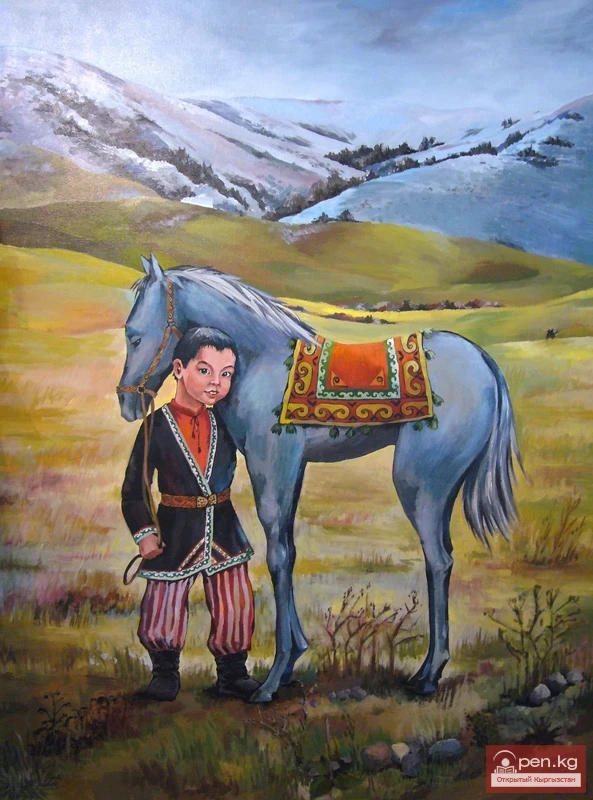
The story took place when khans, kings, and viziers had already appeared on earth, in other words — rulers, when wise fathers had already begun to test what their sons were capable of. There lived a certain Shamir, and he had a single son named Mamyr.
Even in ancient times, the necks of tricksters were long, and male pheasants wore an astonishingly bright red-gold outfit. Even then, some people were luckier in life than others; some accomplished their deeds through strength, while others did so through wit.
A long time ago, when there was still no Issyk-Kul, and at the foot of the mountains there were no settlements, and people did not live here, as they do now, in cities and villages, legends say that there was a valley that occupied a vast territory — from modern Tyup in the east to the Boom Gorge in the west. A great river, Char, flowed through this valley, into which small rivers — Dzhergalan, Ak-Suu, Karakol, Kyzyl-Suu, Barskoon, Tamga, Kök-Terek, Ula-Khol — flowed. The waters of the river
And there was a time like that. In the eastern part of the Chui Valley, at the foot of the mountains, lived a man named Kochkor with his wife Chynar. They had one and only son, whom they named Akkoen at birth, which translates to White Hare.
It was a long time ago, when rivers flowed clear and full, when magpies were not thieves, and when people had just begun to divide into the rich and the poor. During this time, there lived a poor man named Erdene. He lost his parents as a teenager, and he had to earn his bread early. Since he only knew how to take care of livestock, he lived by working for the wealthy as a shepherd.
The Tale of the Wise Boy On one of those fine, sunny days, the khan, accompanied by his six closest viziers, went hunting. It was Friday, a day when Muslims work less and pray more to God. This time, the hunting route passed through a small aiyl called Zhatakchy. Due to the lack of livestock in the summer, they do not migrate to the mountains but remain on the plain, growing wheat, barley, or millet.
According to legends and traditions, the planet Venus also influenced the fates of people. One of the legends tells of a smart, sensitive, and remarkably beautiful girl who lived on Earth. People consulted her, and the young men, struck by her intelligence and beauty, sought to marry her. This led to disputes among them. Hating the enmity on Earth, Cholpon flew to the sky and turned into a star. The people remembered Cholpon's words:
Among the Kyrgyz, there is a preserved legend-myth. In those distant times, when the world was being created, the Prophet — the apostle Noah (or Nuh) had two beautiful daughters — Rajal and Kaiyr. They both loved the apostle Solomon very much and wanted to marry him. However, Solomon married a poor but very resourceful girl. Out of resentment, both beauties flew to the sky and turned into stars.
Once, Khan Baytik decided to capture Tokmak. Not far from the city, in a gorge, he left his daughter with her entourage, while he and his army headed towards the city. The khan dealt harshly with the townspeople: he spared neither the old, nor the women, nor the children—he ordered them all to be killed. Only one old woman managed to escape.
Once upon a time in the mountains lived Tolubai-Synch — an expert on the racing qualities of horses. One day, he was sitting in the mountains, holding a horse's skull in his hands, and lamenting bitterly. At that moment, a bay (a type of horse) passed by. He saw Tolubai, rode up to him, and asked what was troubling him. Tolubai replied, "There was a good horse, but it fell into bad hands and died." Then the bay invited him to choose a good racehorse from his herd.
Once upon a time, there lived a man named Dzhancharbek. He decided to organize a feast and began to gather people. As with any celebration, various games, races, and archery contests were arranged, where participants shot arrows at a bag filled with silver hanging high. Whoever hits it gets to take it. People gathered, and horsemen brought their best steeds.
Iskander gathered a huge army and set off on a distant campaign. During the long siege of a city, he fell seriously ill. Feeling death approaching, he ordered his vizier to gather the army and return home. On the way back, his illness worsened, and feeling the breath of Azrael upon him, he asked the vizier to convey three last wishes to his mother:
Once upon a time, there lived three orphaned brothers. Every day they went to the forest to gather firewood. One day, a heavy rain caught them. They took shelter under a large tree. By chance, the youngest brother found a large burrow in the ground beneath the tree, which turned out to contain a lot of honey. The brothers were delighted with the find and kept sending the youngest for more honey.
Once upon a time, there lived two khans next to each other. Each of them had a son. From childhood, they taught their sons everything. One day, during a conversation, the sons said to each other: “We have learned a lot, but we do not know the language of birds and animals.” And they decided to go to a sage.
A khan's shepherd fell in love with the beautiful daughter of his lord. He came to propose to her. But she, laughing, said to him: "If you bring me the star Cholpon, I will become your wife." The young man returned home in despair. His mother asked him why he was sad. The son told her about his sorrow. His mother comforted him, asking him not to be sad. She had long hair. She cut it and began to weave a rope. And she wove it very long. The young man climbed up this rope to the
Once upon a time, there was a khan. The khan had a daughter. Her name was Aiy-Sulu, and she was as beautiful as the moon. One day, an evil sorcerer saw her and wanted to steal her. Meanwhile, her father intended to marry his daughter off to another khan.
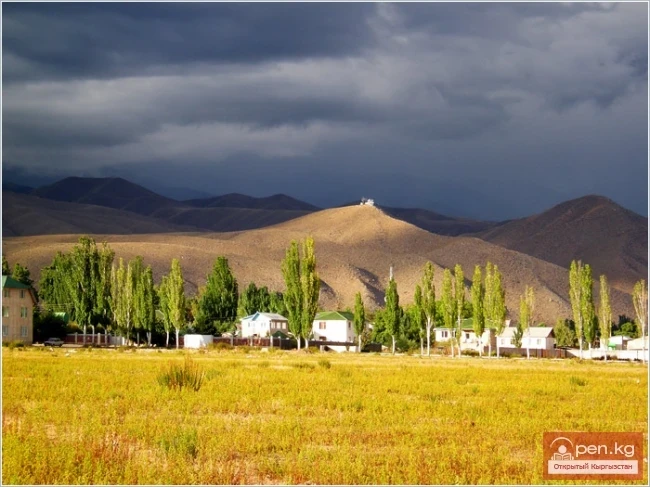
KYZ-KUYYO. On the way from Bishkek to Issyk-Kul, in the Boom Gorge, where the steep cliffs rise above the noisy Chu River, there is a small village called Kyz-Kuyyo.
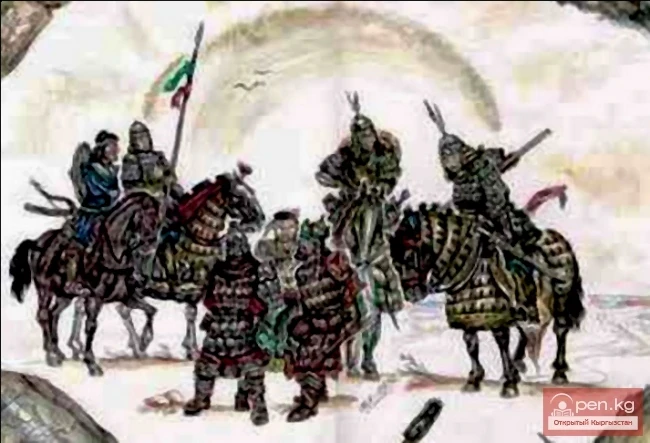
ACHUU BULAK. Not far from here, in a small gorge, there is a spring. It was formed a long time ago—when the Kyrgyz were at war with the Kalmyks. The Kyrgyz had already driven the Kalmyks into the mountains. They captured the young son of the Kalmyk khan Changalmak and killed him in the gorge. The khan buried him there. After some time, a spring with clean, cold, tasty water appeared at the site of the grave. However, anyone who drank water from this spring fell ill in such a way that they
A long time ago, among the high mountains, there lived a poor shepherd with his wife and small son. The shepherd loved his son very much. He saw in him the continuation of his lineage.
In one clan, there were three people left: an old father, his son, and his daughter-in-law. They had no children. The old man began to complain to Allah: "Oh, Allah, do not torment me! Help me continue my lineage."
CHOLPON AND THE TWO HEROES. This happened long ago when the Kyrgyz lived as one tribe among the high snowy mountains. In this tribe, there was a young and beautiful girl named Cholpon, with eyes bluer and purer than the high sky and brighter than the stars shining in it. Two heroes, Ulan and Santash, fell in love with Cholpon—strong and brave, ready to give their lives for the heart of the wonderful Cholpon. She did not know whom to prefer. The heroes began to fight among themselves: they tore
“The people... are the first in time, beauty, and the genius of creativity, philosophers and poets... It is essential to know the history of the people, and it is equally necessary to understand their socio-political thinking. Scholars—cultural historians, ethnographers—indicate that this thinking is expressed in fairy tales, legends, proverbs, and sayings... In the simplicity of words lies the greatest wisdom...” M. Gorky.
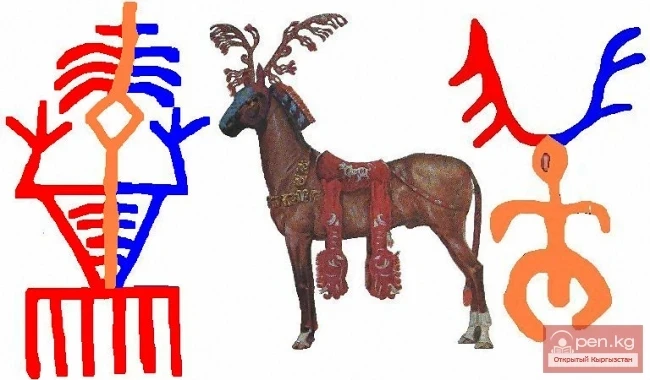
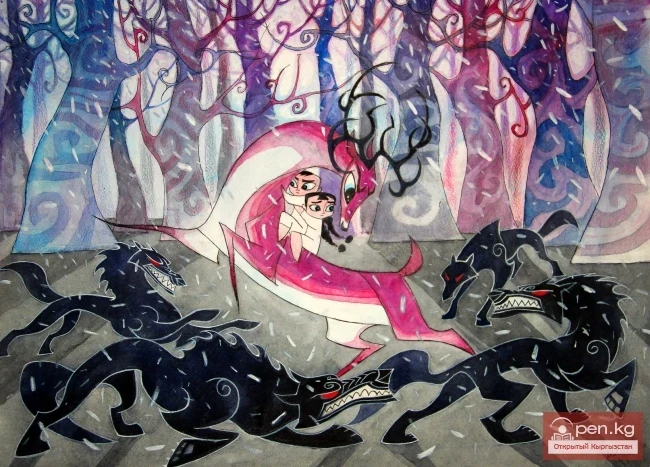
Mother-Deer An ancient unwritten law of human existence states: when a person is mourned and honored on their final journey, people must forget about enmity and revenge. No matter how strong the motives may be, on such a day, blood cannot be shed. But the dishonorable and conscience-less people violated this law. Hiding in the forest, the enemies waited for the right moment... ... No one had time to grab a weapon, mount a horse, or call for help. An unprecedented massacre began. They slashed