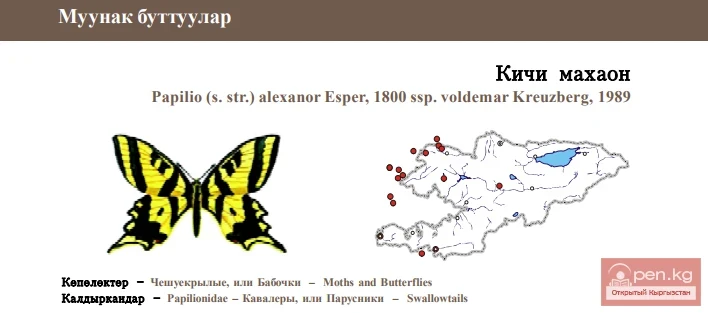
Alexanor, subspecies Voldemar / Kichi Mahahon / Voldemar Southern Swallowtail
Alexanor, subspecies Voldemar
Status: Category II (VU B1ab(iii)+2ab(iii)c(iii,iv); C2b). A local subspecies of a southwestern Palaearctic species with a mosaic range and declining population [23]; in Kyrgyzstan, populations are fragmented, small, and vulnerable, at the edge of the species range. The species is included in the Red Books of the USSR [26] and Uzbekistan (category VU B1ab+2ab(iii)c(iii,iv); D) [23]. An impressive and aesthetically valuable [13] species, one of two species of the genus in the republic.
Brief description of the adult stage appearance. Externally similar to the common swallowtail - a large butterfly, with a forewing length of 31-37 mm. Wings are pale yellow with a black pattern and a weak grayish-blue dusting on the submarginal transverse band. The hindwing has a tail and a blue eye spot with a black border in the upper half and red-orange in the lower part at the inner angle. Antennae are club-shaped, about one-third the length of the forewing. The body is slender, with a black dorsal stripe, and the hair on the shoulders, sides of the thorax, and abdomen is yellow. Sexual dimorphism is weakly expressed, with females being slightly larger than males [53].
General distribution and in the country. The species is sporadically found in Southern Europe, the Middle East, Turkey, the Caucasus, Iran, Afghanistan, and Central Asia; the range of P. a. voldemar is limited to the Western Tien Shan. In Kyrgyzstan [12, 23, 53, 88] - in the western part of the Kyrgyz and Talas ridges, on the southern slope of the Moldo-Tuu ridge [53] and in Sary-Chelek [9]. The indication of the presence in Kyrgyzstan, in the extreme west of the Alai valley, of the subspecies P. a. judeus Staudinger, 1893 [12, 87] is unreliable.
Habitats. In Kyrgyzstan - foothill and mid-mountain steep rocky-clay eroded slopes of mountains with diverse steppe and xerophytic vegetation, at altitudes of 800-2000 m above sea level.
Population. Generally low, occurring singly [87], in Kyrgyzstan, up to 10 populations are reliably known.
Life cycle (life cycles). The development cycle is usually two years, i.e., most pupae in the population hibernate twice, while the remaining part hibernates three times [53]. The butterflies fly and lay eggs from late May to early July. Caterpillars appear in early July, live solitary, feeding on the flowers and fruits of umbelliferous plants (species Ferula, Falcaria, Seseli, Torilis [27, 72], in the Kyrgyz ridge - Ferula sp. [53]), pupating in early August. They are often infected by parasitic wasps, including Trogus lapidator F. from the family Ichneumonidae [72, 86], as well as tachinid flies (family Tachinidae) [23]. The pupa is marshy-brown [53], with a band, attaching to dry parts of host plants and stones. Butterflies feed on nectar from wild onion flowers (Allium), composites (Sonchus, Centaurea, Ligularia) [27]. Males exhibit pronounced territorial behavior; females lay eggs one at a time on buds and vegetative parts of the host plant [53].
Limiting factors. Sedentary lifestyle and inability to migrate, fragmentation of populations. Factors of overgrazing, excessive haymaking, and endoparasitism have also been noted [23], with potential significance from increased recreational loads and pesticide application. For populations in Kyrgyzstan, haymaking is not a relevant factor, while parasitoids constitute the main component of a very high (70%) mortality rate of caterpillars [39].
Breeding (keeping in captivity). The possibility has been experimentally confirmed [23]. In Kyrgyzstan, work has been carried out to rear and grow collected eggs and caterpillars to the pupal stage, from which imagos were obtained after winter diapause (partially after two winters) [39]. This method significantly reduces caterpillar mortality from endoparasitism by wasps and can be used in conducting introductions.
Existing conservation measures. Not developed. The habitats of P. a. voldemar in the locations of current findings in Kyrgyzstan are not protected (the population status in the Sary-Chelek Reserve is unknown [9]). The subspecies is formally protected in the Chatkal-Ugam National Park (Uzbekistan) [23].
Recommended conservation measures. In habitats, create micro-reserves, reducing the load on plant communities through monitoring followed by regulation of human economic activities. It is necessary to investigate the possibility of expanding the range, including through artificial introduction.
Kichi Swallowtail
Voldemar Southern Swallowtail
Papilio (s. str.) alexanor Esper, 1800 ssp. voldemar Kreuzberg, 1989
Status: Vulnerable (VU B1ab (iii)+2ab(iii)c(iii, iv); C2b - Category II), local West Tien Shan subspecies of a mosaic-distributed widespread noticeable large butterfly, which species and subspecies are included into some regional Red Lists. It is one of two congeners in Kyrgyzstan and has aesthetic value and scientific zoogeographical importance and for preservation of regional genetic fund. Butterflies occur in June on stony and clayey low-montane slopes with steppe vegetation and Umbelliferae plants, at 800-2,000 m above sea level. Number is small everywhere. Limiting factors: excessive pasturage and endoparasitoids. At present it is out of any protection, but degree of anthropogenic disturbance of habitats is not critical. Monitoring in created micro-reservations, study of the reproductive ability and forage reserve and possibilities for stabilization of populations including the introduction are necessary for conservation of the species.
Read also:
Types of Insects Listed in the 2004 IUCN RLTS Not Included in the Red Book of Kyrgyzstan
Insect species listed in the 2004 IUCN RLTS, not included in the Red Book of Kyrgyzstan 1....
Types of Insects Excluded from the Red Book of Kyrgyzstan
Insect species excluded from the Red Data Book of Kyrgyzstan Insect species excluded from the Red...
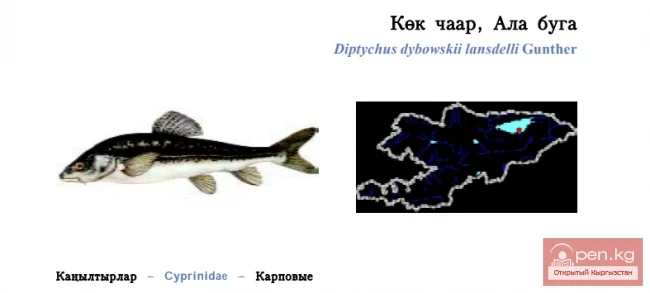
Issyk-Kul Scaleless Osman / Kök Chaar, Ala Buga
Issyk-Kul Scaleless Osman Status: 2 [CR: D]. Lake form, very rare, critically endangered....
Spotted or Diadem, Rat Snake / Charala Soilok / Diadem, or Clifford’s Rat Snake
Spotted or Diadem Snake Status: Critically Endangered (category CR C2b). One of the 4 known...
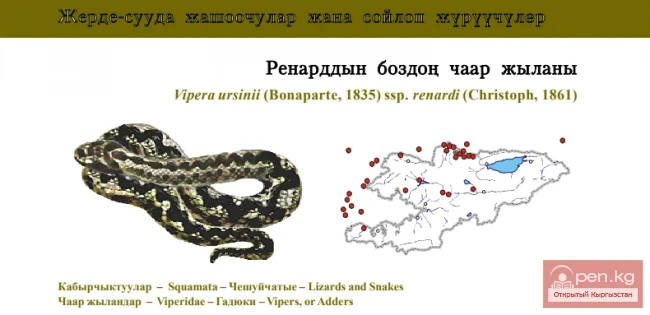
Renard's Meadow Viper
Renard’s Meadow Viper Status: Category VUA4bc. A subspecies of the south-west Palaearctic species,...
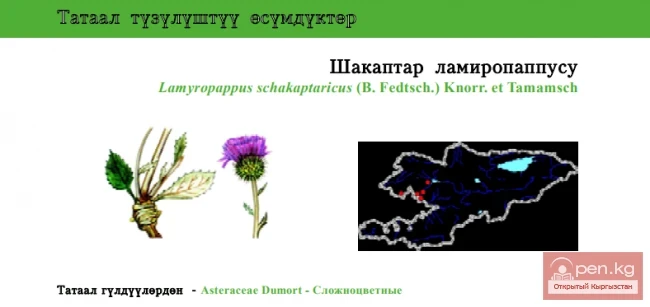
Lamyropappus / Shakaptar Lamyropappus / Lamyropappus
Lamyropappus schakaptaricus Status: VU. A rare representative of a monotypic genus....
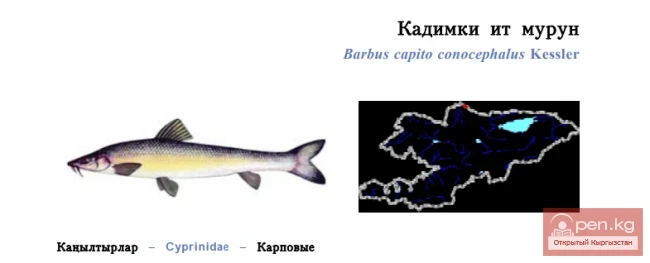
Turkestan Barbel / Kadimki It Murun / Turkestan Barbel
Turkestan Barbel Status: 2 [VU: D]. A subspecies that is endangered in Kyrgyzstan. One of...
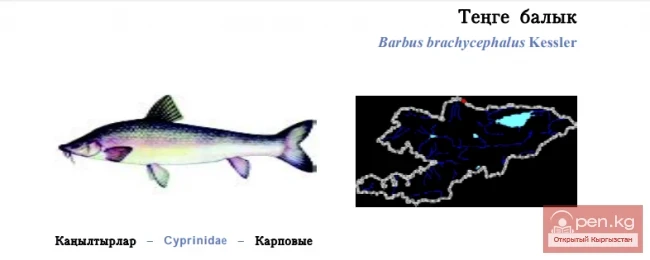
Aral Catfish / Tenge Fish / Aral Barbel
Aral Barbel Status: 2 [CR: C]. Species extinct in Kyrgyzstan....
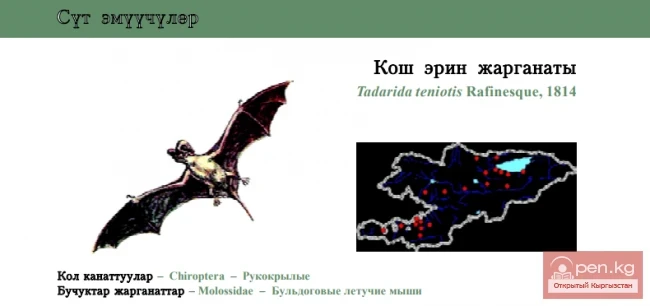
Broad-eared bat / Erin's bat / European Free-tailed bat
Broad-eared bat Status: Category VII, Lower Risk/least concerned, LR/lc....
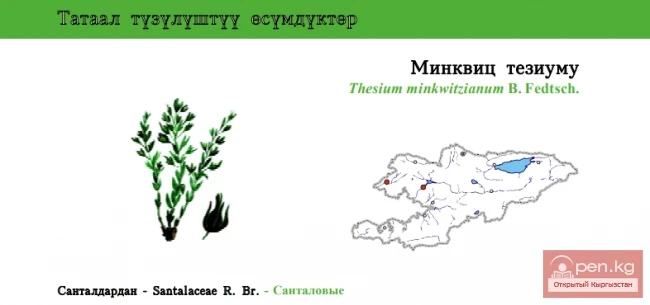
Minkwitz's Bastard Toad-Flax
Minkwitz’s Bastard Toad-Flax Status: CR. Subendemic. An extremely rare relict plant that is...
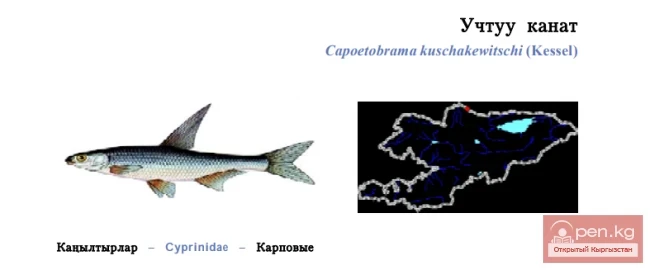
Chuya Sharp-wing / Uchtoo Kanat / Eastern Ostroluchka
Chuy Ostroluchka Status: 2 [CR: C]. Possibly already extinct in Kyrgyzstan, an endemic...
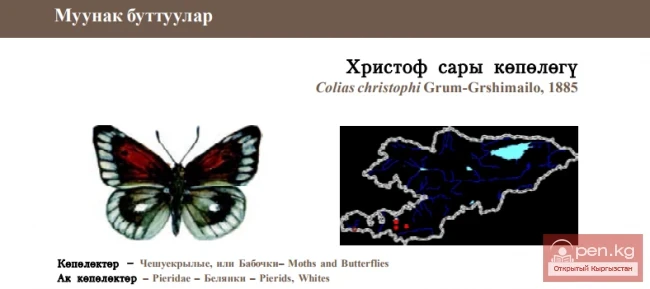
Christoph's Clouded Yellow
Christoph’s Clouded Yellow Status. Category II (VUBlac(v)+2ac(v); D2). Vulnerable species, a...
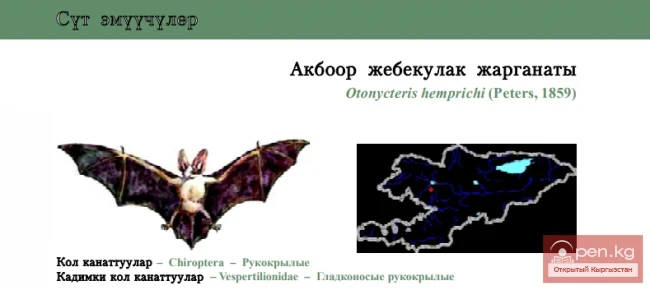
White-bellied Long-eared / Akboor Jebekulak Bat / Desert Long-eared, or Hemprich’s Arrow-eared, Bat
Desert Long-eared Bat Status: Category VII, Lower Risk - Least Concern, LR/lc....
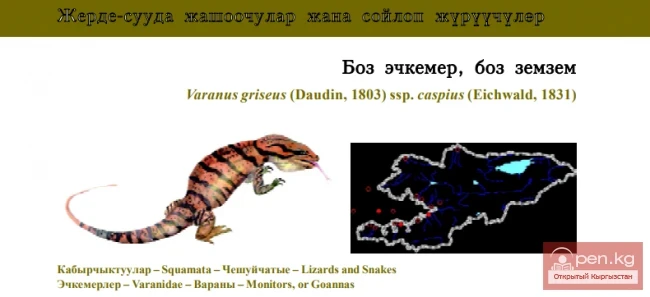
Gray Monitor / Boz Echkemer, Boz Zemzem / Transcaspian Desert Monitor
Gray Monitor Status: Category CR A4bc; E. In Kyrgyzstan - fragmented populations of the declining...
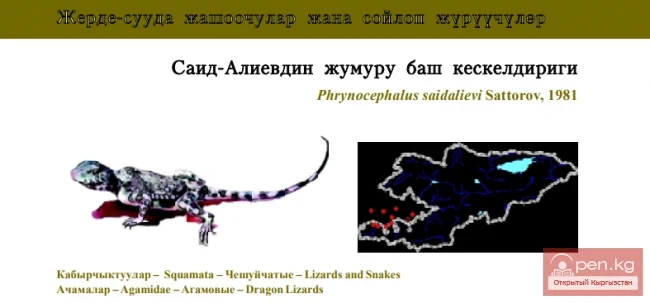
Said-Aliev's Round-Headed Agama / Said-Aliev's Toad Agama / Said-Aliev’s Sunwatcher
Said-Aliev’s Toad Agama Status: Vulnerable (category VUBlab(iii)). A narrowly distributed relic...
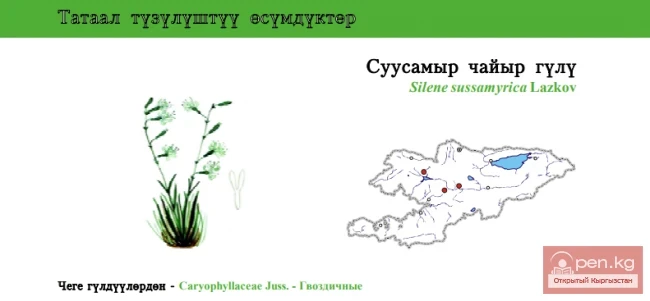
Susamyr Catchfly
Susamyr Catchfly Status: EN. A rare species found in small numbers and in a limited area, which...
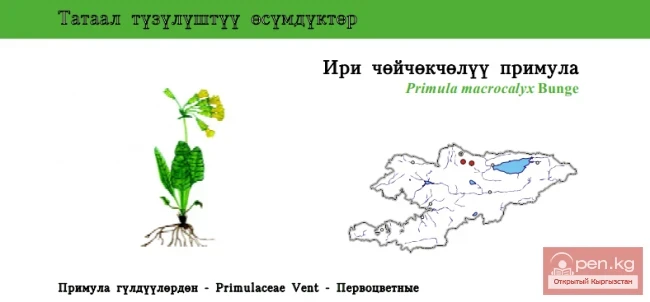
Large-calyxed Primrose
Large-calyxed Primrose Status: VU. In Kyrgyzstan, it is a very narrowly distributed, rare,...
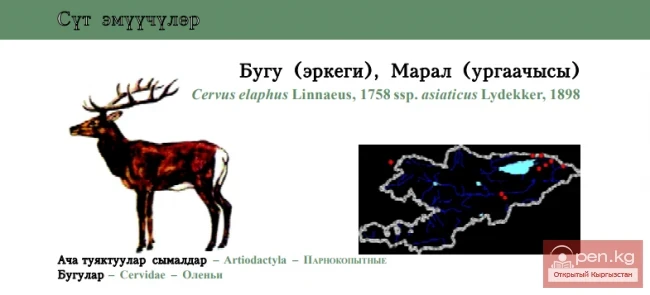
Noble Deer (Tien Shan subspecies), Maral / Bugu (male), Maral (female) / Asiatic Red Deer, Tien Shan Maral, Tien Shan stag
Noble deer (Tien Shan subspecies), Maral Status: Category IV, Endangered, EN C2a(i): R. A sharply...
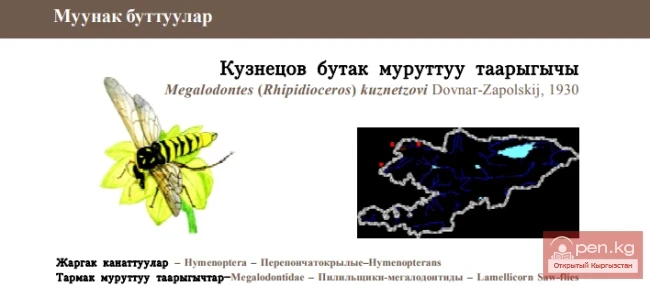
Kuznetsov's Megalodont / Kuznetsov's Lamellicorn Saw-fly
Kuznetzov’s Lamellicorn Saw-fly Status: II category (VU B1ab(iii)+2ab(ii,iii,iv); D2; E). A rare...
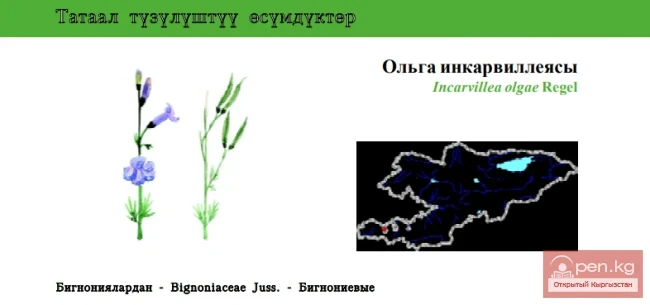
Olga's Incavillia / Olga's Incavillia / Olga’s Chinese Trumpet-creeper
Incarvillea olgae Status: CR B2ab(iii). A very rare, critically endangered ancient species...
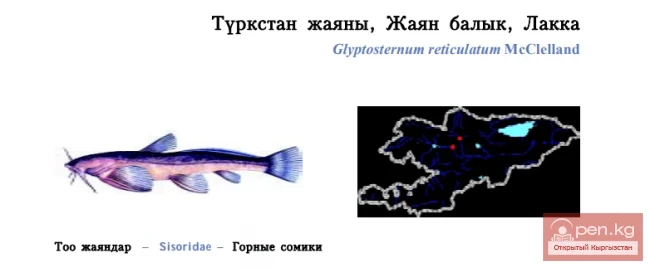
Turkestan Catfish / Turkestan Zhayany, Zhayany Fish, Lakka
Turkestan Catfish Status: 2 [VU: E]. The only representative of the genus in Kyrgyzstan....
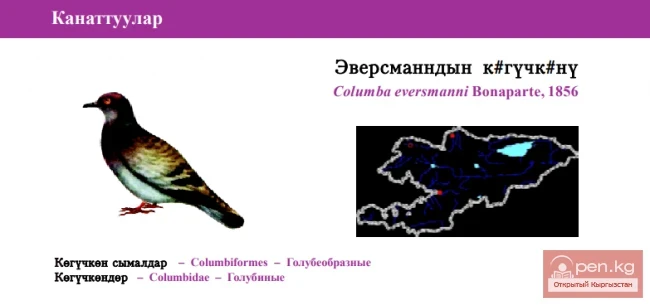
Brown Dove / Eversmann's Dove / Pale-backed Pigeon, Yellow-eyed Pigeon
Brown Pigeon Status: V category, Vulnerable, VU, A2bcd+3bcd. Vulnerable. One of six species in the...
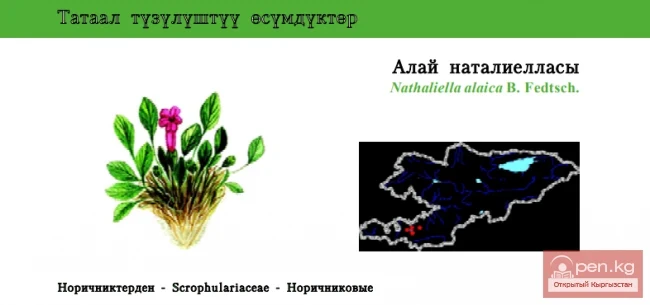
Nathaliella Alai / Alai Nathaliella / Nathaliella
Nathaliella alaica Status: CR B2ab(iii). A rare, endemic species of a monotypic genus of Himalayan...
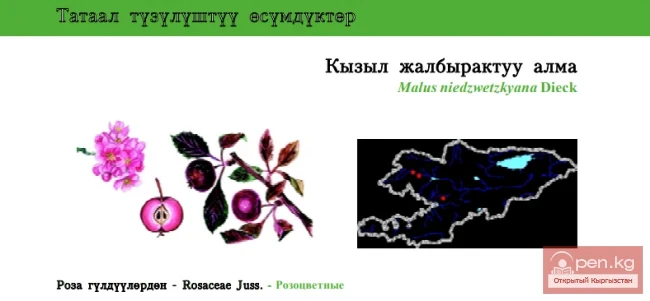
Niedzvetzki’s Apple-tree \ Red-leaved Apple
Niedzvetzki’s Apple-tree Status: VU. Very rare, endemic, endangered species with a small...
Wrapped Alpine Saw-wort
Wrapped Alpine Saw-wort Status: VU. Rare species. Found in Kyrgyzstan at the edge of its range....
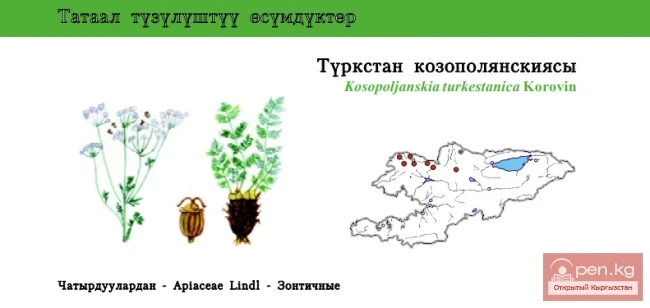
Kosopolyan Turkestan / Turkestan Kosopoljanskia
Kosopoljanskaya Turkestanian Status: VU. One of the two endemic species of this genus found in...
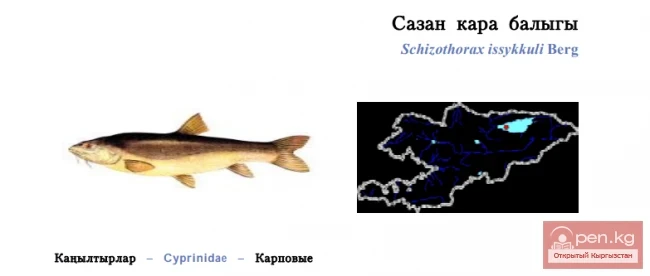
Issyk-Kul Marinka / Carp Fish / Issyk-Kul Marinka
Issyk-Kul Marinka Status: 2 [EN: D]. A rare taxon inhabiting Lake Issyk-Kul. Its...
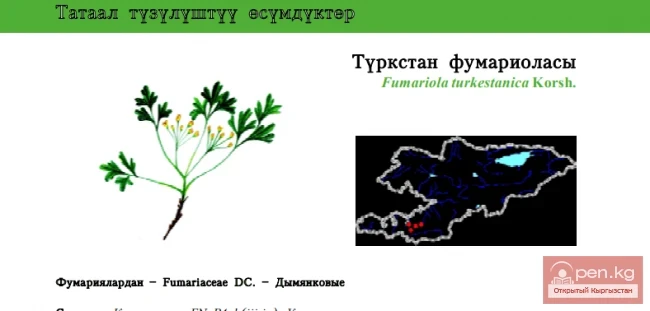
Turkestan Smoke Plant / Turkestan Fumitory / Microfumitory
Turkestan fumitory Status: Category ENBlab(iii,iv). A representative of the monotypic [60,...
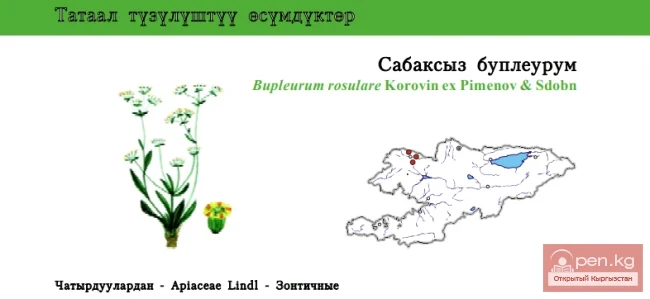
Rosetted Thorough-wax / Sabaksyz Bupleurum / Volodushka Rosetochnaia
Rosetted Thorough-wax Status: VU. Rare species. One of six species of the genus found in...
Five-horned Hardhead / Besh Muyuzduu Sclerotaria / Sclerotiaria
Sclerotiaria pentaceros Status: CR B2ab(iii). Endemic to a monotypic genus....
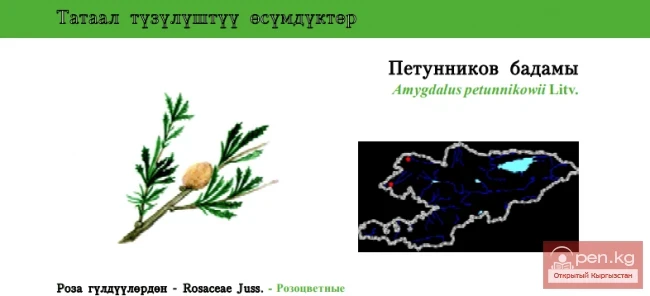
Petunnikov's Almond
Petunnikov’s Almond Status: VU. One of 40 species growing from the Mediterranean to Central Asia....
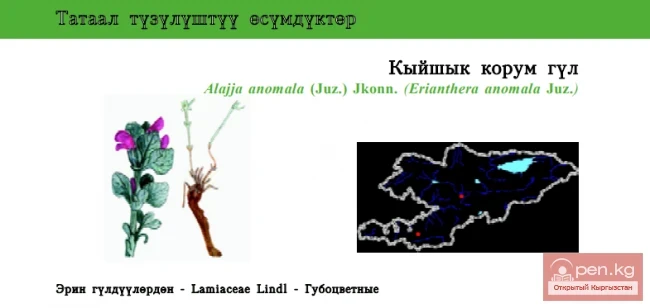
Alajja (Eryantera) Deviating / Kıyshyk Korum Gul / Anomalous Alajja
Anomalous Alajja (Erianthera anomala) Status: VU. Endemic to the mountains of Central Asia. A rare...
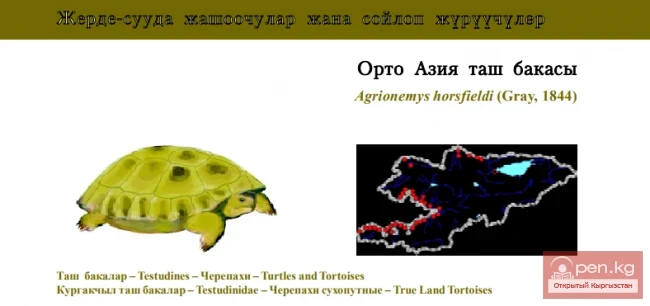
Central Asian Tortoise \ Orto Asia Tortoise / Steppe, or Afghan, Tortoise
Central Asian Tortoise Status: VU Blab (ii, iii, v); Cl. A representative of a monotypic genus,...
Pink Tulip / Little Red Mandala / Pink Tulip
Pink Tulip Status: EN. A narrowly endemic species of the foothills of the Turkestan Range, sharply...
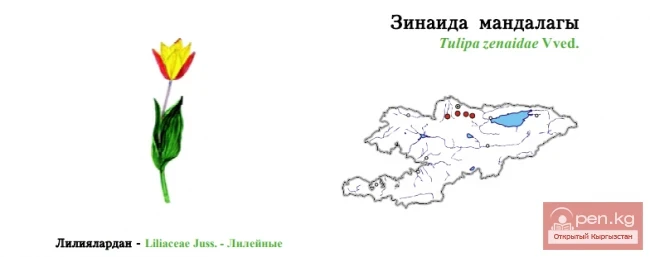
Zenaida's Tulip / Zinaida Mandala
Zenaida’s Tulip Status: VU. A narrowly endemic species of the Kyrgyz Ridge, at risk of rapidly...
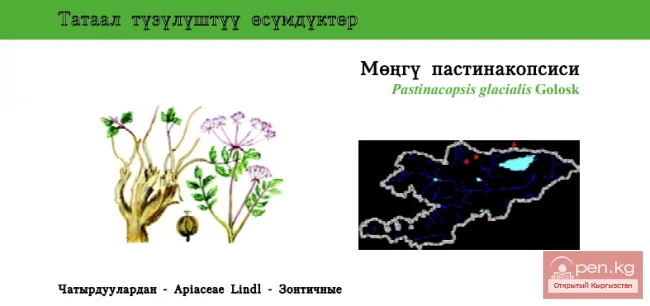
Pasternak's Glacier / Miongu Pastinacopsis / Pastinacopsis
Glacial Pastinacopsis Status: EN. A rare endemic species of a monotypic genus in the Northern Tien...
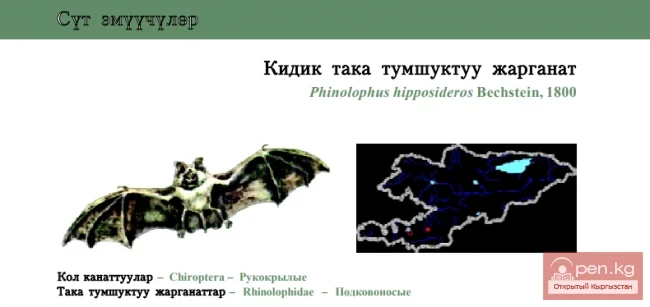
Lesser Horseshoe Bat / Kidik Taka Tumshuktyu Jarganat / Малый подковонос
Lesser Horseshoe Bat Status: Category VI, Near Threatened, NT: R. A species with a declining...
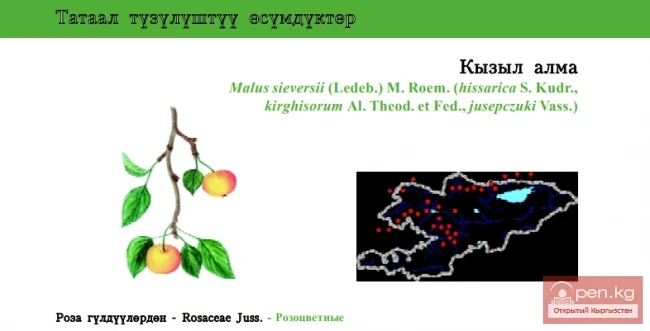
Sievers’s Apple-tree \ Kyzyl Alma \ Sievers’s Apple-tree
Sievers’s Apple-tree Status: LC category. A polymorphic species of the mountain-central Asian...
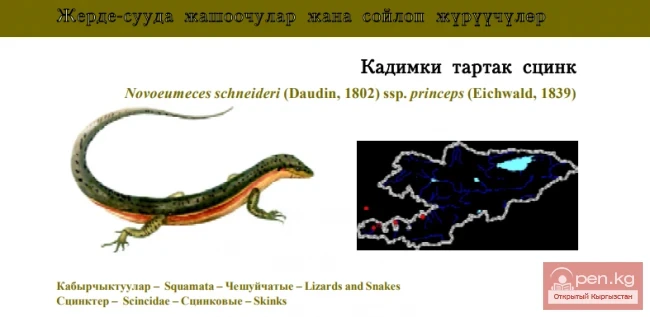
Schneider's Gold Skink / Kadimka Tartak Skink
Schneider’s Gold Skink Status: Category ENB1ab(iii). A sporadically distributed south-Turanian...
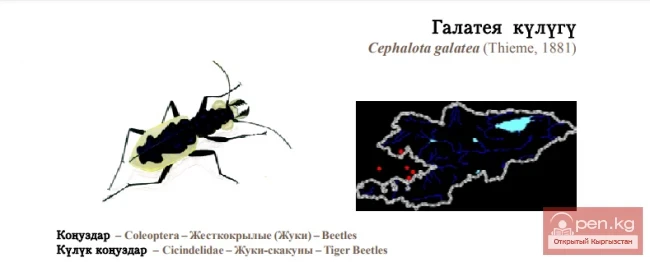
Galatea Steed / Galatea Bug / Galatea Tiger Beetle
Galatea Tiger Beetle Status: Category I (EN B1ab(iv)+2ab(iii,iv)). A narrowly endemic species with...
Vvedensky's Sage / Vvedensky Sage, Vvedensky Kyok Bashy / Vvedensky’s Sage
Vvedensky’s Sage Status: VU. A very rare narrowly endemic species. An ornamental plant....
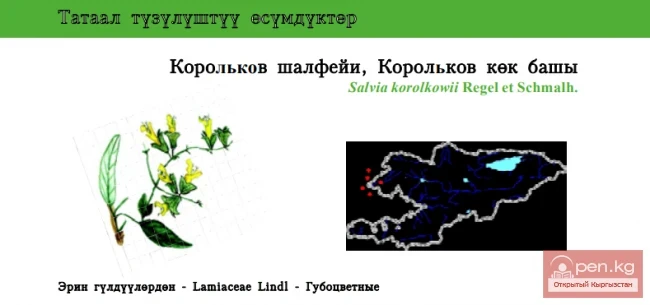
Korolkov's Sage / Korolkov Sage, Korolkov Kyok Bashy
Korolkov’s Sage Status: VU. A rare narrow endemic species. A highly decorative plant....
Adverse Natural Disastrous Processes
A specific form of natural conditions is represented by the internal adverse dangerous natural...