History

{title}
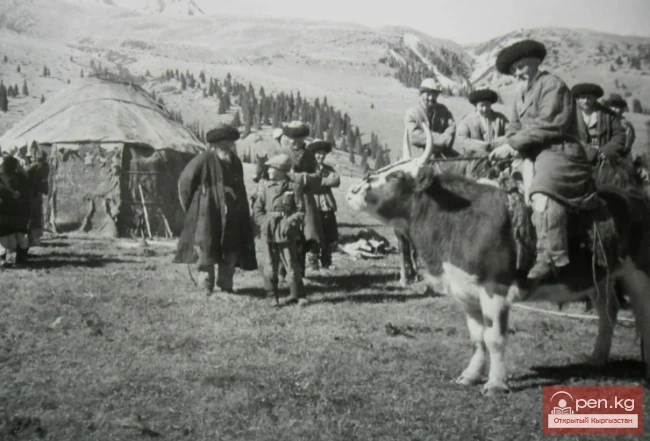
Kyrgyz in antiquity
{title}
Kyrgyz in the VI-XII centuries
{title}
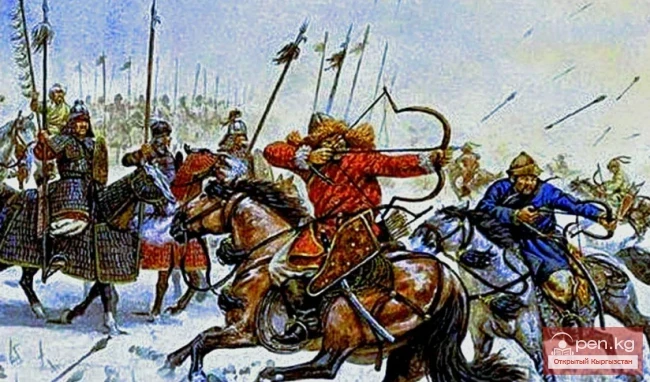
Kyrgyz in the XIII—first half of XVIII century
{title}
The struggle for the independence of the Kyrgyz
{title}
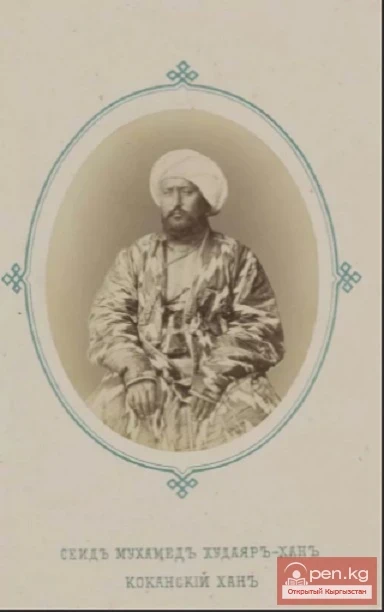
Kyrgyzstan as part of Russia
{title}
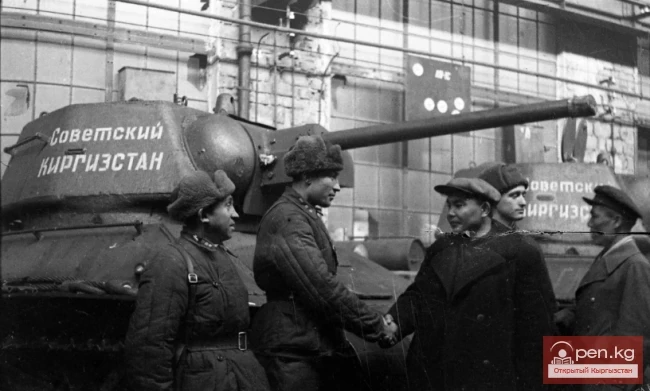
Kyrgyzstan during the Soviet period
{title}
Kyrgyzstan — a sovereign state
{title}
Historical records
{title}
Kurmanjan Datka
{title}
Chagatai Ulus. Haidu State. Moghulistan
{title}
History and archeology of the ancient Tien Shan
{title}
Peoples movements of Central Asia in the XIX century
{title}
Kyrgyzstan during the Great Patriotic War
{title}
Kyrgyzstan in the 1920s
{title}
1937 in Kyrgyzstan
{title}
Shabdan Baatyr
Creation of the Anti-Hitler Coalition of Three Powers
Kyrgyzstan during the Great Patriotic War

Creation of the Anti-Hitler Coalition of Three Powers

The Coalition of Three Powers Against Hitler As a result of the active resistance of the Soviet Armed Forces, the enemy suffered significant losses in the first battles. By mid-July, the German army had lost nearly 100,000 soldiers and officers and about half of the tanks operating on the Soviet-German front. From June 22 to July 19, 1941, the German Air Force lost 1,284 aircraft. The total losses of the enemy's ground forces by the end of June exceeded 213,000 personnel. The calculations

25.11.2021, 15:07
The Influence of Islam on the Kyrgyz People
Chagatai Ulus. Haidu State. Moghulistan

The Influence of Islam on the Kyrgyz People

The Influence of Islam on Kyrgyz Rituals On the map of the Liao era (916—1125) and Northern Song (960—1279), the Kyrgyz are shown west of Ushi and Aksu, south of the Tashagan River (a tributary of the Tarim River), the Kashgar River, and the settlements of Barchuk, north of Upper Atush (Artudzh) and Lower Atush. In general, the nomadic territories of the Kyrgyz are located east of the Karakhanids and west of the Uyghurs, i.e., on the border between the Karakhanids and Uyghurs. According to

23.11.2021, 19:38
The Assistance of Batyr Shabdan to the Royal Military Detachment
Peoples movements of Central Asia in the XIX century

The Assistance of Batyr Shabdan to the Royal Military Detachment

Suppression of the Uprising of the Nomads of Alai and Gulchi In mid-1876, Shabdan, along with his 25 horsemen, actively participated in suppressing the uprising of the nomads of Alai and Gulchi. In July of the same year, the residents of these areas, numbering 2,000 people, refused to accept Russian citizenship and resisted the imperial punitive detachment led by Captain Kuropatkin, who was seriously wounded during the clash. The leaders of the rebels were Abdullabek, Omorbek, Sulayman

22.11.2021, 12:22
Unanswered Letters of Yu. Abdrakhmanov to Stalin
1937 in Kyrgyzstan

Unanswered Letters of Yu. Abdrakhmanov to Stalin

On the Distortion of the National Policy of the Party in Practical Work The ineffectiveness of the triple planning system, amid the gradual weakening and reduction of the role of the all-federal national governing body, was evident. All three planning and regulatory bodies (the USSR, the RSFSR, and the Central Asian) believed that the implementation of the planned activities in the republic should proceed along a different subordination line, "nodding to each other." The ECOCO of

21.11.2021, 20:18
Establishment of Military Administration in Fergana Region
Kurmanjan Datka

Establishment of Military Administration in Fergana Region

Military-Police Administration As we can see, the ancient city at the beginning of Russian rule represented a Gordian knot of everyday and other problems. This, of course, highlighted the necessity for competent and effective governance. Let us take a closer look at its system. The Fergana Region, established on February 19, 1876, after the liquidation of the Kokand Khanate, was part of the Turkestan General Governorship and housed a dense network of military units within its territory. I

16.11.2021, 18:11
Tribal Structure and Way of Life of the Kyrgyz During the Period of Bolshevization
Kyrgyzstan in the 1920s

Tribal Structure and Way of Life of the Kyrgyz During the Period of Bolshevization

The Kyrgyz During the Bolshevization Period One should not think that the collective responsibility and subordination to one's clan, the traditional customs and norms were perceived by the nomad as a violation of human rights or an affront to his individuality. The clan structure and lifestyle were perceived not abstractly, but concretely — as an obligation to perform certain tasks, to herd livestock, to participate in raids, to protect the clan, to serve guests, at celebrations,

14.11.2021, 12:07
The First Heroes: Kyrgyzstanis at the Beginning of World War II
Kyrgyzstan during the Great Patriotic War

The First Heroes: Kyrgyzstanis at the Beginning of World War II

The First Heroes from Kyrgyzstan In the very first days of the war, fierce and bloody battles broke out. Soviet soldiers of all nationalities, in an incredibly difficult and complex situation, stood shoulder to shoulder, persistently and selflessly repelling the fierce onslaught of the enemy, going on the counterattack, and more than once forcing him to flee. One of the most brilliant pages in the history of the Great Patriotic War was written by the defenders of the border Brest Fortress.

13.11.2021, 23:18
The Infiltration of the Yenisei Kyrgyz into the Tian Shan
Chagatai Ulus. Haidu State. Moghulistan

The Infiltration of the Yenisei Kyrgyz into the Tian Shan

The Infiltration of Yenisei Kyrgyz into the Tian Shan Our task is to examine the issues regarding the movement of part of the Yenisei Kyrgyz to the southwest in the 9th century and their settlement in Semirechye and the Tian Shan. Written sources confirm the resettlement of a significant part of the Uyghurs led by Prince Pan-Tegin and the court minister to the western regions of Eastern Tian Shan.

11.11.2021, 19:36
Clashes of Rebels with Tsarist Punishers in the Summer of 1876
Peoples movements of Central Asia in the XIX century

Clashes of Rebels with Tsarist Punishers in the Summer of 1876

Uprisings of Indigenous People for Their Independence in the Summer of 1876 In the summer of 1876, several uprisings of indigenous people for their independence occurred in the same Alaï and in the area bordering Karategin. At the end of May and the beginning of June, herders migrating between Varukh and the Soq Gorge rose up. Their numbers reached up to 400 people. The uprising was led by Abdurakhman-mulla and Abdul-Karimbek, the nephew of Khudoyar-khan, who pursued their own selfish

10.11.2021, 16:41
Triple "Citizenship" of the Kyrgyz Republic in the 1920s-1930s
1937 in Kyrgyzstan

Triple "Citizenship" of the Kyrgyz Republic in the 1920s-1930s

Triple Subordination of the Kyrgyz ASSR Studying documents from the 1920s to the early 1930s, including those reflecting the activities of such a colorful figure as Yu. Abdrakhmanov, in his position as Chairman of the Council of People's Commissars of the Kyrgyz Autonomous Republic, one inevitably comes to the thought expressed by T. Yu. Krasovskaya in her publication "NEP and the Leadership of National Cultures Development." “Is it clear to us,” she writes, “to envision Stalin

08.11.2021, 08:59
Treaty of Friendship between the Kyrgyz and Kazakhs in August 1847
Shabdan Baatyr

Treaty of Friendship between the Kyrgyz and Kazakhs in August 1847

TREATY OF FRIENDSHIP BETWEEN THE MANAPS AND BIYS OF THE KYRGYZ AND THE SULTANS AND BIYS OF THE ELDER AND MIDDLE JUZ OF THE KAZAKHS, AMONG THE SIGNATORIES OF WHICH WAS JANTAY ATEKIN (KARABEK UULU) Fortress Kopal August 22, 1847 a) "On the 22nd day of August 1847. We, the undersigned biys of the Kyrgyz people, sent by the trust of our people to the border chief of the Siberian Kyrgyz, Major General Vishnevsky, have made this agreement as follows:

07.11.2021, 08:20
Construction and Improvement of the "New" Osh
Kurmanjan Datka

Construction and Improvement of the "New" Osh

Construction of the "new" city The location for the construction of the "new" city, which occupied an area of 95 desyatins, was chosen by the imperial authorities a bit south of the "old" Osh, upstream along the Ak-Buura River. In its layout, the new city part, where the streets were laid out in a checkerboard pattern and intersected at right angles, favorably distinguished itself from "native" Osh and other ancient Central Asian cities and settlements

05.11.2021, 22:50
Traditional Consciousness of the Kyrgyz People
Kyrgyzstan in the 1920s

Traditional Consciousness of the Kyrgyz People

Moral and Ethical Norms of the Kyrgyz From the perspective of a modern person, it seems not difficult to imagine the social structure of Kyrgyzstan at the beginning of the 20th century, to distinguish between exploiters and the exploited, and to discover the close connection between the manaps and bai with tsarism, Russian landowners, and the bourgeoisie. We have been trained for too long and too persistently to think within the framework of class struggle that we have completely forgotten how

01.11.2021, 09:58
Kyrgyz
Chagatai Ulus. Haidu State. Moghulistan

Kyrgyz

Kyrgyz K. A. Pishulina rightly points out that only those tribes and clans that participated in the political life of Moghulistan are mentioned in written sources. Among the tribes that remained outside the attention of contemporary historiographers are the Nayman, Jalair, and Kipchak. Undoubtedly, they were inhabitants of the state of Moghulistan. As is known, the Mongolian tribe Nayman appeared in Semirechye after their defeat by Genghis Khan in 1208 on the Irtysh River. It should be noted

28.10.2021, 11:01
Decision of the Central Committee of the VKP(b) on the Removal of Yu. Abdrakhmanov from the Position of Chairman of the Council of People's Commissars of the Kirghiz ASSR
1937 in Kyrgyzstan

Decision of the Central Committee of the VKP(b) on the Removal of Yu. Abdrakhmanov from the Position of Chairman of the Council of People's Commissars of the Kirghiz ASSR

Removal of Yu. Abdrakhmanov from the post of Chairman of the SNK of the Kirghiz ASSR The errors exposed and condemned at the June plenum of the regional committee characterize the presence of an unacceptable anti-state tendency within the bureau of the regional committee, opposing local interests to state interests, essentially reflecting the kulak-bai resistance to the tasks of the proletarian state and representing a rightward deviation from the general Bolshevik line... The bureau of the

27.10.2021, 21:58
Patriotism of Kyrgyzstanis in the First Days of the Great Patriotic War
Kyrgyzstan during the Great Patriotic War

Patriotism of Kyrgyzstanis in the First Days of the Great Patriotic War

Readiness of Kyrgyzstanis to Defend the Motherland On the very first day of the war, June 22, 1941, the Communist Party and the Soviet government appealed to the people with a call to stand up for the great achievements of October. “Our cause is just. The enemy will be defeated. Victory will be ours!”—these slogans of the party instilled in the peoples of the USSR faith in their strength, in the triumph of the righteous cause, expressing their unwavering confidence in the victorious outcome of

24.10.2021, 19:58
Osh in the Early 20th Century
Kurmanjan Datka

Osh in the Early 20th Century

Growth of the City in the Early 20th Century Little expanding in the pre-war years due to its surroundings, Osh did not rise in height either, except for the increasing number of minarets by 1917 at the mosques. The spatial growth of the city, more precisely its residential part, is associated with the construction of new single-story buildings in the upper part of the city. The following data provides an idea of the growth of residential construction: at the end of the 1870s, there were about

22.10.2021, 18:21
Features of the Group Consciousness of Kyrgyz Nomads
Kyrgyzstan in the 1920s

Features of the Group Consciousness of Kyrgyz Nomads

Narrow Mindset of the Kyrgyz Nomad The proposed general scheme of the evolution of consciousness aims to show what horizons can be revealed by understanding the characteristics of historical types of consciousness in the study of Kyrgyz history and history in general. Let’s clarify this with specific examples. Historical psychology is a young science, and there is still much that is unclear and undiscovered in it, so the first results of its application in specific historical analysis can only

18.10.2021, 20:17
Heterogeneous Anticolonial Protests Against Tsarist Authority
Peoples movements of Central Asia in the XIX century

Heterogeneous Anticolonial Protests Against Tsarist Authority

Protests Against Tsarist Colonial Power by the Kyrgyz The anti-colonial protests were also a reflection of the uprising of 1873–1876, led by the aforementioned associates of Pulat-khan. It was directed against the tsarist colonial authority and had a national liberation character. Its eyewitness V.L. Tageev justifiably wrote: "An uprising erupted in Alai. The mountain settlement of Alai boiled and stirred, and bands (a group of rebels—K.U.) of brave batyrs began to swell with new forces.

17.10.2021, 17:43
Choros, Suldus, Tatars, Turkmen, Uyghurs, Minalagi, Nuygut, Ordabegi
Chagatai Ulus. Haidu State. Moghulistan

Choros, Suldus, Tatars, Turkmen, Uyghurs, Minalagi, Nuygut, Ordabegi

Minlaga, Noyguts, Suldus, Tatars, Turkmen, Uyghurs, Ordabegi, Churasi Minlaga (Minalaga) — their origin is unknown. They were mentioned in the battle involving the aforementioned Uldja-Buga-muchalachi from the Kauchins against Kamar ad-Din to the east of the Ili River. There are no other known accounts of them. Noyguts (Nuyguts) — a tribe of Mongolian origin. The name of a companion of Sultan Said-khan, Tubra Noygaus (Tubra Noyagut, Tubra Noyguts), appears in sources. In the 16th century,

16.10.2021, 16:16
Sharp protest by Yu. Abdrakhmanov against arbitrariness during grain procurement
1937 in Kyrgyzstan

Sharp protest by Yu. Abdrakhmanov against arbitrariness during grain procurement

Searches in Peasant Yards During Grain Procurement Chairman of the Council of People's Commissars of the Kyrgyz ASSR Yu. Abdrakhmanov, carrying out the corresponding directive from the Central Asian Bureau, went on a long business trip to the cotton-growing regions of the Osh district. In the Bazar-Kurgan district, he met with I. Zelensky at a meeting held here regarding the issue of "cotton extraction." It was here that measures were developed that differed from previous ones

12.10.2021, 23:32
The Beginning of the Great Patriotic War
Kyrgyzstan during the Great Patriotic War

The Beginning of the Great Patriotic War

Pirate Attack by German-Fascist Invaders The German-Fascist command, intoxicated by easy victories in Europe, sought to quickly conquer world domination. However, the main obstacle in the way of this aggressive campaign was the Soviet Union — the only socialist state on the planet. This is why its defeat was viewed by the Nazi military-political leadership as a decisive step toward achieving their adventurous goals. The German General Staff had developed a plan for military operations against

11.10.2021, 14:39
Transition from One Historical Type of Consciousness to Another in Kyrgyz Society
Kyrgyzstan in the 1920s

Transition from One Historical Type of Consciousness to Another in Kyrgyz Society

Class Societies by Social Structure Each type of consciousness, until a certain point, of course, corresponded to society and satisfied its needs. Therefore, it is not appropriate to interpret each previous stage as primitive or elementary. “Primitive,” “archaic,” “barbaric,” “mythological” consciousness is by no means primitive and is called so due to its antiquity and originality. It is important to emphasize that all three types of consciousness do not exist in a “pure” form. Each of them

05.10.2021, 10:08
Defeats of Abdullabek by Skobelev's Punitive Detachment
Peoples movements of Central Asia in the XIX century

Defeats of Abdullabek by Skobelev's Punitive Detachment

Attracting Kurmanjan Datka to the Side of the Tsarist Authority On April 25, 1876, punitive forces approached Yangy-Aryk, where the participants of the uprising were vigorously preparing for a decisive resistance. The rebels blocked the path leading to them, set up several rows of stone barricades, and dismantled the bridge over the river. They believed their position was impregnable. However, they soon saw the punitive detachment, and a battle ensued. As noted in an archival document, a

04.10.2021, 20:38
Kazakh, Konchi, Karlaut, Mekrit, Kushchi
Chagatai Ulus. Haidu State. Moghulistan

Kazakh, Konchi, Karlaut, Mekrit, Kushchi

Kazakh, konchi, karlaut, mekrit, kushchi Konchi — their progenitor, a merchant from Khorezm, accompanied Khizr-Khodja in his flight among others. Under Esen-Buka, along with other tribes, they caused disorder in the country. Their notable emir was Mir Khodja, whose daughter was married to Yunus-khan. Later, the konchi received a new name, sagrychi. Both names mean "tanner." Karlaut — a Mongolian tribe. They are first mentioned in the territory of Moghulistan during the reign of

02.10.2021, 15:48
Order of Prince A. Vyazemsky on the Escort of Deputy Abdrakhman Kuchakov to the Fortress of St. Peter
Shabdan Baatyr

Order of Prince A. Vyazemsky on the Escort of Deputy Abdrakhman Kuchakov to the Fortress of St. Peter

ORDER OF PRINCE A. A. VYAZEMSKY TO THE ADJUTANT OF THE SIBERIAN DRAGOON REGIMENT SIPAYLOV REGARDING THE ESCORT OF THE ENVOY ETEKE BAGADUR ON HIS RETURN JOURNEY, TO SHOW HIM CARE AND DUE RESPECT January 23, 1787 Upon the arrival of the time for the return of the envoy sent to the Court of Her Imperial Majesty from the chief of the Kyrgyz nomads in the remote steppe between the stone mountains, Etike Bagadur, Deputy Abdrakhman Kuchakov, along with his servant, I instruct you for the case of his

29.09.2021, 08:22
Negative Consequences of "Stalinist" Collectivization in Kyrgyzstan
1937 in Kyrgyzstan

Negative Consequences of "Stalinist" Collectivization in Kyrgyzstan

Pressure on Peasantry through Collectivization Y. Abdrakhmanov was a staunch opponent of administrative arbitrariness towards the peasantry. At the regional party conference in June 1930, when the negative consequences of collectivization "Stalin-style" became evident, especially in the outskirts of the country, in Kyrgyzstan, in the livestock zone, he said: "Cooperation is the highway to socialism... But how we have treated this highway, how we help cooperation to truly become

29.09.2021, 07:45
Kyrgyzstan on the Eve of the Great Patriotic War
Kyrgyzstan during the Great Patriotic War

Kyrgyzstan on the Eve of the Great Patriotic War

Kyrgyzstan on the Eve of the Great Patriotic War Alongside the expansion of the industrial base, measures were taken to further boost agricultural production. By the decree of the Central Committee of the All-Union Communist Party (Bolsheviks) and the Council of People's Commissars of the USSR dated April 7, 1940, starting from the harvest of 1940, a per-hectare principle for the procurement of agricultural products in crop production and animal husbandry was introduced in collective

27.09.2021, 21:17
The view of Osh through the eyes of foreign travelers in the late 19th century.
Kurmanjan Datka

The view of Osh through the eyes of foreign travelers in the late 19th century.

Description of Osh by Foreigners Brief but curious descriptions of Osh, its old and new urban areas, were left by Russian and foreign travelers. For example, Guillaume Capu, a participant in the French-Kyrgyz expedition to Pamir in the 1880s, noted: “From the height of the terrace of the district chief's house... we have a view of the city of Osh, resembling a chaotic cluster of yellow adobe houses, huddled among tall poplars, like cobblestones on a large construction site. At its edge

26.09.2021, 11:39
The Word in the Traditional Type of Consciousness of the Kyrgyz
Kyrgyzstan in the 1920s

The Word in the Traditional Type of Consciousness of the Kyrgyz

Traditional Type of Consciousness of the Kyrgyz In the traditional type of consciousness, the reflection of the world occurs predominantly spontaneously, but with elements of awareness and at the level of everyday pre-scientific concepts. As a result, the outcomes of knowledge are expressed quite generally and verbally. These knowledges are usually reduced to the statement of facts, their description, and do not rise to the level of scientific explanation and understanding; they do not form a

22.09.2021, 22:34
Anticolonial Protests of Indigenous Peoples in the Region in the 1880s-1890s
Peoples movements of Central Asia in the XIX century

Anticolonial Protests of Indigenous Peoples in the Region in the 1880s-1890s

Anti-colonial Protests of Indigenous People Although in mid-February the entire territory of the former Kokand Khanate and the southern part of Kyrgyzstan were annexed to Russia, some high-altitude areas, particularly Alay, Gulcha, and Pamir, effectively remained outside the sphere of the Russian Empire. In these hard-to-reach areas, former associates of the executed Pulat-khan found refuge from the tsarist punitive forces: Abdullabek, Omorbek, Sulayman Udaychi, Valikhan-Tyure, and several

21.09.2021, 22:13
Karluks, Katagans, Kauchins, Kereits
Chagatai Ulus. Haidu State. Moghulistan

Karluks, Katagans, Kauchins, Kereits

Karluks, Katagans, Kauchins, Kereits Karluks — a large Turkic tribe of Moghulistan. However, there is almost no information about them in written sources. They are mentioned only as part of the troops of Abu-Bekr and Sultan Said-khan. In the ethnic structure of modern Kyrgyz, there is a Karluk tribe called Boston among the Ichkiliks, a group of Machak — among Chon-Bagys and Saruu, and Kilet — among Chon-Bagys. Katagans (Katakin) — a Mongolic-speaking tribe. They migrated to the Chagatai ulus

20.09.2021, 17:07
The Reception of Kyrgyz Envoys by Empress Catherine II
Shabdan Baatyr

The Reception of Kyrgyz Envoys by Empress Catherine II

FROM THE ENTRY IN THE CHAMBER-FURRIER'S JOURNAL ABOUT THE RECEPTION OF KYRGYZ ENVOYS BY EMPRESS CATHERINE II March 15, 1786 On Sunday, that is, on the fortieth day after the successful delivery of Her Imperial Highness, the Grand Duchess Maria Fedorovna, during which Her Imperial Highness had the fortieth-day prayer and listened to the liturgy in the small court church, where the exit was at 11 o'clock in the morning together with His Imperial Highness, the Tsarevich, and Their

18.09.2021, 11:00
Abdrakhmanov's Approach to the Problems of Economic Construction in the Republic
1937 in Kyrgyzstan

Abdrakhmanov's Approach to the Problems of Economic Construction in the Republic

Horse threshing with stones in the village. 1914 Difficulties in Transforming the Social Psychology of Peasantry. A considerable amount of energy was also required in organizing "Chuystroy" within the framework of the union trust for new agricultural crops. This organization put an end to the artisanal irrigation construction in the Chui Valley and allowed for the most important work for the republic to be carried out on a broad scale, at a modern engineering level for those years.

16.09.2021, 06:00
The Beginning of World War II
Kyrgyzstan during the Great Patriotic War

The Beginning of World War II

The Attack of Nazi Germany on Poland. On September 1, 1939, Nazi Germany attacked Poland. Two days later, England and France—Poland's allies—declared that they were at war with Germany. Thus began World War II. It arose among the imperialist powers between two of their groupings and had a reactionary, aggressive character. In 1940, Nazi Germany occupied Denmark, Norway, Belgium, the Netherlands, Luxembourg, and defeated France. In the spring of 1941, fascist troops invaded Yugoslavia and

15.09.2021, 11:00
The Peaceful Selfless Labor of Kyrgyzstanis in the Pre-War Years
Kyrgyzstan during the Great Patriotic War

The Peaceful Selfless Labor of Kyrgyzstanis in the Pre-War Years

Multinational Workforce of Industrial Workers and Engineering and Technical Intelligentsia on the Eve of War In the process of creating the material and technical base of socialism, multinational cadres of industrial workers and engineering and technical intelligentsia were formed and grew. On the eve of the war, 165.3 thousand workers and employees were engaged in industry, transportation, and construction, in MTS and state farms of Kyrgyzstan, including 36,078 industrial workers compared to

14.09.2021, 17:19
Construction of the New Part of the City of Osh in 1876
Kurmanjan Datka

Construction of the New Part of the City of Osh in 1876

M.E. Ionov with family Construction of the New Part of the City In 1872, the source of headaches for Russian diplomacy, the Kokand Khanate, ceased to exist. On its territory, the Fergana region of the Turkestan General Governorship was formed. The triumph of M.D. Skobeleva in southern Kyrgyzstan did not go unnoticed by the local residents. Having relatively quickly recovered from the shocks of war, they soon felt many advantages of being subjects of a vast empire, living on its outskirts, but

14.09.2021, 11:53
Pulad-Khan — the Poor Kyrgyz Who Became a Khan
Peoples movements of Central Asia in the XIX century

Pulad-Khan — the Poor Kyrgyz Who Became a Khan

Mulla Iskak Asan oglu — Pulad-Khan The most loyal and consistent leader of the uprising of 1873–1876 was Mulla Iskak Asan oglu — Pulad-Khan (1844–1876). As evidenced by a number of archival documents and literary sources, Pulad-Khan was of common origin. The head of the Zaravshan department, A. Abramov, and military historian M. Terentyev emphasize that Pulad-Khan was a simple Kyrgyz. The ruler of Kashgar, Muhammad Yakubbek, and the Shah of Karategin, Muhammad Rahimbay, referred to Pulad-Khan

10.09.2021, 09:31
Itardji, Yarki, Kaluchi
Chagatai Ulus. Haidu State. Moghulistan

Itardji, Yarki, Kaluchi

Itardji, Yarki, Kaluchi Itardji (Itarchi) have been known since the time of Khizr-Khodja-khan. According to Muhammad Haider, Emir Khudaydad Duglat hid the young Khizr-Khodja from the persecutions of Kamar ad-Din and sent twelve people with him, including the ancestor of the Itardji tribe, Ardižrak. Subsequently, Khizr-Khodja, having become the khan of Moghulistan, elevated all those who accompanied him in his flight. Itardji are mentioned in the army of Sultan Said-khan. Later, they became

09.09.2021, 23:13
Letters of Ataka Batyr Tynai Biiy Uulu
Shabdan Baatyr

Letters of Ataka Batyr Tynai Biiy Uulu

LETTER FROM ATAKE BATYR TYNAY BI UULU TO THE COMMANDER OF THE SIBERIAN REGIMENTS GENERAL N. T. OGAREV August 23, 1785 To the esteemed state advisor, friend of the ruler of eternal happiness, equal to the batyr Sulayman and akin to the great padishah Iskender, possessing a four-sided space, the chief elder, serving and having access to the majestic emperor, radiating happiness and goodness, the great welcoming military leader, member of the government, victorious in battles, listening to the

08.09.2021, 22:09
Appointment of Yu. Abdrakhmanov as Chairman of the Council of People's Commissars of the Republic
1937 in Kyrgyzstan

Appointment of Yu. Abdrakhmanov as Chairman of the Council of People's Commissars of the Republic

The Contribution of Yu. Abdrakhmanov to the Economic Development of the Kirghiz ASSR Thanks to the ideological defeat of the supporters of group fighting, a turning point was achieved in the work of the party organization of the republic in 1925-1926. This led to a regrouping of forces and a search for new tactics. The regional party committee implemented significant personnel changes. The leaders of the factions—second secretary of the regional committee Babakhanov, head of the

07.09.2021, 15:47
Industrial Progress in the Republic of Kyrgyzstan on the Eve of the Great Patriotic War
Kyrgyzstan during the Great Patriotic War

Industrial Progress in the Republic of Kyrgyzstan on the Eve of the Great Patriotic War

Kyrgyzstan on the Eve of the Great Patriotic War In February 1941, the workers of Kyrgyzstan celebrated a significant date—the fifteenth anniversary of national socialist statehood. During the days of this glorious anniversary, the Kyrgyz people, with a sense of great pride, summarized the results of the difficult path of struggle and victories achieved under the leadership of the Communist Party within the fraternal family of free and equal peoples of the USSR. The main condition and starting

05.09.2021, 17:05
The Bukhara Invasion of Fergana in the Early 1840s
Kurmanjan Datka

The Bukhara Invasion of Fergana in the Early 1840s

The Bukhara Invasion of Fergana The successful conquest of Kyrgyzstan's territory by the Khans of Kokand was facilitated by inter-clan and tribal feuds among Kyrgyz feudal lords, who refused to unite even in the face of a common enemy. Thus, in late summer 1821, Omar Khan sent Beknazar-biy - his loyal Kyrgyz feudal lord, who led the clan of Kutluk-Seyid and was simultaneously the hakim of the city of Kasana - to subjugate the Kyrgyz of the Sarybagysh clan, who were nomadic near the city

04.09.2021, 18:07
The Evolution of Consciousness - Part of the Overall Process of Historical Development of the Kyrgyz
Kyrgyzstan in the 1920s

The Evolution of Consciousness - Part of the Overall Process of Historical Development of the Kyrgyz

The evolution of consciousness - part of the overall process of historical development of humanity Human mental processes have characteristic historical features that arise from the peculiar conditions of life and social practice of each historical era. These features are determined by the system of social relations, under the influence of which a person exists from the very first steps of their life, and the system of language through which they express their thoughts and feelings. A whole

20.07.2021, 09:46