Struggle for Power and Territories
In the twenty-second year of the reign of Zhenguan, upon receiving news that the Tylek generations had submitted to the House of Than, a messenger was sent from Khagas with local products. The elder Silifa Shibokuy Azhang personally came to the Court. Taizong, entertaining him at the table, said to his nobles: "In the past, on the Beiqiao bridge, I beheaded three Tujue who boasted of many merits. Now Silifa at the table seems to have lost his composure." The intoxicated Silifa expressed a desire to hold Hu-ban (32). The emperor renamed his possessions the Gyan-Gung region. Silifa received a military rank and was appointed chief commander in his region, which was subordinate to the governor of Yanzhan. During the reign of Emperor Gaozong (650—683 AD), he visited the Court twice.
During the reign of Jinglong (706—711 AD), local products were presented. Zhongzong summoned the envoy to himself and said: "Your ruling house comes from the same lineage as mine (the Tang dynasty descended from a steppe Turkic lineage), and I distinguish it from other vassals." During the reign of Emperor Xuanzong (713—755 AD), there were four embassies with local products. In the reign of Qianyuan, in 758, the Khoykhus (Uighurs) conquered this state; after this, Khagas embassies could no longer penetrate the Central State.
Subsequently, the northern nomads mistakenly called Khagas Khakyan'si, which in the Khoykhus language means: red-faced, and this word was also mistakenly pronounced as Gyagyas. This state was always in friendly relations with Dashi (Arabs — O. K.), Tufan (Tibet — O. K.), and Gelolu; but the Tufan feared plundering from the Khoykhus when communicating with Khagas; therefore, they took guides from Gelolu. From Dashi, no more than twenty camels passed with patterned silk fabrics; but when it was impossible to fit everything, they spread it over twenty-four camels. Such a caravan was sent once every three years.
The Khagas ruler received from the Khoykhus khan the title of Piz'ye Tung'ye Jin. But as soon as the Khoykhus began to decline, Ajo declared himself khan, his mother, born of Tutsishi (Turgesh — O. K.), as the widowed khan, and his wife, the daughter of Gelu-shehu, as the khan's wife.
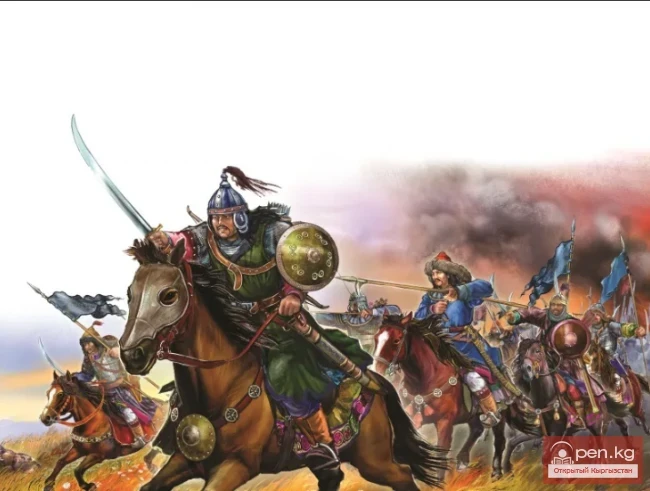
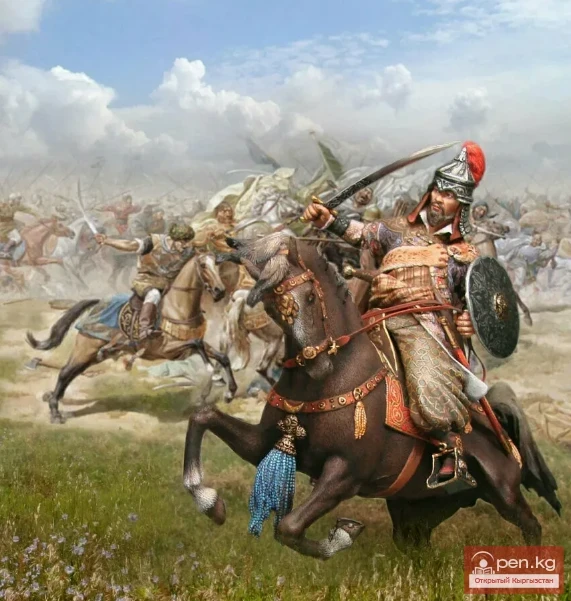
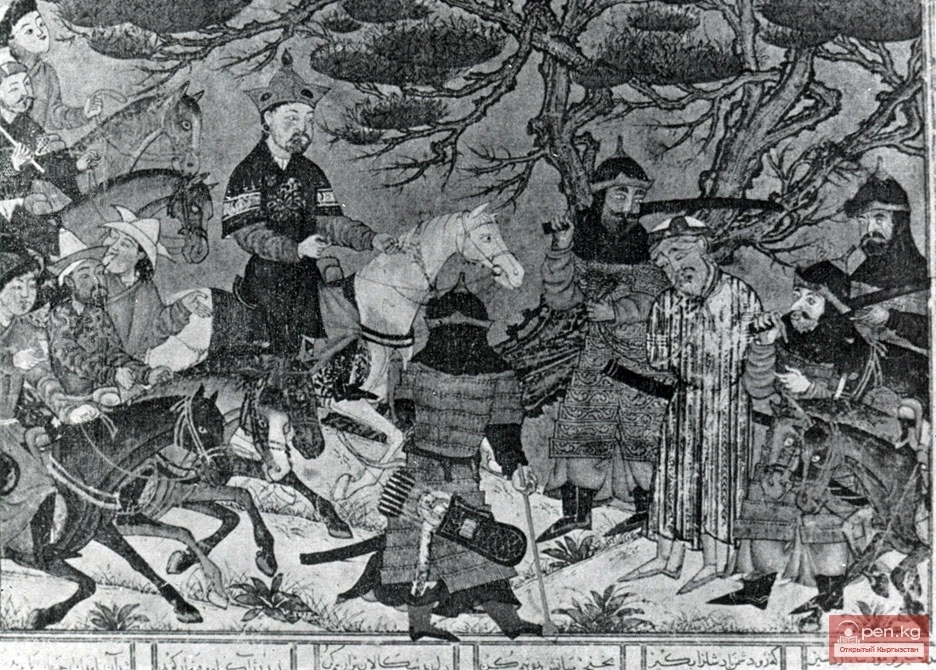
The Khoykhus khan sent a minister with troops, but he was unsuccessful. The khan continued the war for twenty years (33). Ajo, intoxicated with victories, said: "Your fate is over. I will soon take your golden horde, place my horse before it, and raise my flag. If you can compete with me, come immediately; if you cannot, then leave quickly." The Khoykhus khan could not continue the war. Finally, his general Gui'lu Mohe led Ajo into the Khoykhus horde. The khan was killed in battle, and his D'ele scattered. Ajo, under personal command, set fire to the khan's encampment and the residence of the princess. The Khoykhus khan usually sat in a golden tent. Ajo took all his treasures and captured Princess Thai-ho; after which he moved his residence to the southern side of the Lao-shan mountains.