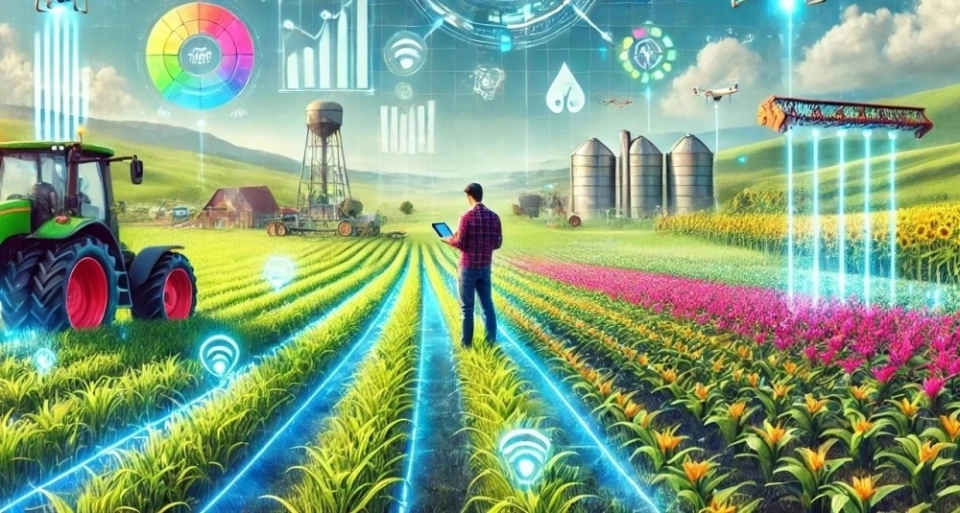
In Central Asia, which includes Kazakhstan, Kyrgyzstan, and Uzbekistan, young farmers, previously seen merely as continuers of traditional agricultural practices, are now becoming pioneers in digital technologies and automation. Although their activities do not initiate large-scale political debates, they significantly accelerate changes in the agricultural sector, outpacing government program actions.
Just two decades ago, the rural areas of the region were perceived as zones of low productivity; however, today they are transforming into platforms for the implementation of innovative technologies such as moisture sensors, agrodrones, and digital logistics. In Kazakhstan, where about 41% of the population lives in rural areas, modernization is particularly active in the southern and western regions. Young farmers here are quickly mastering new methods of managing water resources and fertilizers.
The introduction of moisture sensors has allowed for a reduction in irrigation water consumption by 18–30% on farms where remote monitoring is applied. For example, in the Turkestan region, 600 such devices transmit data to cloud services and automatically regulate drip irrigation. This not only saves resources but also significantly reduces labor costs: one operator now manages 40–50 hectares, whereas previously 4–5 people were required for this task. Despite the fact that government digitalization programs are currently lagging behind demand, young farmers are finding affordable solutions and using their own funds. According to the Farmers' Association, about 27% of new agrost startups are financed through microloans and family investments.
In Kyrgyzstan, where the sizes of agricultural plots are smaller than in Kazakhstan, digitalization is taking a different path. Here, affordable agrodrones play a key role, having decreased in price by 35% over the past three years. This has enabled young drone operators to provide services for field digitization and pest monitoring. For farmers in remote regions, such as Naryn and Batken, this has been a real breakthrough. Previously, assessing the condition of pastures took weeks, but now the same amount of work is done in one to two days. According to the Ministry of Agriculture of Kyrgyzstan, the area of land with digital monitoring has increased from 12,000 hectares in 2020 to 96,000 hectares in 2024. Moreover, the average age of farmers using drones is 28–34 years, making them the youngest segment in the country's agricultural sector.
Uzbekistan, as a traditional agricultural center, emphasizes automation and mechanization through a combination of government programs and private services. The country is actively developing agrost startups with the help of preferential loans at 14–16% for drip irrigation systems and small processing robots. Over the past four years, more than 42,000 microfinance loans have been issued, most of which are aimed at purchasing equipment costing up to $5,000. Young farmers are using these tools to create high-tech farms, including autonomous greenhouses with automatic gas heating and carbon dioxide sensors, which significantly reduces electricity consumption and increases yields.
Despite the differences in approaches to digitalization in different countries, the overall trend shows that the rural population is becoming less dependent on seasonal migration, which previously compensated for income shortages. According to World Bank data, the share of households using remittances as a primary source of investment in agriculture has decreased from 32% to 19% over the past decade. Young farmers are now turning to microloans, crowdfunding, and government subsidies to launch technologically advanced projects.
Regional programs, such as agrostarter grants in Kazakhstan and the "Kenen Maalymat" program in Kyrgyzstan, provide young farmers with access to interest-free loans for the implementation of digital technologies. In Uzbekistan, 17% of startups in the agricultural sector are created by young specialists, indicating a significant change in youth engagement.
The results of the technological revolution in the agricultural sector of Central Asia are already noticeable. In Kazakhstan, productivity on automated farms is 26% higher than on traditional ones. In Kyrgyzstan, fertilizer costs are reduced by 18–40% due to targeted spraying by drones, while in Uzbekistan, water savings in greenhouses reach 30–45%. These changes enhance the region's resilience to climate risks, which is especially important in light of forecasts of potential economic losses due to climate change.
With changes in the rural way of life, new professions are emerging, such as drone operator and agri-data specialist. In Kazakhstan, there are about 1,600 agrotechnologists, in Kyrgyzstan, more than 700 drone operators are registered, and in Uzbekistan, educational programs in digital agriculture are being implemented. This opens up new opportunities for youth in rural areas.
The rural economy is also undergoing changes in resource distribution. Microfinance tools allow farmers to design their farms more efficiently. In Uzbekistan, small farmers with access to preferential loans demonstrate higher profitability, while in Kazakhstan, digital farms have a profitability that is 21% higher than traditional ones. Thus, digitalization not only increases productivity but also contributes to social integration in the agricultural sector.
The quiet transformation of the rural way of life in Central Asia is the result of the efforts of thousands of young people who strive for change without waiting for top-down directives. It is an uneven process, as in some areas access to technology and the internet remains limited, but a cultural shift has already occurred. Agriculture is beginning to be perceived as a field with a future, where new technological enterprises are emerging.
Central Asia has a unique chance to become one of the world centers of agrotechnology thanks to young farmers who can work with data and technology. The rural way of life is not disappearing but transforming, acquiring new qualities: automation, measurability, and resilience. This quiet revolution is changing the structure of water use, migration flows, and financial models, and its consequences will be key to the region's development in the next two decades.
Source: stanradar.com