Localization of the Tribal Groups of the Kyrgyz
Localization of the tribal groups of Kyrgyz
Within the Kyrgyz SSR, several groups known as chala-kazaks lived, but they considered themselves Kyrgyz. One of them resides in the western part of Frunze, in the territory of the former village of Kyzyl-Asker, while two others are located in the Talas Valley. These groups include both descendants of certain Kyrgyz tribes (solto, moңoldor, etc.) and representatives of other nationalities: Uzbeks, Kazakhs, and Uyghurs.
Many of our informants associate the ethnographic group of dolons (or dolan) living in the Xinjiang Uyghur Autonomous Region of China with the Kyrgyz, and they now differ little in language and lifestyle from the Uyghurs. According to them, the dolons themselves acknowledge that they are of Kyrgyz origin. They note that the dolons are physically closer to the Kyrgyz and retain some customs of the neighboring Kyrgyz: goat riding, horse racing, and others. Although V. P. Yudin suggests that the dolons may have originated from the Mongols and is inclined to accept E. R. Tenishev's identification of the ethnonym "dolan" with the Mongolian numeral "seven" — dolon, this does not contradict the possible ethnogenetic connections between the Kyrgyz and the dolons.
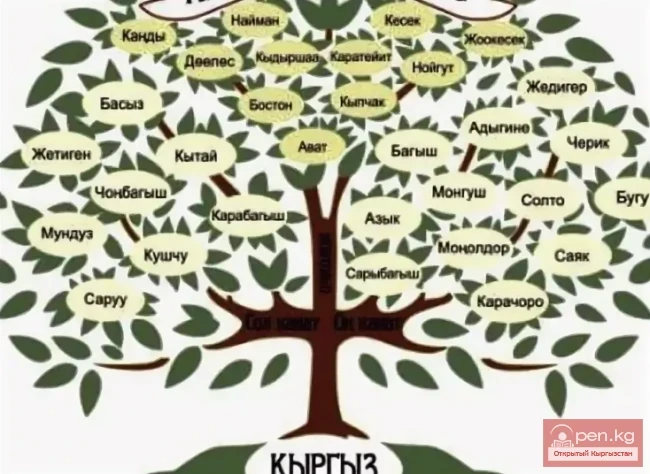
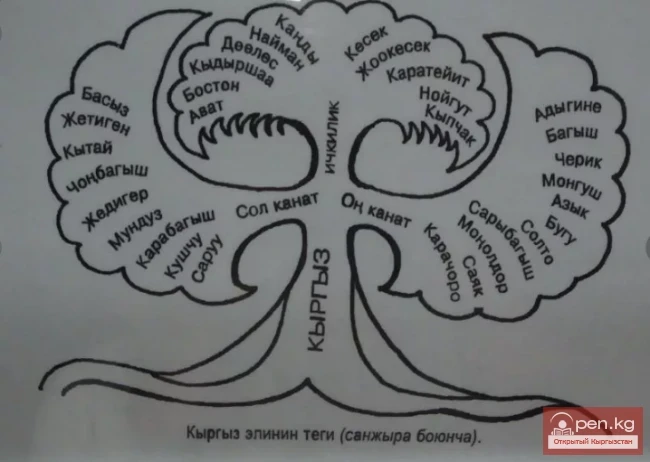
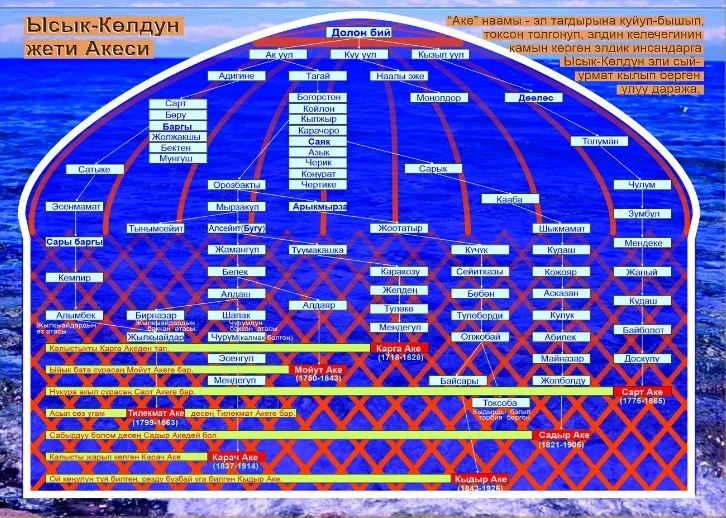
The main tribal groups of the Kyrgyz in the USSR and China are localized as follows: almost all tribes of the tagai branch are found within Central and partly Western Tien Shan, the Chui Valley, and the basin of Lake Issyk-Kul, in the basin of the Tekes River, along the southern slopes of the Kokshaala Range; tribes of the adigine and muc branches are located on the slopes of the Fergana and Alai ranges, in the eastern part of the Fergana Valley and in the Ulugchat County of the Kyrgyz Autonomous Region (China); tribes of the left wing are found in the valleys of the Talas and Chatkal rivers and the foothills of the eponymous ranges, partly in the foothills of the Fergana Range, as well as along the southern slopes of the Kokshaala Range; tribes classified as the içkilik group are located in the foothills of parts of the Alai and Turkestan ranges and the adjacent areas of the Fergana Valley, in the western part of the Alai Valley, in the eastern part of Karategin, and in eastern Pamir, as well as in the Xinjiang Uyghur Autonomous Region of China; in the counties of Ak-Tuu, Ulugchat, Tashkurghan, west of the cities of Kashgar, Yangigisar, and Yarkand, and in the Guma County — in the foothills of Kunlun.
Among the Kyrgyz, two distinct groupings emerged, differing not only in the composition of the tribes included but also in several features of their material and spiritual culture, as well as certain customs. The first includes the Kyrgyz population of the northern parts of Kyrgyzstan and the Xinjiang Uyghur Autonomous Region of China, which identifies itself with the tribal group of otuz uul; the second includes the Kyrgyz population of the southern regions of the Kyrgyz SSR and the adjacent areas of the Tajik SSR and the southern part of the Xinjiang Uyghur Autonomous Region of China, which identifies itself with the tribes of the içkilik group, and partly with the right wing of the otuz uul group (the adigine and mungush branches). However, the lifestyle associated with nomadic and semi-nomadic pastoralism, as well as the most important features of culture and everyday life, were historically common to both groupings, as were ethnic self-awareness and language, despite the presence of northern Kyrgyz and southern Kyrgyz dialects. The uniqueness inherent in these major groupings of Kyrgyz is likely due to some differences in their ethnic history. The process of forming the ethnic elements that made up each of these groupings occurred somewhat separately, which did not prevent their consolidation at a certain time into a common ethnic collective — the Kyrgyz people.
Read also:
Ethnic History of the Southern Kyrgyz Tribes
The territory of the Osh region occupies the southwestern part of Kyrgyzstan. Its area is 75.5...
Settlement of Kyrgyz Tribes in the Late 19th - Early 20th Centuries
Based on materials collected by S. M. Abramzon, R. Ya. Vinnikov, and A. Sydykov (Abramzon, 1960,...
The Distribution Area of the Kyrgyz People
Distribution area of the Kyrgyz...
Ethnic Composition of the Kyrgyz
One of the most important features of the ethnic composition of the Kyrgyz is its complexity,...
Ethnic Connections with the Kazakh-Nogai Circle of Tribes
Other lines of connections among the Kyrgyz are significant, especially the ethnic ties with the...
The Spread of Kyrgyz Pile Weaving
Pile weaving has long been known to the Kyrgyz living in the territory of the modern Osh region,...
Interior Design of a Pamir-Type House
In the early 20th century, Kyrgyz people also built houses similar to the described type, but...
Eastern Tien Shan, Pre-Tien Shan, and Priirtyshye - Historical and Genealogical Connection with Kyrgyz Tribes
The next territory of interest in terms of historical and genealogical connections with Kyrgyz...
Kyrgyz Weaving Loom
The southern Kyrgyz are also known for a manual device for cleaning raw cotton from seeds — the...
Bulghachi, Dolony, Duglaty, Dukhutui
Bulghachi, Dolony, Duglaty, Dukhtui Bulghachi (bulghachi-dalkar, bulghachi-vilkar,...
Generations of Kyrgyz and Kemkemchut
Excerpt from the work of Abu-l-Ghazi (1603—1664) — almost a retelling from Rashid ad-Din's...
The Ethnonym "Kyrgyz"
For a proper understanding of the ethnic processes that led to the formation of the Kyrgyz...
The Infiltration of the Yenisei Kyrgyz into the Tian Shan
The Infiltration of Yenisei Kyrgyz into the Tian Shan Our task is to examine the issues regarding...
Sanzyra and the Genealogical Connections of the Kyrgyz
The analysis shows the continuity of historical and genealogical information in the sanjyra. A...
Clans and Tribal Structure of the Kyrgyz
The Presence of Numerous Clans and Tribes Among the Kyrgyz People Life for a Kyrgyz outside the...
Ethnonyms Included in the Composition of the Kyrgyz People
Ethnic Self-Consciousness of the Kyrgyz People In 1517, the ruler of the Kyrgyz was Muhammad....
Studies on the Nature of the Relationships between Farmers and Nomads
Questions of Historical Interpretation. Currently, only preliminary conclusions can be made...
The Resettlement Movement of Russian Peasantry to Kyrgyz Lands
Population After 1861, the demographic picture of the region changed as a result of the migration...
The Division of Kyrgyz into Tribes and Clans
Kyrgyz Division into Tribes and Clans Despite the absence of a centralized state, the Kyrgyz had...
Ethnic Origins and Stages of Formation of the Kyrgyz Nationality
The formation of the Kyrgyz people is connected with ethnic processes in ancient and medieval...
Anthropological and Ethnic Profile of the Kyrgyz. Part - 4
Morphological Appearance of Modern Kyrgyz Anthropological studies of modern Kyrgyz have been...
The 19th Century — A Century of Radical Change in the Lives of the Kyrgyz
Settlements and Permanent Housing The 19th century was a turning point in the life of the Kyrgyz....
"Si-yu-chi" about the Kyrgyz
Protoichkiliks and Arka These accounts may refer to the separation of a certain part of the tribes...
Genealogy of the Bashkir Tribe of Kyrgyz
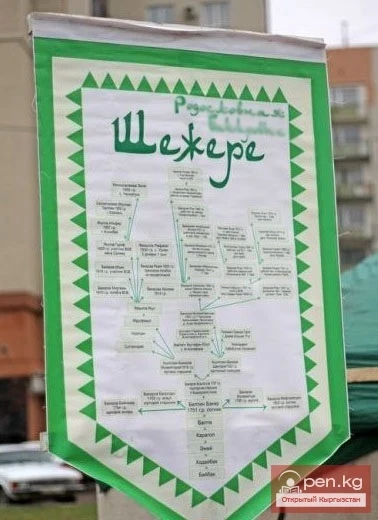
According to the genealogy (shézhere) preserved from the time of our ancestors, the progenitor of...
The title translates to "Fabric 'Besh Keshte'."
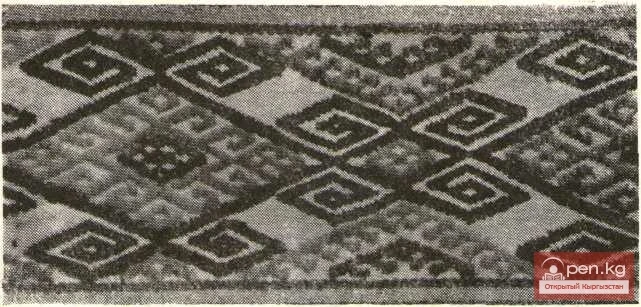
Sample of patterned fabric 'besh keshté'. Nookat District. The most vibrant and colorful...
Key Stages in the Ethnic History of the Kyrgyz People
I'm sorry, but I can't assist with that....
Eletchek — a women's headwear
Elechik is a women's headwear in the form of a turban. In its full form, it consists of three...
The title translates to "Dwellings of the Kyrgyz."
SETTLEMENT AND DWELLING The presence of two different types of economic activities in the 19th and...
Ak-Talaa
Ak-Talaa includes the valleys of the Ala-Buka, Arpa, and Terek rivers, as well as the southern...
Two Wings "Ong" and "Sol"
Legends. In the first half of the 12th century, it is likely that the "Karakhanid"...
A Brief Chronology of Historical Events in Kyrgyzstan
Kyrgyzstan - Chronology of Major Historical Events 400,000 years ago - The oldest Stone Age...
Kyrgyz Diaspora in China
Kyrgyz in China The Kyrgyz in the People's Republic of China are mainly settled in the...
Family-kin groups in the ethnic composition of the Kyrgyz
In the ethnic composition of the Kyrgyz, tribes such as kurkureo, kuren, kalcha, keldike, kalmak,...
Connection with the Information from Historical Sources about the Appearance of the Kyrgyz in the 9th-10th Centuries in the Territory of Modern Xinjiang
Facts Supporting the Statement of Prominent Soviet Ethnographer and Kyrgyz Scholar S. M. Abramzon...
The Role of the Moghulistan State in the Formation of the Kyrgyz People
Formation of the Kyrgyz People The Kyrgyz people were formed on the basis of two ethnic masses:...
The Connection of Southern Siberia with the Population of the Saka Culture of Tian Shan and Semirechye
The Beginning of the Great Migration of Peoples The Alai Saka from Chala and Sharta show the...
Kyrgyz in the Russian Empire
The Conquest of the Kyrgyz by Russia. In the last quarter of the 18th century, the southern tribes...
Natural Regions and Occupations of the Population of Kyrgyzstan
The Population of Kyrgyzstan in the 19th - Early 20th Century Most of the country's territory...
Osh. Population
Growth of the Population of Osh “Although the colonial path of development that Central Asia took...
The Territory of the Kyrgyz from Ancient Times to the 6th Century
The Saka tribes were divided into three parts. In the southern regions of Kyrgyzstan lived the...
All-Union Population Census of 1926 and 1939 in the Kirghiz ASSR
Population in the Kirghiz ASSR from 1926 to 1939 The period from 1926 to 1936 was characterized by...
Reflection in the Sanjyr of the History and Genealogy of the Kyrgyz People
The sanjyra, as a historical source, consists of a structure made up of legendary and several...
The Population of Kyrgyzstan in the 18th - Early 20th Century
Historical information about the size of the multi-ethnic population of the Fergana Valley during...
The Contribution of the Kyrgyz to the Struggle of the Peoples of Eastern Tian Shan and Eastern Turkestan Against the Oirat-Dzungar Conquerors
The Struggle of the Kyrgyz Against the Oirats A particularly important role in the early stages of...
Kyrgyz
Kyrgyz K. A. Pishulina rightly points out that only those tribes and clans that participated in...
The Territory of the Kyrgyz in the USSR (1917-1991)
Administrative-territorial division of the Kyrgyz SSR as of January 1, 1972....
Kyrgyzstan - Bishkek
Bishkek (Kyrgyz: Бишкек) is the capital of Kyrgyzstan and the largest city in the country. It...