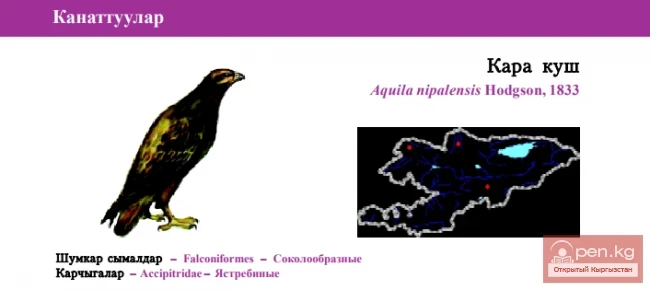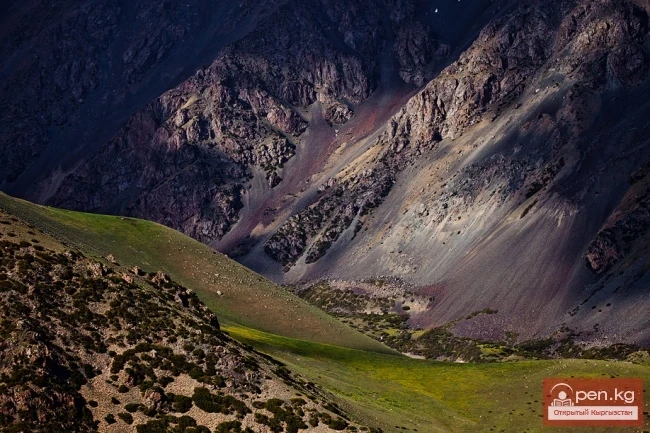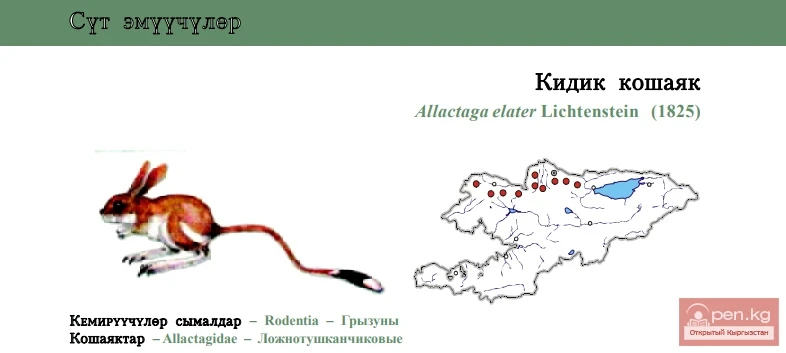
Small Jerboa / Kidik Koshayak / Small Five-toed Jerboa
Small Five-toed Jerboa
Status: VII category, Lower Risk/least concerned, LR/lc.
Distribution general and in the country. Northwest China, Turkey, Iran, Afghanistan. Inhabits clay deserts and semi-deserts from the Eastern Caucasus to the Zaisan Basin. Recorded in all lowland areas of Central Asia and Kazakhstan, in the valleys of the Amu Darya, Vakhsh, Chu, Ili, in the Pribalhashye and other desert-like areas. The subspecies A.e.vinogradovi inhabits the Jambyl region (Kazakhstan), Chu and Talas valleys (Kyrgyzstan).
Habitat. Prefers clay relatively flat desert areas with sparse herbaceous and shrub vegetation. In the Chu Valley, it does not rise above the foothills of the Kyrgyz Range; in the Talas Range, the upper limit of its settlement reaches 2200 m [31]. It stays on plateaus, avoiding steep slopes. It does not live in forests, shrubs, marshy, plowed, or irrigated lands. In the western part of the Talas Valley, it has been registered in sandy areas with sparse chia bushes [31].
Population. A rare species, declining due to habitat development. In the Chu Valley, during counts from a vehicle at night over a 10 km route, 7 individuals were encountered; for the Talas Valley, these figures are 1.5-2 times higher [31]. Therefore, its population is low even in characteristic habitats.
Life style. (life cycles). Burrowing animals. Burrows can be permanent or temporary (permanent ones are located at a greater distance than temporary ones), connected by well-visible paths that are trampled by the animals [6,31]. It leads a nocturnal lifestyle, does not leave burrows during daylight. In the Talas Valley, it hibernates in the cold season, i.e., in the second half of October, waking up in the first decade of April [6,31]. In the Chu Valley, the timing of seasonal activity is extended due to a warmer climate (it burrows in late November, emerges from burrows in early March) [3]. In the Chu Valley, it begins to reproduce in March [3]. In the Talas Valley, reproduction occurs later - from April to August [6,31]. Some individuals produce two litters during the spring-summer period. The number of embryos is 2-5 [31]. In spring, it eats green parts of plants; in summer, the bulk of its diet consists of seeds, bulbs, tubers, and rhizomes of ephemerals and ephemeroids, as well as insects, caterpillars of cutworms, grasshoppers, ants, and others [3, 29, 30, 31].
Limiting factors. Development of animal habitats due to human economic activities: land plowing, irrigation, etc.
Breeding (keeping in captivity). Not conducted.
Existing conservation measures. Currently absent.
Recommended conservation measures. Preservation of characteristic habitats.
Kidik Koshayak
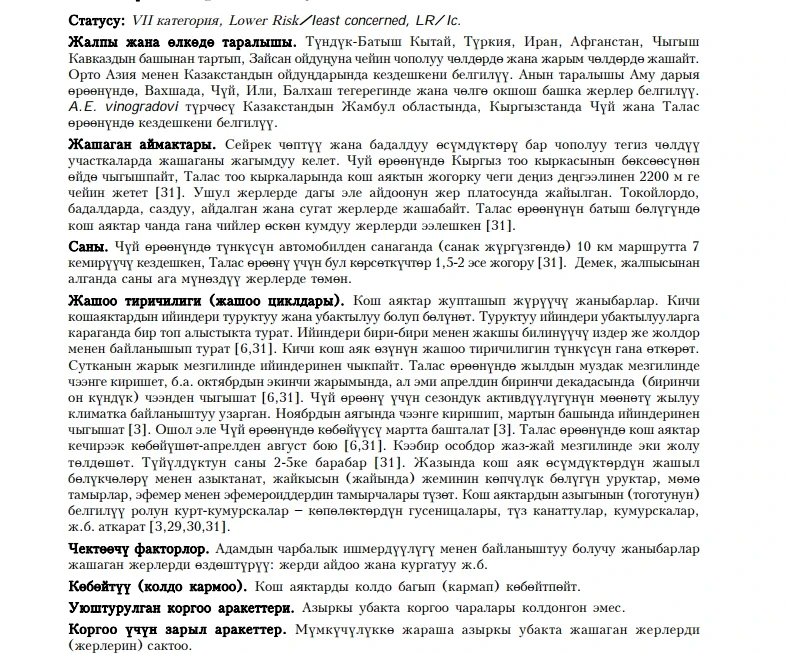
Small Five-toed Jerboa
Allactaga elater Lichtenstein (1825)
Status: VII, Lower Risk/least concerned, LR/lc. Occurs in Chu and Talas Valleys. Prefers clay plain desert spots with scarce grass and scrubs up to 2,200 m (2,200 feet) above sea level. There were 7 Jerboas registered from the car within 10 km census transect in Chu Valley; that figure is 1.5-2 times higher in Talas Valley. Lives in permanent and temporary burrows. Holes are well connected with Jerboa paths. Nocturnal animal, hibernates during the winter. Starts to mate in March in Chu Valley and later - in Talas Valley. Uses for food green parts of vegetation, seeds, bulbs, roots of ephemerals and ephemeroids. Insects are included in Jerboa’s food. Limiting factors are destruction of suitable habitats such as ploughing up and watering. No evidence on keeping them in captivity. Protection measures are not currently undertaken. It is recommended to conserve suitable habitats.
Read also:
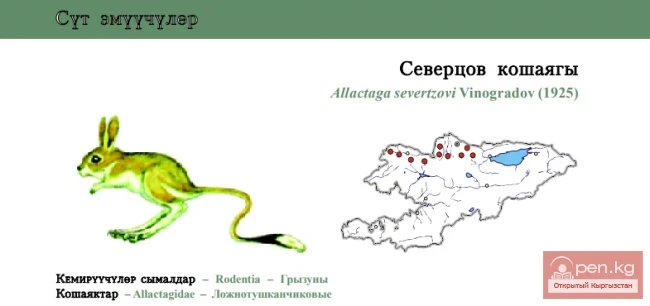
Severtzov’s Jerboa
Severtzov’s Jerboa Status: VII category, Lower Risk/least concerned, C^//rare, poorly studied...
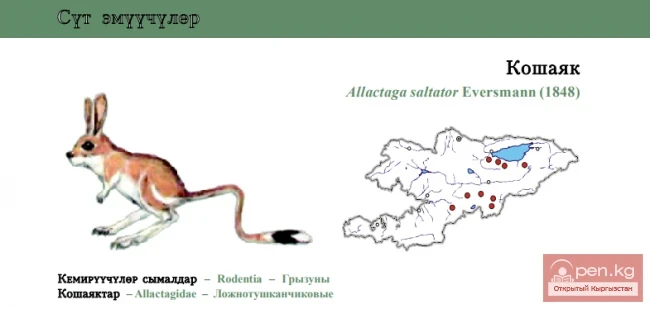
Jumping Jerboa / Koshayak / Jerboa
Jerboa Status: Near Threatened, NT: R...
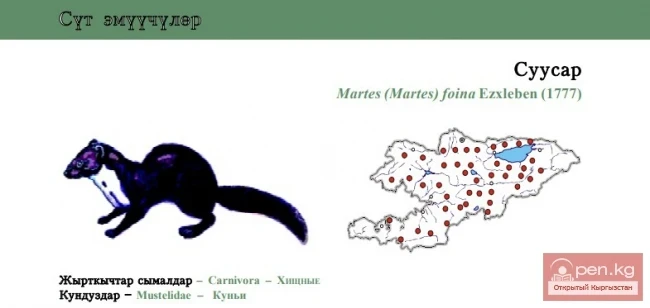
Stone marten or white-breasted marten / Suusar / Beech marten
Stone marten or beech marten Status: VII category, Lower Risk/least concerned, LR/lc. A rare...
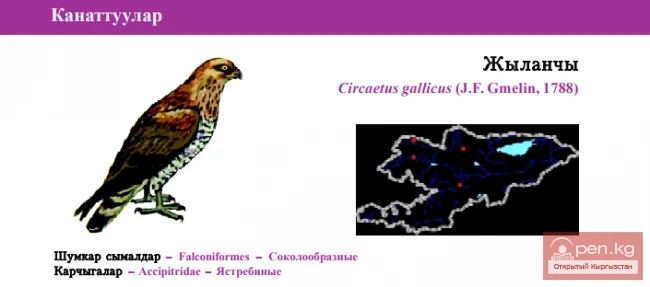
Snake Eagle \ Short-toed Eagle
Short-toed Eagle Status: V category, Vulnerable, VU: R. The only representative of the genus in...
Yellow-bellied Skink / Butsuz Glass Lizard, Snake-like Glass Lizard / Sheltopusik, or Armour Glass Lizard
Sheltopusik Status: Near Threatened (category NT). A rare widely distributed representative of a...
Jayran / Zheiren / Goitered gazelle
Dzhayran Status: Category III, Critically Endangered, CR: R, Cl. An endangered or possibly extinct...
The Onset of Autumn in Bishkek. Kyrgyzhydromet Reports...
Significant cooling and snow — weather forecast for Kyrgyzstan until October 18 On Sunday, October...
Dressing / Chaar Kusen / Marbled Polecat
Marbled Polecat Status: III category, Critically Endangered, CR: R, Cl. Close to extinction. The...
Eastern Sand Boa / Chygys Kumchul Muuntkuchu / Tatary Sand Boa
Eastern Sand Boa Status: Near Threatened (NT). One of 10 species of the genus, which includes...
Black-bellied Sandgrouse
Black-bellied Sandgrouse Status: VI category, Near Threatened, NT. A species with low numbers,...
Spotted or Diadem, Rat Snake / Charala Soilok / Diadem, or Clifford’s Rat Snake
Spotted or Diadem Snake Status: Critically Endangered (category CR C2b). One of the 4 known...
The title translates to: "Little Bustard / Kadimki bezbeldik / Striped"
Little Bustard Status: VI category, Near Threatened, NT. It has apparently not bred in Kyrgyzstan...
Central Asian otter / Kunduz / Common otter
Central Asian otter Status: III category Critically Endangered, CR: R, Cl. The subspecies Lutra...
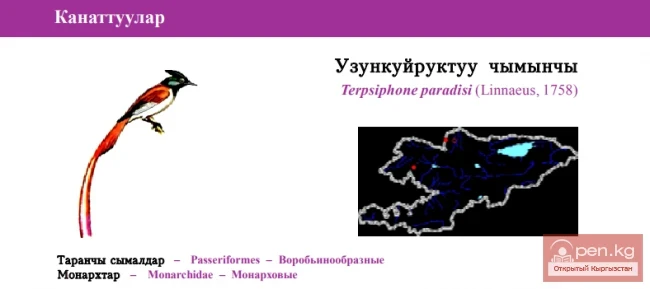
The title translates to: "Long-tailed Flycatcher / Asian Paradise Flycatcher."
Asian Paradise Flycatcher Status: VI, Near Threatened: NT: R. One species of the Monarchidae...
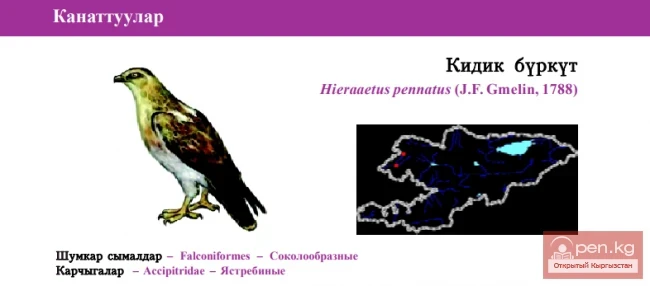
Dwarf Eagle / Kidik Burkut / Booted Eagle
Booted Eagle Status: VI category, Near Threatened, NT: R. Monotypic species [47]. A rare...
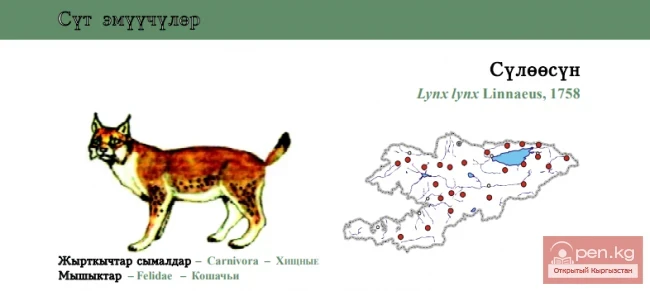
Lynx / Sulyoyosun / Eurasian Lynx
Lynx Status: V! category, Nearly Threatened, NT. A rare subspecies Lynx lynx isabellinus Blyth,...
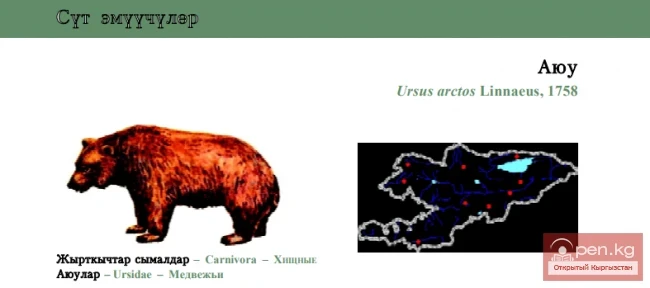
Brown Bear \ Ayyu / Brown Bear
Brown Bear Status: VII category, Lower Risk/least concerned, LR/lc. A rare subspecies of bear...
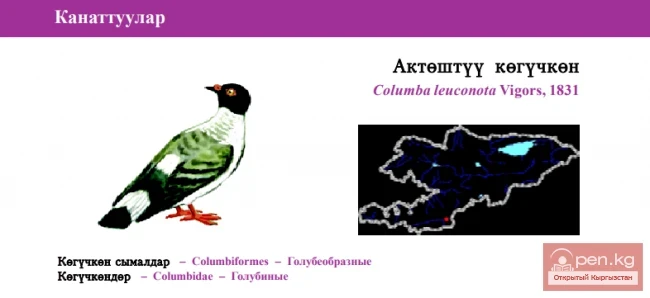
White-throated Dove / Actor's Pigeon / Snow Pigeon
Snow Pigeon Status: VII, Least Concern, LC. One of six species in the genus found in the fauna of...
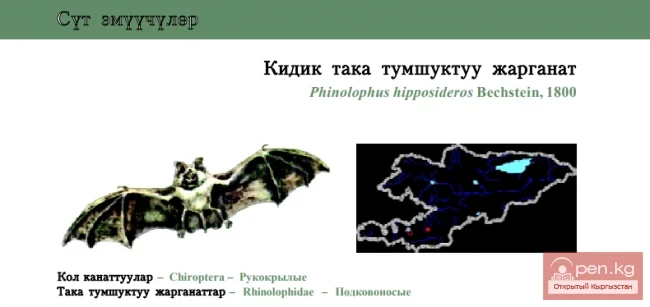
Lesser Horseshoe Bat / Kidik Taka Tumshuktyu Jarganat / Малый подковонос
Lesser Horseshoe Bat Status: Category VI, Near Threatened, NT: R. A species with a declining...
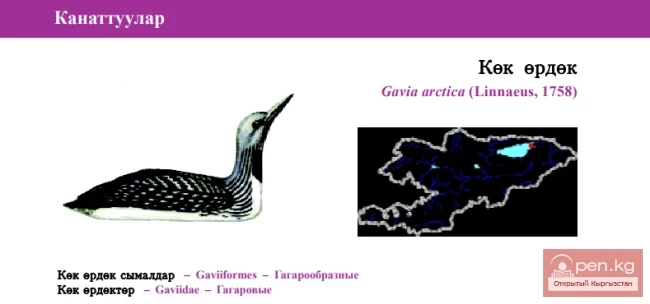
Black-throated Loon
Black-throated Loon Status: Category III, Critically Endangered, CR: R. Close to extinction in the...
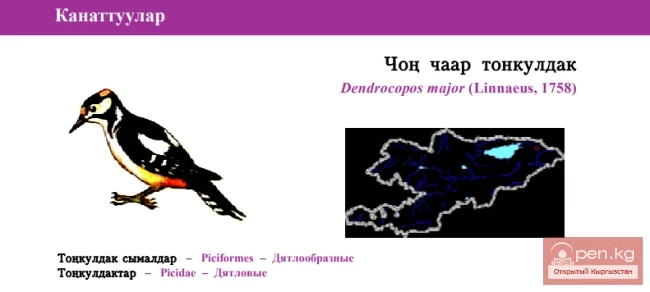
Great Spotted Woodpecker
Great Spotted Woodpecker Status: VI, Near Threatened, NT: R. Kyrgyzstan is home to Dendrocopos...
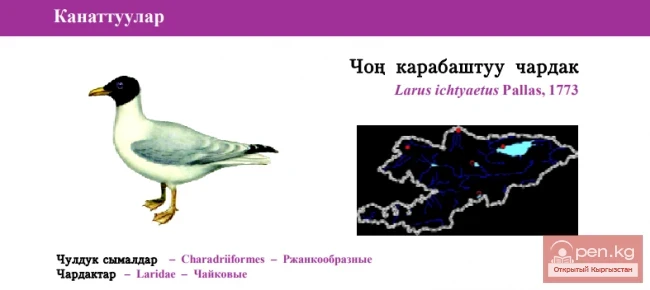
Black-headed Gull / Great Black-headed Gull
Great Black-headed Gull Status: VI, Near Threatened, NT: R. One of 6 species of the genus in the...
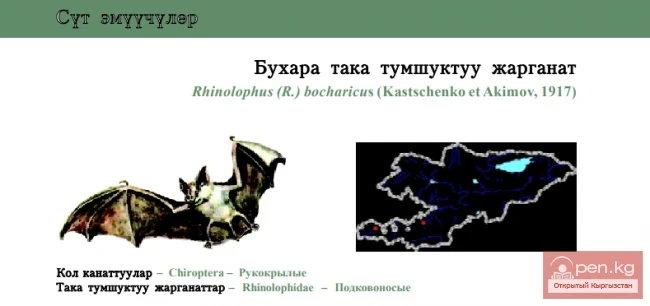
Bukhara Horseshoe Bat
Bokhara Horseshoe Bat Status: Category VI, Near Threatened, NT: R. A rare species for Kyrgyzstan,...
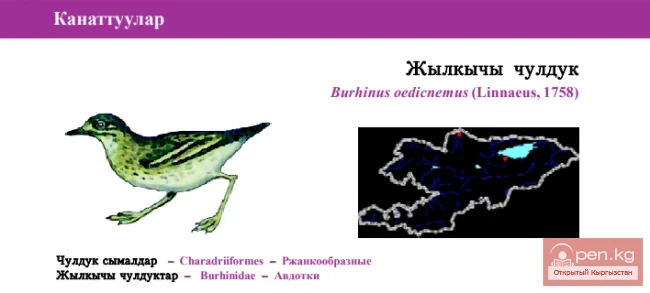
Avdotka / Zhilkychi Chuldik \ Eurasian Stone Curlew
Avdotka Status: V category, Vulnerable, VU: R, A1. At the same time, according to information from...
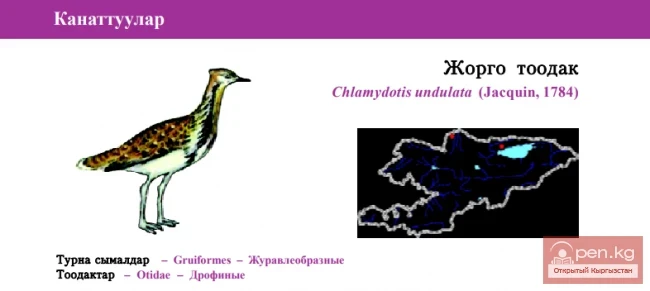
Houbara Bustard / Gorgeous Bustard / Houbara Bustard
Houbara Bustard Status: III category, Critically Endangered, CR: R, A1. The subspecies Chlamydotis...
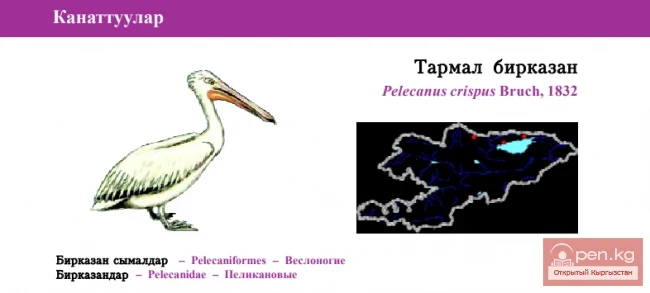
Curly Pelican / Tarmal Birqazan \ Dalmatian Pelican
Dalmatian Pelican Status: V category, Vulnerable, VU, A2c+3c. One of 2 species of the genus,...
Frosts Expected Again in Bishkek. Decrease in Air Temperature
As meteorologists have already reported, a storm warning has been issued in Kyrgyzstan: unstable...
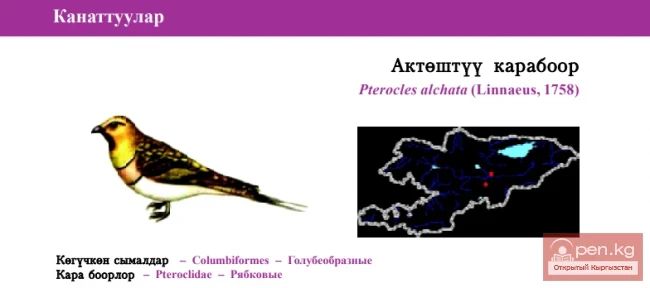
White-bellied Sandgrouse / Actor Black-headed / Pin-tailed Sandgrouse
Pin-tailed Sandgrouse Status: VI category, Near Threatened, NT: R. A species with low numbers,...
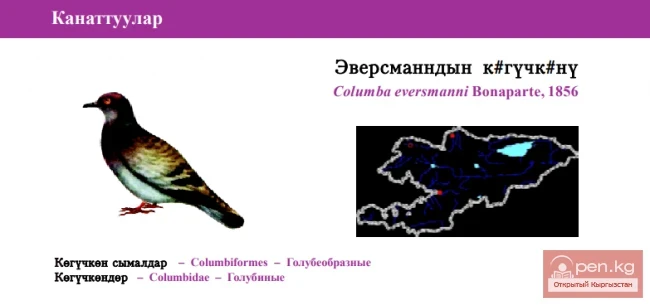
Brown Dove / Eversmann's Dove / Pale-backed Pigeon, Yellow-eyed Pigeon
Brown Pigeon Status: V category, Vulnerable, VU, A2bcd+3bcd. Vulnerable. One of six species in the...
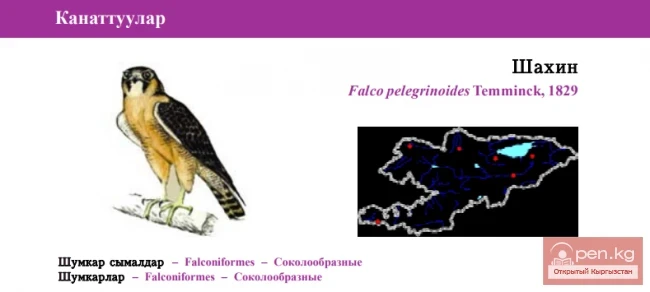
Red-headed Falcon / Shaheen / Barbary Falcon
Barbary Falcon Status: Category III, Critically Endangered, CR: R. Kyrgyz ornithologists believe...
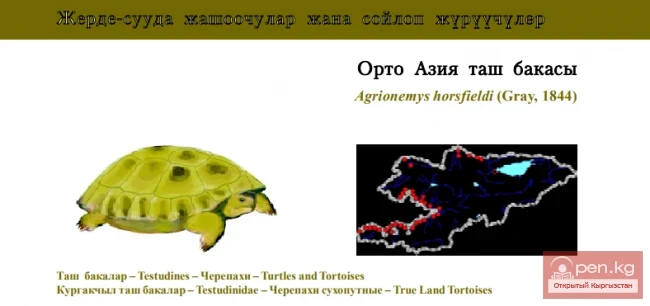
Central Asian Tortoise \ Orto Asia Tortoise / Steppe, or Afghan, Tortoise
Central Asian Tortoise Status: VU Blab (ii, iii, v); Cl. A representative of a monotypic genus,...
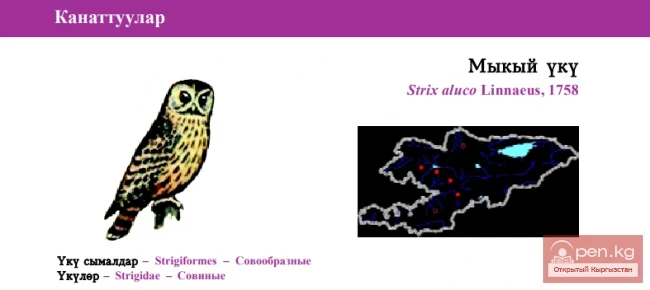
Gray Owl / Mykyy Uku / Tawny Owl
Tawny Owl Status: VII, Least Concern, LC. In Kyrgyzstan, Strix aluco harmsi (Zarudny, 1911) is...
Common Flamingo / Pink Flamingo / Greater Flamingo
Common Flamingo Status: VI category, Nearly Threatened, NT: R. The only species of the flamingo...
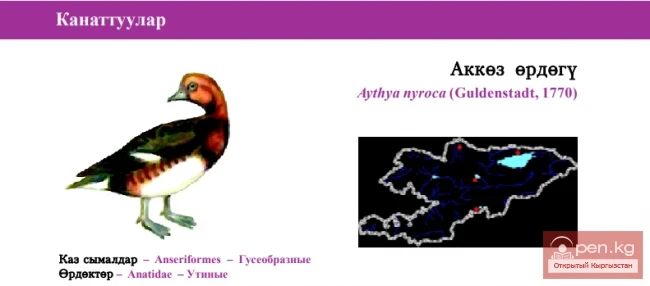
The title translates to: "White-eyed Pochard / Aккоз ордогу / Ferruginous Duck."
Ferruginous Duck Status: VI category, Near Threatened, NT. Monotypic species. One of four species...
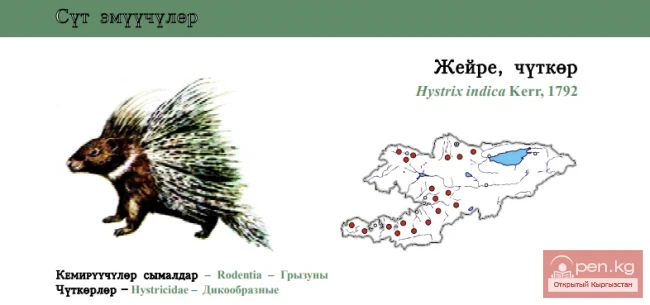
Indian Crested Porcupine / Jeyre, Chutkjor / Indian Porcupine
Indian Crested Porcupine Status: Category VII, Lower Risk/least concerned, LR/lc, poorly studied...
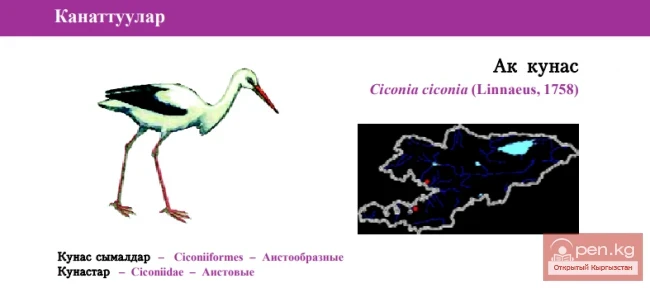
White Stork / Ak Kunash / Белый аист
White Stork Status: IV category, Endangered, EN: R. One of the 2 species of the genus found in...
Crane Beauty / Karkyra / Demoiselle - Crane
Demoiselle Crane Status: Category VI, Near Threatened, NT: R. One of two species of the genus in...
Great Bustard
Great Bustard Status: III, Critically Endangered, CR: R, A1. The nominative subspecies Otis tarda...
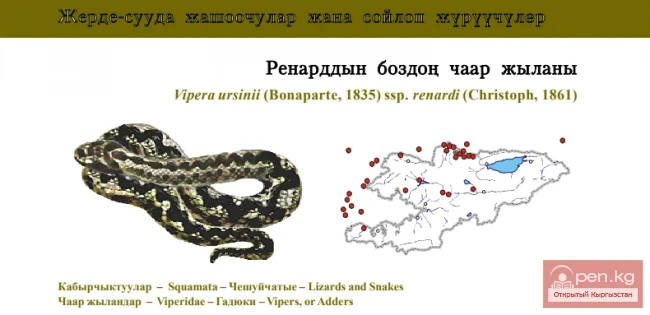
Renard's Meadow Viper
Renard’s Meadow Viper Status: Category VUA4bc. A subspecies of the south-west Palaearctic species,...
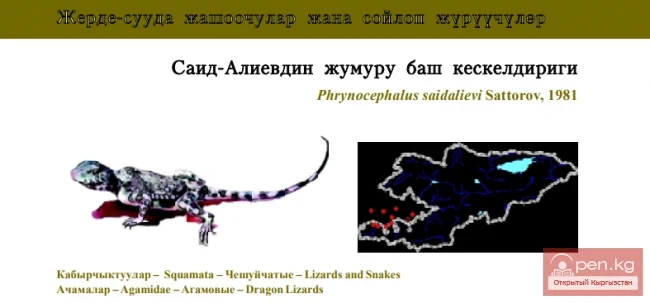
Said-Aliev's Round-Headed Agama / Said-Aliev's Toad Agama / Said-Aliev’s Sunwatcher
Said-Aliev’s Toad Agama Status: Vulnerable (category VUBlab(iii)). A narrowly distributed relic...
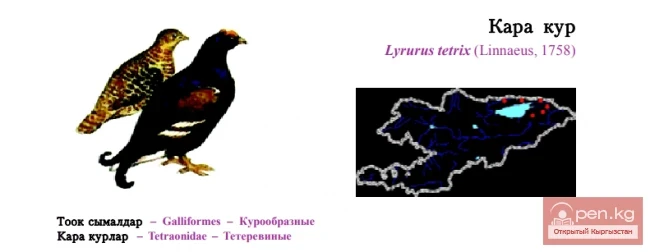
Black Grouse
Black Grouse Status: Category VI, Near Threatened: R. The subspecies L. t. mongolicus (Lonnberg,...
Steppe Eagle \ Kara Kush \ Steppe Eagle
Steppe Eagle Status: VI category, Near Threatened, NT: R. One of four species of the genus in the...
Adverse Natural Disastrous Processes
A specific form of natural conditions is represented by the internal adverse dangerous natural...