Ivan Vasilyevich Mushketov repeatedly undertook expeditions to Central Asia — a geologist and geographer, a graduate of the St. Petersburg Mining Institute. The results of his first study of Tian Shan and the Syr Darya valley were encouraging: over two years — 1874-1875 — a number of deposits of minerals were discovered. A later three-year expedition — 1877-1880 — allowed for geological and orographic descriptions of Central Asia; the history of the Tian Shan and Pamir-Alai mountains found reflection in the monumental two-volume work "Turkestan." In 1887, Mushketov, interrupting his studies of the Caucasian glaciers and mineral springs, returned to Central Asia. In Verny — now Almaty — a powerful earthquake occurred. The scientist's duty was to investigate the causes and consequences of the catastrophe on-site, Mushketov believed.
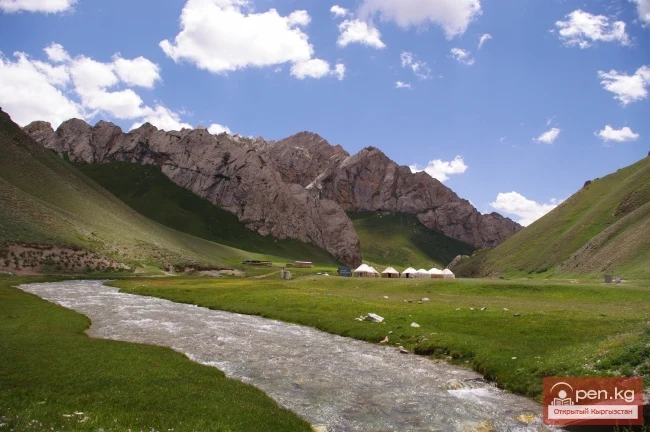
In the center of Tian Shan, on the northern slope of the Sary-Jaz ridge, there is a valley glacier twenty kilometers long, from the edge of which the Aydyr-Tor River originates. The glacier bears Mushketov's name.
And a monument stands in Kyrgyzstan to the native of Smolensk province — Przhevalsky. A city was named after him — now again Karakol. And in his honor, a breed of horse he discovered bears his name... He lived only forty-nine years, a life filled to the brim. What if it had not been for the illness that struck him so unexpectedly?
After graduating from high school — he entered military service, then graduated from the General Staff Academy. Later, at the Warsaw military school, he was a librarian and a teacher of geography and history.
In 1867, a meeting with Semenov in St. Petersburg changed his fate. First came an expedition to the Ussuri region, then to Mongolia, China, and Tibet, lasting three years. The second Central Asian expedition — Lobnor and Dzungar — took place in 1876-1877. Almost immediately followed the first Tibetan expedition, in 1883-1885 — the second Tibetan. At the beginning of the fifth journey, Przhevalsky died. The illness struck him on the shores of Lake Issyk-Kul in the city of Karakol.
To truly represent the ascetic life of Przhevalsky — it is enough to mention the distance he traveled during all his expeditions. More than thirty thousand kilometers of travel, not the easiest, as the reader understands. Is that a lot or a little? For comparison: approximately eight times on foot from Moscow to Bishkek.
The result of his life — a series of books providing a vivid picture of nature and characteristics of the relief, climate, rivers, lakes, vegetation, and wildlife. The directions of the main ridges of Central Asia were established. New ones were discovered. The boundaries of the Tibetan plateau were defined. Lake Lobiore was described. A zoological collection of 7,500 specimens, a botanical collection of about 16,000 plant specimens, and mineralogical collections were gathered. The wild camel and wild horse, Przhevalsky's horse, were discovered and described. Only the botanical collection provided botanists with 218 new species of plants and 7 new genera.
They say that for a person to justify life, they need to plant one tree, give birth to one child, and build one house. So how many lives did Przhevalsky justify with his feat?
It would be unjust not to mention, alongside travelers to "unknown lands," those who made the history and culture of the Kyrgyz people the content of their lives. Such a connoisseur of Kyrgyzstan's history was academician Vasily Vladimirovich Bartold, an Islamic scholar who translated the alphabet from Arabic to Latin, who devoted his life to collecting ancient Eastern manuscripts and created an Oriental studies library.
Vasily Vasilyevich Radlov, born Friedrich Wilhelm, during a ten-year expedition through Altai, Siberia, Kazakhstan, and Central Asia collected materials on the languages, folklore, ethnography, and archaeology of Turkic peoples. We owe him the first reading of the famous Orkhon-Yenisei inscriptions, executed in the so-called runic script, which traces back through Old Sogdian to Aramaic. He also laid the foundations for the comparative-historical study of Turkic languages.