The scientist believes that the spread of caragana is complex and requires a deep analysis of the causes of pasture degradation.
According to him, the term "harm of talypozy" does not have a strict biological definition and requires a more detailed analysis of the factors influencing the changes taking place.
“As a biologist, I prefer mechanical methods of control rather than chemical ones. Chemistry poses a potential threat, akin to a ticking time bomb. However, it is important to focus not only on methods but also on the causes and consequences,” Milko noted.
He also emphasized that Caragana includes not just one species of plants but represents an entire group.
“Caragana thickets are associations of shrubs belonging to the Caragana genus. In Kyrgyzstan, there are 12 species, and Altygana is just one of them, which is not found everywhere. For example, in Susamyr, several species with different properties can be found,” the scientist explained.
The specialist warned against hasty conclusions about the rapid spread of Caragana. The analysis of satellite images may contain errors.
“Satellite images are not just photographs. They are complex data collected by software that can sometimes make mistakes. Therefore, it would be incorrect to assess the spread of shrubs solely based on them,” he added.
Nevertheless, Milko acknowledged that local expansion of Caragana is indeed observed.
“The real increase in the number of bushes can be noticed if you carefully examine the area—young shoots appear around the parent plant. In such cases, new bushes do indeed form,” he explained.
The main reason for the degradation of pastures, according to the specialist, is the disruption of the balance between herbaceous vegetation and shrubs caused by improper grazing pressure on the pastures.
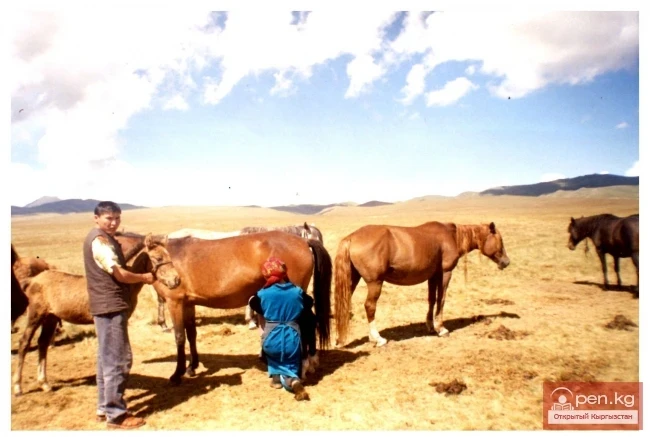
“Previously, Susamyr was covered with grass up to the knee, but now it resembles a golf course. The reason is that herders do not maintain discipline while grazing. Livestock is kept at the foot of the hills and near the camps until the land turns to dust,” Milko noted.
He also added that the situation is exacerbated by premature grazing in high-altitude pastures.
“There are cases where horses are driven into the upper zones as early as the end of March. The question is, what can grow there after that?” he concluded.
Read also:
Cattle Breeding among the Kyrgyz before the 20th Century
Curl error: Operation timed out after 120001 milliseconds with 0 bytes received...
Animal Husbandry
Curl error: Operation timed out after 120001 milliseconds with 0 bytes received...
Annual Cycle of Nomadic Herding among the Kyrgyz
Ail before migration. Osh region, Alai valley. 1930. Annual Cycle of Pastoral Livestock Breeding...
Cattle Breeding Among the Kyrgyz in the 20th to Early 21st Century
Migration near the village of Troitskoye. Kara-Kyrgyz. Syrdarya region. 1902. Animal Husbandry in...
Agriculture
Grain farming is one of the main sectors of agriculture. Economic difficulties in agriculture over...
Agriculture, Land Resources of Kyrgyzstan
Land Resources of Kyrgyzstan The climatic features dictate the development of agricultural sectors...
Development of Agriculture among the Kyrgyz in the 20th - Early 21st Century
Annual Cycle of Agricultural Work The most common practice was crop rotation with two-year and...
Composition of the Kyrgyz Herd
Composition of the Herd Kyrgyz people raised horses, sheep, yaks, goats, camels, and cattle. For...
Cattle Breeding among the Kyrgyz
Migration in the Alai Range. Early 20th century. Kyrgyz SSR HERDING The leading sector of the...
Water Management
In the system of water use and water consumption, intra-economic and inter-state water relations,...
Hunting - An Important Component of the Kyrgyz Economy from Ancient Times to the Early 20th Century.
Hunters with Golden Eagles. Mountain Semirechye, Kyrgyzstan. 1926. HUNTING Hunting has been an...
Agriculture among the Kyrgyz
AGRICULTURE Agriculture was an important area of economic activity for the Kyrgyz, ranking second...
Methods of Hunting and Game Management by Kyrgyz Hunters in the 19th - Early 20th Century.
Hunting Dogs and Birds of Prey. Even in the early Middle Ages, specially trained dogs served as...
Devices and Weapons for Hunting by the Kyrgyz in the 19th - Early 20th Century.
Hunting Tools and Weapons. Since ancient times, the Kyrgyz have used both "active" and...
Production of Livestock Products as of March 1, 2015
Meat Production. During the reporting period of 2015, economic entities of all categories in the...
Agriculture of the Southern Kyrgyz in the 19th - Early 20th Centuries.
The second half of the 19th century and the beginning of the 20th century were filled with...
Kyrgyz Irrigation Technique - Irrigation
Irrigation The Kyrgyz used techniques and methods of irrigation developed over many centuries,...
Hunting Techniques and Division of Spoils among the Kyrgyz from Ancient Times to the Early 20th Century.
Hunting Techniques and Division of Game. The Kyrgyz hunted both on horseback and on foot. In deep...
Agriculture, Forestry, and Fishing
The gross output of agricultural products, forestry, and fishing in January-June 2014 amounted to...
Cattle Breeding Cults of the Kyrgyz in the Early 20th Century.
Forage Preparation Forage preparation became widespread in the late 19th century due to a lack of...
Commercial Animals of Kyrgyzstan in the Early 20th Century.
Commercial Animals. Sources from the 19th to early 20th centuries contain information about wild...