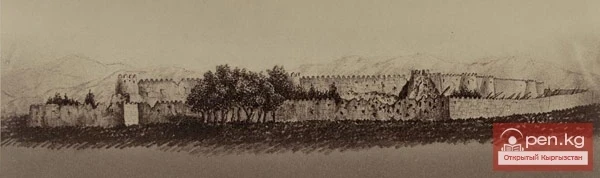
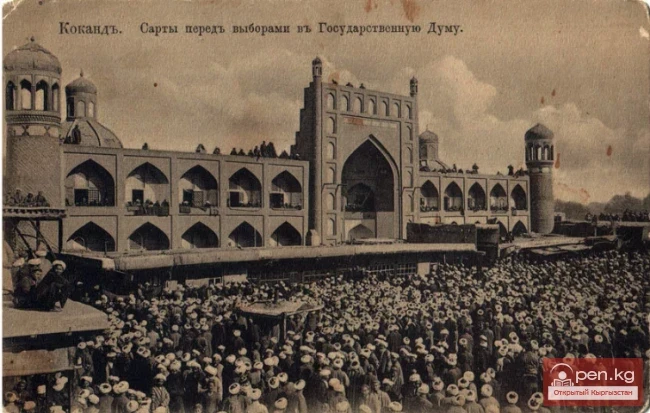
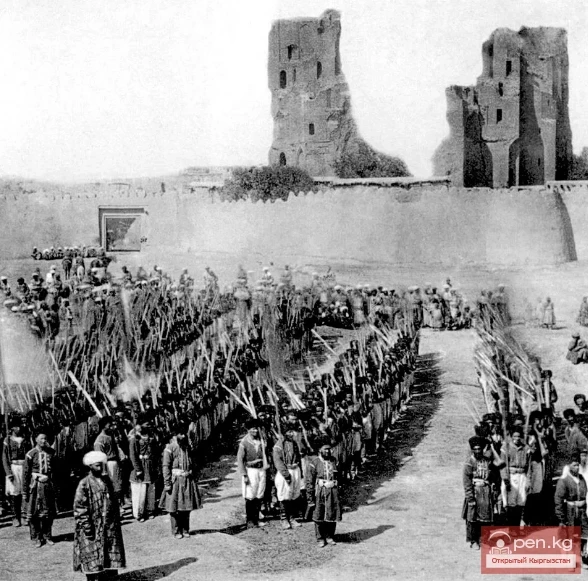
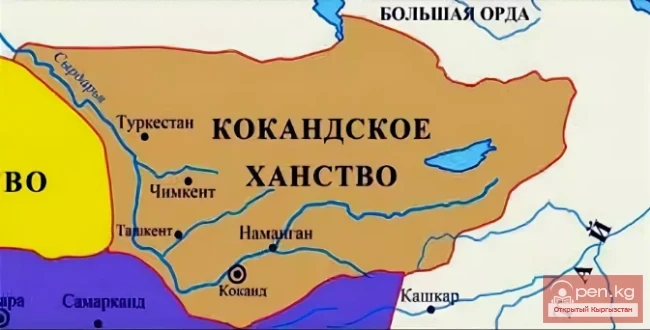
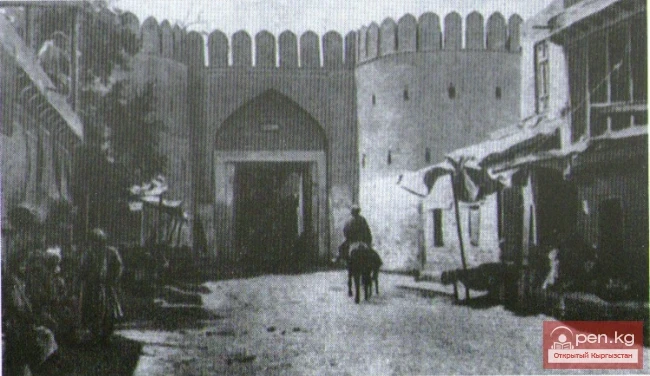
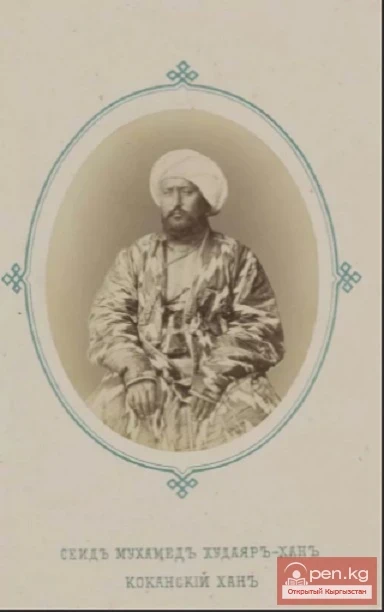
Foundation of the Khanate and its Strengthening. In the early 18th century, a new feudal state was established — the Kokand Khanate. Its capital was the city of Kokand. The main population of the khanate consisted of Uzbeks, and besides them, Tajiks and Kipchaks also lived here.
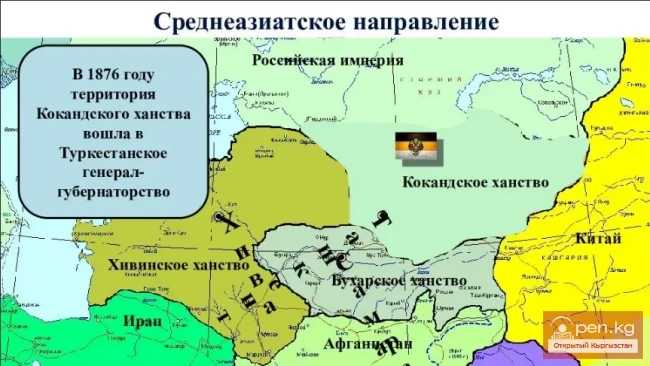
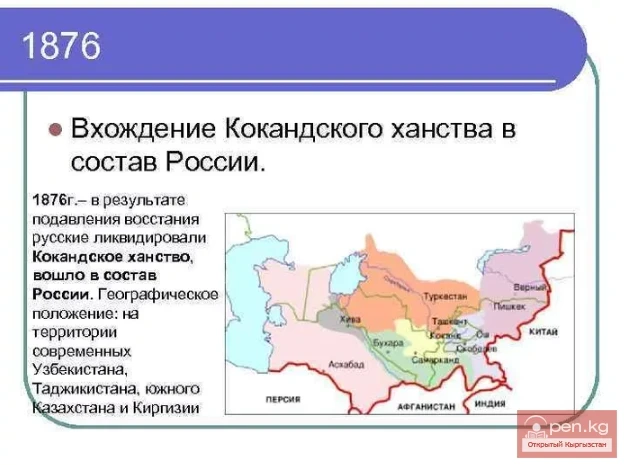
The Kokand ruler Alim, proclaimed khan in 1800, initially ruled only in the Fergana Valley. In 1810, he annexed the feudal possessions of Tashkent. His successor Omar-khan, as a result of a successful war with the emir of Bukhara, managed to conquer vast nomadic territories of the Kazakhs, the cities of Turkestan, Auliye-Ata, and other territories. The Kokand Khanate became the largest in Central Asia, leaving the Bukhara and Khiva Khanates behind.
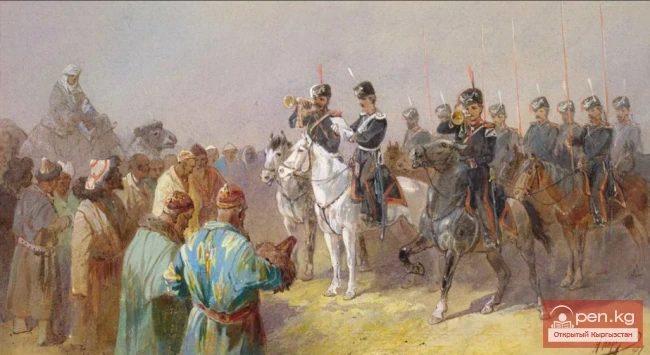
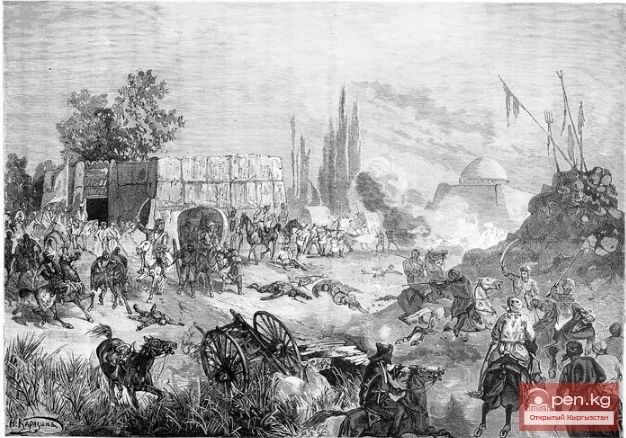
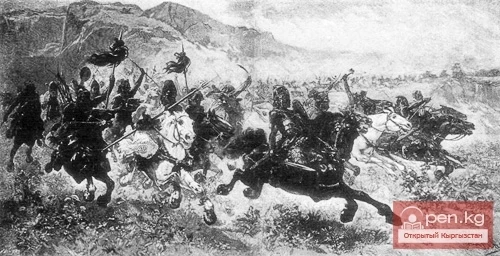
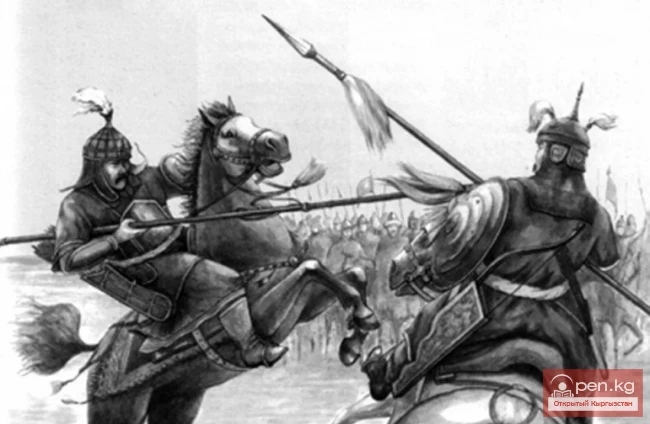
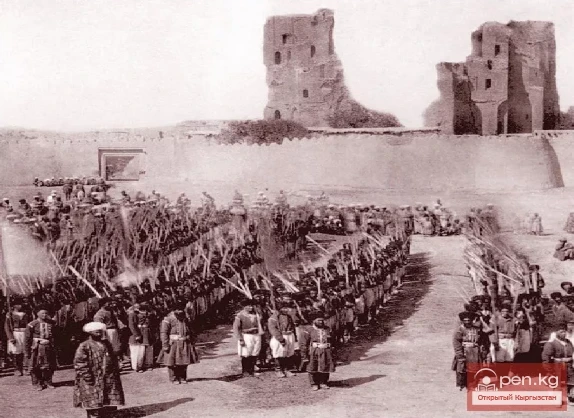
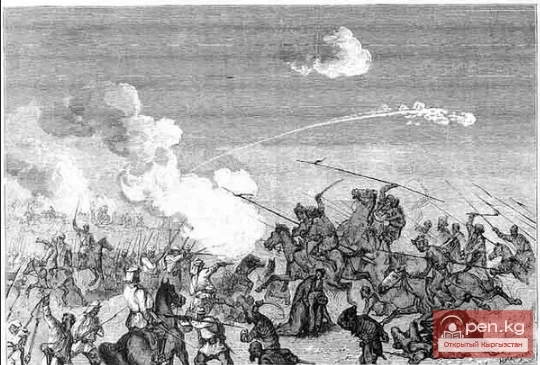
Starting from the 1820s, the Kokandis began to build aggressive plans regarding Kyrgyzstan and carried out raids deep into Kyrgyz lands. During the 1920s and 1930s, Madali-khan — the successor of Omar-khan — launched a major offensive to conquer northern Kyrgyzstan. One part of the hundred troops, departing from Tashkent, passed through the cities of Chimkent, Auliye-Ata into the Chui Valley and reached the shores of Issyk-Kul. The other, coming from the Fergana Valley, crossed the Kugart Pass, entered Suusamyr, and from there through Jumgal, Kochkor, At-Bashi, Naryn headed towards Issyk-Kul to join the first group’s detachments.
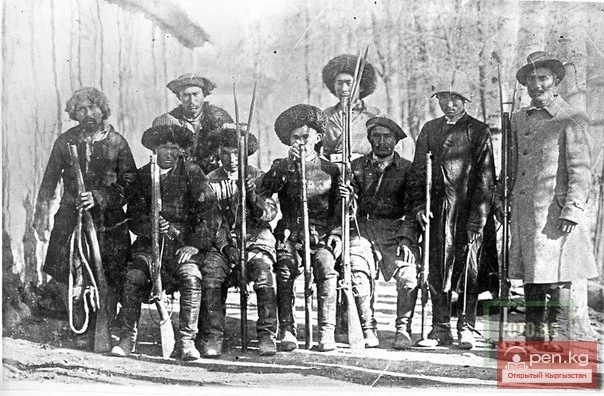
The Kyrgyz rose up as one to fight the enemy and offered the most stubborn resistance to the troops of the Kokand khan. The attacks of some Kokandi detachments ended in their complete defeat. The Kokand military leader Khakkula had great difficulty suppressing the armed resistance of the Kyrgyz in the Tian Shan, led by Taylak batyr.
However, despite this, the Kokandis ultimately prevailed. The reasons for the defeat were the lack of unity among the Kyrgyz and weak armament. A significant role was also played by the fact that the khan bribed some prominent Kyrgyz manaps, who, in essence, opposed the struggle for independence.
By the mid-1830s, all tribes of the Kyrgyz found themselves under the rule of the Kokand Khanate.
Proclamation of Sheraly as Khan. Kyrgyz feudal lords and biys actively participated in the political life of the Kokand Khanate. For example, the Aksy feudal lord Yusup played a decisive role in proclaiming Sheraly, the nephew of the Kokand khan Narboto, as khan and effectively ruled the khanate on behalf of Sheraly. Here is how the proclamation of Sheraly as khan is described by the writer T. Kasymbekov in the historical novel “The Broken Sword.”
- Let's go... It's done...
With trembling hands from excitement, he put a worn tubeteika on Sheraly, helped him pull on a greasy chapan, and himself tied his belt.
Sheraly emerged from the yurt. He could not hide his uncontrollable joy; beads of sweat appeared on his temples and forehead. With happy and grateful eyes, he looked at everyone, his lips spread into a smile. Kedaybay supported him under his right elbow, and the Kipchak bek Musulmanqul supported him under his left.
- Weapons! Banner!
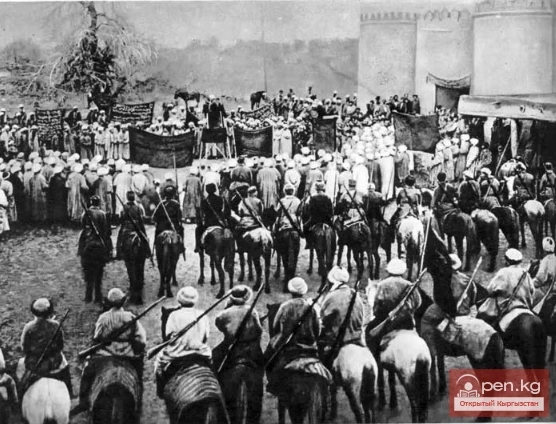
Gunshots thundered. The drummers, who stood nearby the yurt, struck the drums so furiously that it seemed the earth roared. The horses, peacefully grazing, raised their heads and became alert. The army began to flow towards the yurt, towards the green banner that fluttered above the heads of the slowly moving standard bearers. In front of the standard bearers, two warriors stepped forward with raised naked curved swords at shoulder height. Under the shade of the banner walked Yusup; his eyes were red, his face alternately flushed and pale. Sheraly continued to smile and looked at the warriors greeting him with grateful and happy eyes. They stepped leisurely onto the blooming riverside meadow. The cheerful river sparkled in the sun with a silver-scaled shine; in the middle of the meadow, a dazzling white square of carefully spread felt lay. People gathered around it from all sides — like ants around spilled milk. Yusup, Sheraly, the standard bearers, and the retinue headed straight for the white felt, to the white khan's felt.
People parted, giving way, bowing and prayerfully pressing their hands to their chests.
- Where is he, where? Which one? ...
- Here he is, here!
- He has rawhide chockoi on his feet... God Almighty, worn out, crooked chockoi!
- Hi... hi...
- You, be quiet! Don’t let your head be taken off your shoulders...
Yusup's devilishly sensitive ears heard all this. “Good. Very good,” he thought. “Let the people see. Let them see who this Sheraly was. Let them know whose strong hands raised him on the white felt. Let them tell from generation to generation...”
The procession stopped. The horns thundered, the drumbeats fell like a sweet chill on the hearts.
At the felt sat the aksakals. They rose, greeting those who approached.
- Assalam aleikum, esteemed elders! - Yusup greeted first in a sing-song voice.
The old men responded in a dissonant chorus.
- Wa aleikum assalam, son of your father! Safe travels to you! May the holy Khizr accompany you...
The ceremony of proclaiming the khan began.
- Begin... - Yusup said quietly.
Abil-biy, at these words, looked over his shoulder and called:
- Ashir!
A rosy, handsome young man immediately ran up to him.
- At your service, Abish... - said the jigit, and it was clear that by just one word from Abil-biy, he was ready to go through fire and water.
Abil-biy pointed at him with his hand.
- Take him!
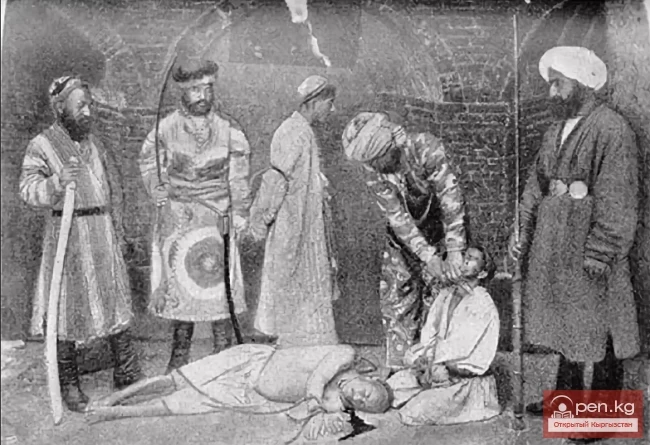
Silently, the warriors took the young man by the arms. He did not resist, did not struggle, only turned pale in an instant and glanced at Abil-biy, but he did not look at the young man. The sounds of the horns and the dull, anxious beating of the drums echoed in the jigit's head with only one word: “death”! It suddenly and inevitably raised its sword over him, and he had neither the strength nor the opportunity to resist it. The ulema shouted the name of God, the faces of the people around froze in a hard stillness, and no one dared to look the doomed straight in the eye. The warriors gradually pushed the jigit to the edge of the white carpet.
Do not be afraid... do not be afraid... Nothing will happen...
The gentle voice sounded like a farewell prayer. The young man suddenly calmed down, slowly closed his eyes. Obeying the strong hands, he knelt down. Death! Death! His heart thudded heavily. Not to be afraid? Nothing will happen? Hope had not yet faded; a small spark from a distant fire glimmered in the approaching darkness. Maybe this is not a real sacrifice, just a semblance, a ritual. They will strike hard, so that blood will show... A little blood...
Now they had tied the jigit's hands behind his back. Another hand took him by the chin so that his head was thrown far back. Cold steel touched his open throat. A shiver ran through his body.
- Mama!
He wanted to break free, but could only convulsively shrug his shoulders. In the next moment, the merciless dagger ended the life of the young man.
- Allahu akbar! Allahu akbar! In the name of God... in the name of the sultan... in the name of the holy spirit... Allahu akbar!
A scarlet stream, glistening in the sun, splashed onto the white felt with hot blood. The air was filled with the scent of blood, hot blood. The pipes and drums celebrated the bloody triumph.
Scarlet flowers bloomed on the white felt. Yusup and Musulmanqul led Sheraly onto the carpet and made him step over the head of the sacrificed Ashir. They stopped in the very middle.
- God bless you! - said Yusup with a gentle smile. Thus, Sheraly was proclaimed khan.