The Tomb of Manas - an architectural monument of the Middle Ages.
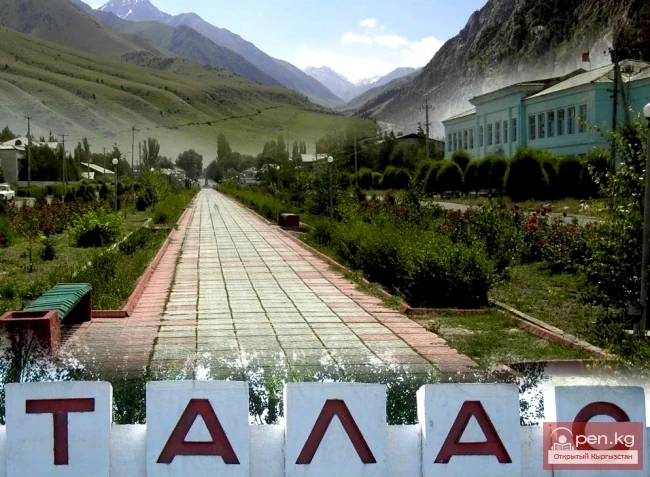
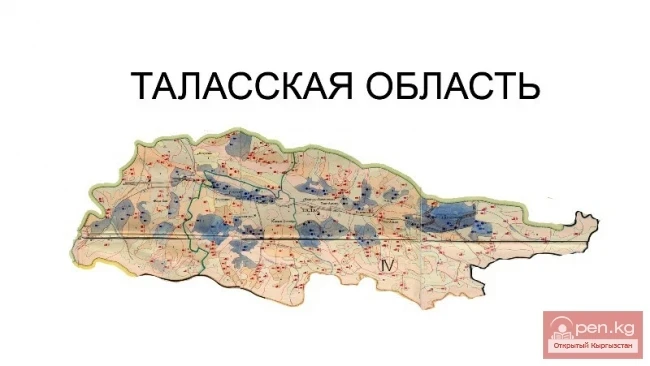
The unique historical monument of the tomb (mausoleum) of Manas is located 22 km from the city of Talas to the northeast of the city. It belongs to the attractions of the Great Silk Road era that have survived to this day.
This monument of medieval architecture in Kyrgyzstan, located in the upper reaches of the Talas River, is the burial place of Kanyzyak-khatun, the daughter of Emir Abuka, and, according to legend, the tomb of the hero Manas. It was built in 1334.
Away from ancient trade routes, south of the city of Taraz, beyond the Big Kapka gorge, deep in the Talas Valley, among the mountains, stands a low, austere domed building in the lands of the Ail Dolono. The dimensions of the structure are not large, but every resident of the country knows about its existence from childhood; this is the Tomb of Manas.
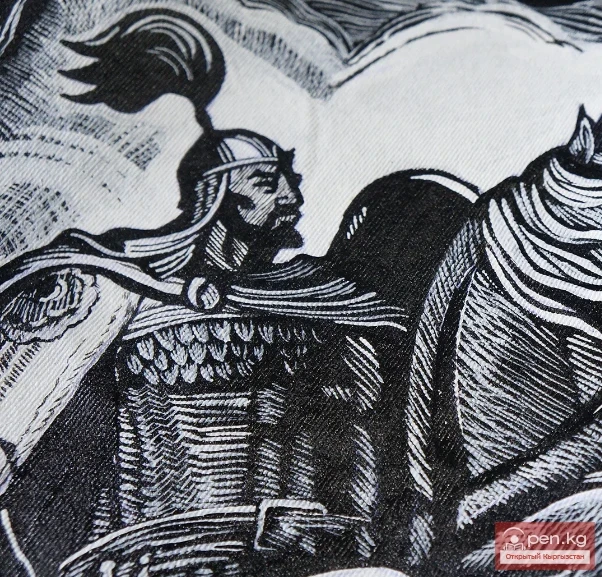
The tomb, or mazar of Manas, is a mausoleum in which, according to legend, the remains of the epic hero, the national hero, and the main character of the eponymous epic - Manas - rest.
According to one of the existing legends, the mausoleum was built by the hero's son - Sementei, who transported the body of the fallen hero to Akhytash. According to another, Manas's wife - Kanykey, ordered a mausoleum to be erected here for her husband and even invited craftsmen from Bukhara and Samarkand, and to divert the enemy's attention from Manas's last refuge, she ordered the name of a completely unrelated wealthy woman to be inscribed on the mausoleum.
But legends aside, we want to know how things really are.
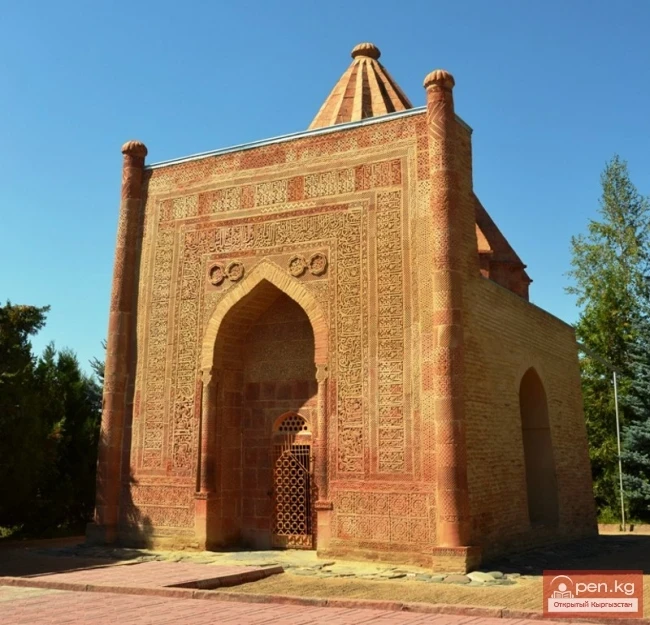
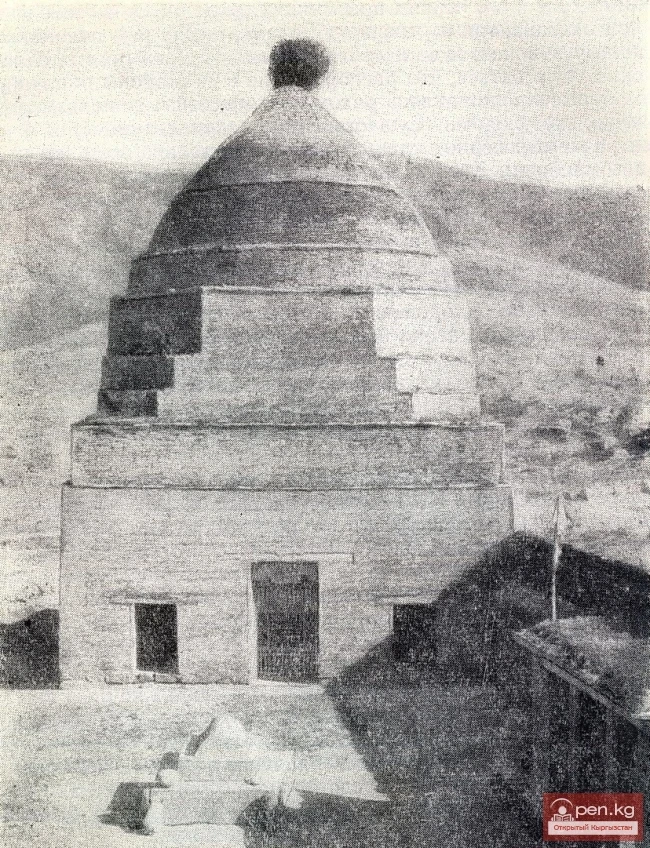
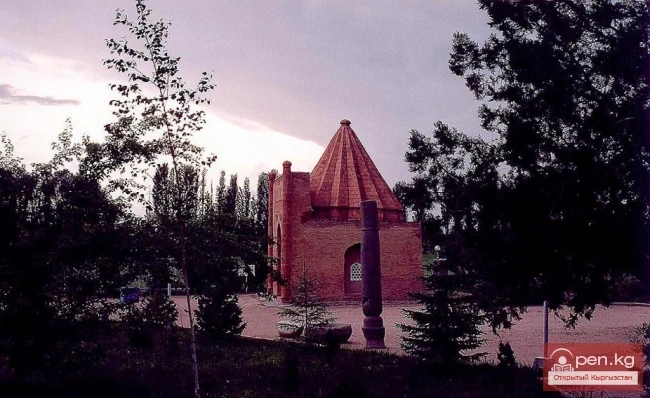
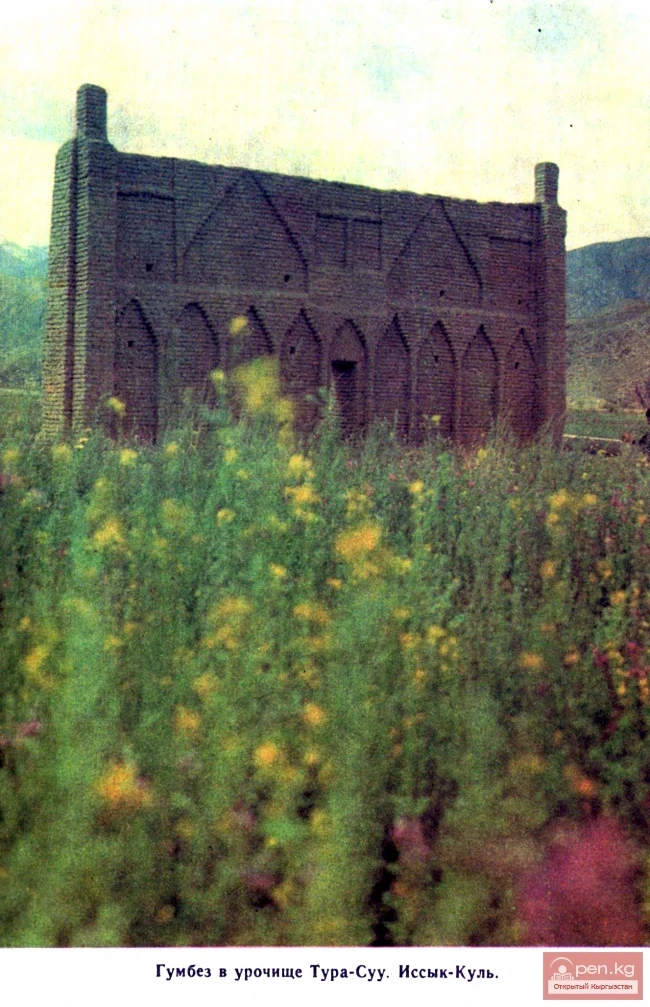
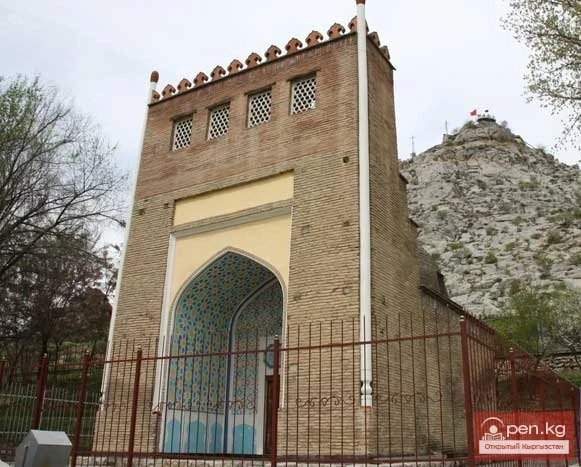
As mentioned above, the mausoleum is relatively small, with a height of 11 m, and the length of each of the facade sides is 7 m. However, it creates an impression of grand monumentality, achieved through the careful calculation of three external volumes.
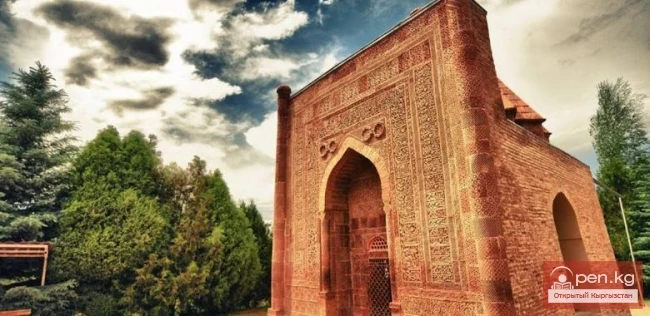
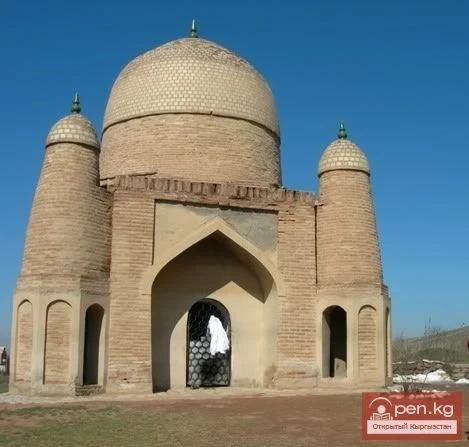
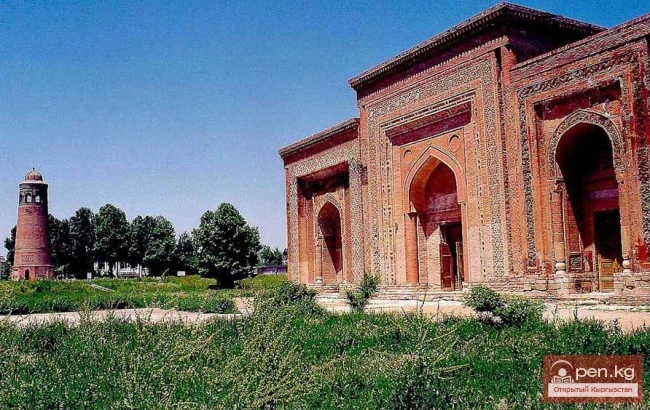
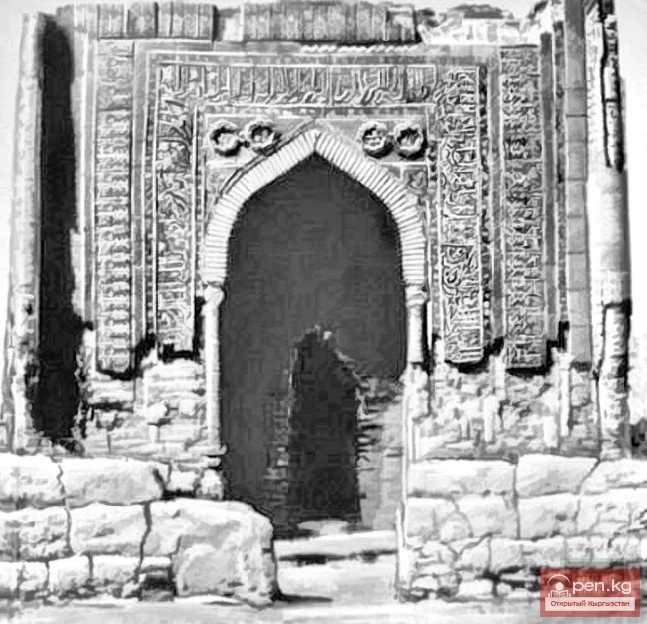
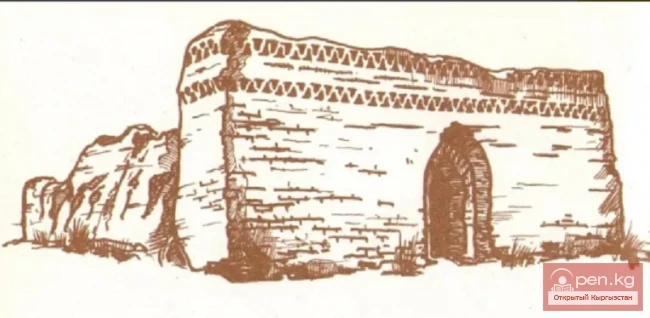
The structure represents a central mausoleum made of burnt brick with a cubic base, a domed ceiling, a grand portal entirely clad in carved terracotta, and a pointed niche for the entrance.
The portal-peshtak is a true work of art. On both sides of the entrance niche, it is adorned with various columns, decorated with a whole set of artistic friezes, faced with terracotta tiles, featuring cut-out floral patterns and Kufic inscriptions.
It is from the inscriptions on the portal that it becomes clear that the mausoleum was built in honor of a certain Kenizak Khatun - the deceased daughter of Emir Abuka.
Her grave is significantly shifted to the eastern side of the building to leave room for the future burial of her grieving father, who, despite the overwhelming sorrow, outlived his daughter by a significant margin.
According to archaeological research data, the burial site has repeatedly been subjected to the invasion of "black diggers."
As it turns out, the Tomb of Manas is merely a monument that has no relation to the actual burial.
The faithful wife of Manas - Kanykey, turned out to be wiser and buried the remains of her dear husband somewhere in unknown rocks, leaving only a beautiful building for plunder and desecration.
Soviet scientists completed the restoration of the Tomb of Manas in 1970. In terms of its structure, the architecture of the mausoleum is represented by portal-type buildings. In the plan of the Tomb of Manas, three main components can be distinguished.
The portal of the main facade, which is covered with ornamental plates of carved terracotta, and a square base with a faceted tent dome. The pattern of the ornamental plate is extraordinarily similar to the patterns of Kyrgyz applied art. The geographical ornament has calligraphic inscriptions.
The inscriptions create an interesting and quite complex play of light and shadow in bright lighting. They have tonal softness and beauty in overcast weather. The artistic decoration of the Tomb of Manas is a vivid example of how the patterns of applied art intersect with architecture. The Tomb of Manas has greatly influenced the development of architecture in Kyrgyzstan.
After conducting archaeological research, scientists concluded that the Tomb of Manas was a burial site for a long time. The deceased were buried in ancient coffins under the floor of the mausoleum. After some time, the old graves were destroyed, and new burials were created in their place.
The Tomb of Manas represents a central mausoleum with a cubic base and domed ceiling, with a portal clad in carved terracotta and a pointed arch of the entrance niche. The high portal currently covers the destroyed dome from the facade. The mausoleum is constructed of burnt bricks measuring 23x23x5.5 cm. The length of the sides of the base of the mazar is 6.80 x 7.16 m; the total height is 7 m (A.N. Bernshtam, 1950).
Currently, the floor of the mausoleum is covered with earth; according to available information, the mausoleum has been excavated multiple times. A.N. Bernshtam conducted a cleaning of the mausoleum in the 1950s to determine the nature of the burial: excavations showed that everything inside the mausoleum had been disturbed and destroyed. At the beginning of the work, the floor, consisting of a twig woven mat on beams coated with clay, was uncovered. Under the floor were four empty wooden coffins oriented from north to south.
In his work, M. Masson dates these coffins to the 14th century. Below these coffins were the main burials of the mausoleum: the right (eastern) one was completely looted and destroyed. It represented a rectangular pit elongated from north to south. The burial pit was covered with a pointed vault made of burnt bricks of the same size as the bricks in the walls of the mausoleum. The pit was found without a burial, filled with earth and debris. This grave was separated from the neighboring one by a loess partition formed during the creation of the burial pit for another burial, also oriented from north to south, but at a slight angle to the first.
The second grave was covered with raw bricks placed at an angle of almost 90 degrees to each other, with clay-coated seams. The burial had not been looted and contained the skeleton of a middle-aged man. There were no items near the skeleton (A.N. Bernshtam, 1950).
According to the inscription on the portal, the mausoleum was built in memory of a certain Kenizak Khatun, the daughter of Emir Abuka.
The inscription, as read by A. M. Belinitsky, is as follows: “(this majestic tomb) of the virtuous, chaste (literally - closed), modest (literally - covered with a veil), ideal of happy (women), initiator of pious deeds, fourth (support) of the era, the most glorious of women, Kenizak Khatun, daughter of the excellent, revered, respected emir, source of generosity and mercy, victor by pen and sword, Emir Abuka, and may Allah make paradise their dwelling: and this was at the beginning of the month of Ramadan, which is the month of Allah blessed in the fourth year” (A. M. Belinitsky, 1948).
From the inscription, it is evident that the father died later than his daughter, and she has the grave with a semi-circular vault made of burnt bricks.
Her grave was deliberately shifted to the eastern side of the mausoleum to leave room for the future burial of her father. The second grave can be considered belonging to her father, “Emir Abuka.” The slight difference in orientation is, in our opinion, caused by the different times of burial.
As excavations have confirmed, the mausoleum has no relation to the epic hero Manas, with whose name this mausoleum is associated by popular rumor. This mazar is a tomb structure where the remains of a father and daughter are buried, the exact dates of whose lives remain unknown to us. These dates were indicated in the inscription, but the facing tiles with this information have fallen out and been lost.
The mausoleum was built on the eve of Timur's campaigns, who established bases in Talas (particularly in the city of Sheldzhi) for the campaign to China. At the same time, the Kyrgyz tribes were rising in Moghulistan to fight for independence, only in the early 16th century, almost 150 years later, declaring themselves in Tian Shan, including in Talas. Thus, a column appeared in the Shaker settlement, which is considered to be Manas's hitching post. Isn't the small mountain on which the mausoleum stands his watchtower - “Manas Supa”?
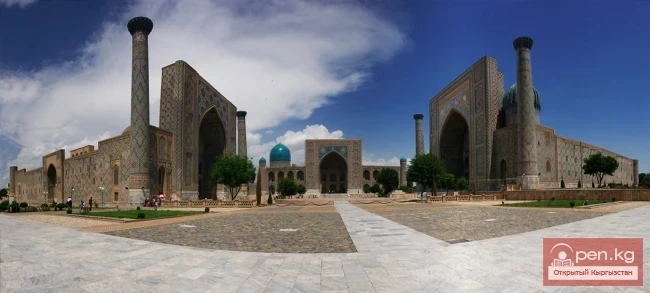
Therefore, the Tomb of Manas is a monument, not a burial site, as they believe in Kyrgyzstan. It was precisely to prevent the remains of the hero from being desecrated that he was buried among unknown rocks, where his treasures were also placed. His faithful companion Kanykey, to create a monument to Manas, called craftsmen from Bukhara and Samarkand; and here the epic is right, for in the craftsmanship of this structure, the experience of the builders of Maverannakhr is felt.