The Education of the Ancient Kyrgyz
We do not have data on the development of science and education among the nomadic peoples of ancient Kyrgyzstan. However, they did possess some initial scientific concepts. This is evidenced by the ancient nomadic population's ability to work with metal, gold, improve weaponry, and some cultural achievements (for example, the 12-cycle calendar, whistling arrows). The acquisition of primitive scientific ideas among the nomadic population was also facilitated by their proximity to the ancient civilization of China and other oases of Central Asia, especially the ancient state of Dayuan.
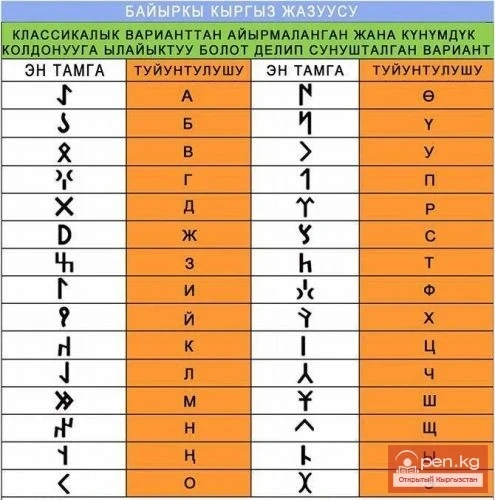
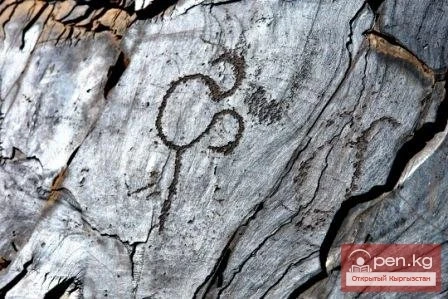
The nomadic peoples did not invent writing, but they could have used the writing systems of China and Sogdiana. The Turkic (ancient Kyrgyz) script, which emerged in the 6th century AD, has its roots in Sogdian writing.
The Huns were the progenitors of the system of nomadic statehood. Therefore, we can assert that they, including the Kyrgyz, had rudimentary legal skills. Based on the customs and traditions of the people, the norms and rules of social life among the ancient Huns were passed down from generation to generation and became immutable canons. The Chinese believed that the laws of the Huns were easily enforceable. Serious crimes were punishable by death. Those who committed minor offenses were branded on the face. Those caught stealing lost all their property, and within 10 days, their family members were also held accountable. During the period of increased power of the shanyu (3rd-1st centuries BC), laws were introduced that provided for responsibility for crimes against the interests of the state. For example, those who evaded military service or violated military discipline were sentenced to death.
The scientific concepts of the settled population of Kyrgyzstan, that is, the inhabitants of the state of Dayuan, were more significant. For instance, the culture of the Ferghana Valley reached a high level. Irrigation works were carried out, particularly the construction of artificial irrigation canals, which significantly increased agricultural efficiency. In the 4th-1st centuries BC, the Dayuan people mastered glass production, developed a special variety of rice (the ancestor of the modern Uzgen rice variety), improved cotton cultivation, and used the most progressive technology for flour production. The breeding of thoroughbred horses indicates the presence of initial scientific ideas in the field of animal breeding.
Significant development occurred in grape growing and winemaking. Ancient Chinese sources indicate that many grape varieties and a special type of grass (bede) for fattening horses were brought to China from Dayuan. These facts suggest that ancient Ferghana had the beginnings of agronomy.
According to indirect evidence, during the period of the Dayuan state, some residents of Ferghana could write, and therefore, one of the varieties of Sogdian writing was used in the state.
Read also:
The Culture of the Kyrgyz from Ancient Times to the 6th Century
The cultures of the ancient peoples of Kyrgyzstan are considered in close connection with one...
The Religion of the Kyrgyz in Ancient Times
The foundation of marital and family relationships among the nomadic population of ancient...
Activists Presented the Updated Alphabet "Ancient Writing of the Kyrgyz"
Members of the literary club and public foundations "Aitysh," "Kochmon,"...
The Education of Kyrgyz in the 6th to 18th Centuries
The Karakhanid period, as the apex of Turkic civilization, was a time when science and education...
Military Forces of the Kyrgyz from Ancient Times to the 6th Century
The military art that prevailed during the ancient and medieval periods among the nomadic tribes...
Governance in Ancient Kyrgyzstan Before the 6th Century
Kyrgyzstan is one of the world’s centers of human emergence, statehood, and civilization. The life...
The Territory of the Kyrgyz from Ancient Times to the 6th Century
The Saka tribes were divided into three parts. In the southern regions of Kyrgyzstan lived the...
Military Forces of the Kyrgyz in the 6th to 18th Centuries
The structure, organization, and supply of the armed forces of the Kyrgyz during that period were...
Population of Kyrgyzstan from Ancient Times to the 6th Century
The first reliable traces of humans on the territory of Kyrgyzstan date back to the Paleolithic —...
Medieval Weapons from the Territory of Kyrgyzstan
The necessity of expanding the source base of medieval weapons. The medieval history of Kyrgyzstan...
Scientific Achievements and Tasks of Kyrgyz Historical Science in the Study of the History of the Kyrgyz and the Kyrgyz Republic
A new stage in the study of the history, population, economy, and nature of Kyrgyzstan began after...
Natural Resources of the Kyrgyz in the Bronze Age
The main landscape of Kyrgyzstan consists of mountains. Enclosed mountain valleys are surrounded...
Burial Chambers of Bactria
From Ossuary Burials to Corpse Placement For historical reconstructions, burial rites are...
The Culture of the Kyrgyz in the 6th—18th Centuries
The ancient Turkic nomads who inhabited the territory of Kyrgyzstan left behind unique monuments —...
A.N. BERNSTEIN - Researcher of Ancient Cultures of Central Asia. Part - 3
The Brilliant Insights of the Talented Scholar - Alexander Natanovich Bernstein In his work...
The Territory of the Kyrgyz in the VI—XVIII Centuries
All political entities of the Middle Ages in the territory of Central Asia somehow affected the...
Kyrgyz Khaganate: The Leading Nomadic State in Central Asia from the Mid-9th to the First Quarter of the 10th Century
Kyrgyz Great Power During the VI-VIII centuries, when the Kyrgyz state existed only in the...
The Food Culture of the Kyrgyz in the Second Half of the 19th Century.
The Food Culture of the Kyrgyz The formation of the traditional food culture of the Kyrgyz went...
The Population of Kyrgyzstan in the VI—XVIII Centuries
The ethnonyms “Turk” and “Turkut” were first mentioned in a Chinese chronicle from the year 546....
A.N. BERNSTEIN - Researcher of Ancient Cultures of Central Asia. Part - 2
A.N. Bernstein's Interest in the Ethnogenesis of Turkic Peoples During the war years, A.N....
Mineralogy and Mining
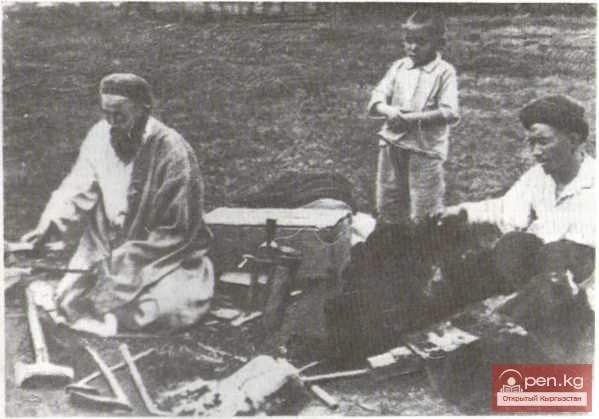
The forge of the zergers. Mid-19th century. The photo is kept in the State Historical Museum...
Military Forces of the Kyrgyz in the 18th - Early 20th Century
Since the Kyrgyz did not have their own state formation during the period in question, there is no...
Ancient Kyrgyz under the Rule of the Huns
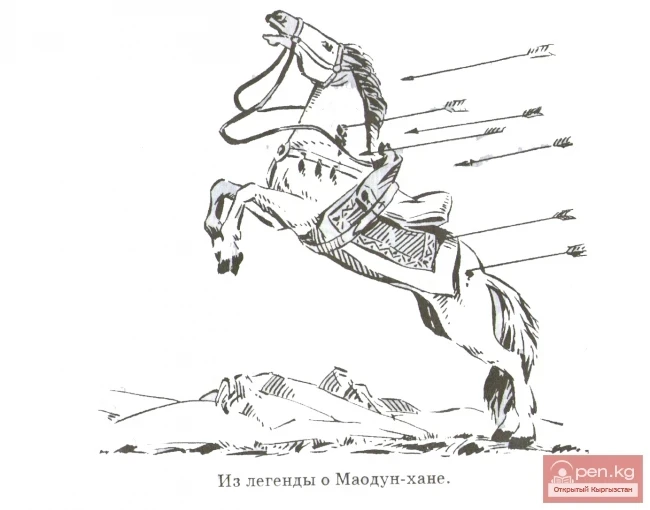
The word “Kyrgyz” is first mentioned alongside the name of the king of the Huns, Maodun-khan...
The Population of Kyrgyzstan in the 18th - Early 20th Century
Historical information about the size of the multi-ethnic population of the Fergana Valley during...
A.N. BERNSTEIN - Researcher of Ancient Cultures of Central Asia. Part - 1
A.N. Bernstein's Interest in the History and Ethnography of Turkic Peoples A.N. Bernstein -...
The Underwater City of Lake Issyk-Kul
Secret places of the planet. The Kyrgyz are one of the oldest peoples of Central Asia. They...
Phonetics in the Kyrgyz Language. Part - 2
Main Features of the Grammatical Structure in the Kyrgyz Language For centuries, speakers of the...
Aggressive-Expansionist Policy of Manchu-Qing China in Eastern Turkestan
Armed Resistance of the Kyrgyz Against Chinese Troops At the same time, Eastern Turkestan became...
The exhibition "Mongols: A Journey Through Time" will open at the Rietberg Museum in Zurich.
This exhibition aims to showcase the evolution and historical development of urban planning in...
Famous Russian traveler Fyodor Konyukhov is preparing his expedition to Lake Issyk-Kul to search for an ancient monastery.
Famous Russian traveler Fyodor Konyukhov is preparing his expedition to Lake Issyk-Kul to search...
Pre-scientific Representations of the Kyrgyz about Nature
Knowledge and understanding of natural processes in which human life takes place is a prerequisite...
Divinations of the Ancient Kyrgyz
Let us now turn to the ancient myths and legends of the ancient Kyrgyz people regarding cosmology...
Kurut - An Invention of the Nomadic Peoples of Central Asia
Kurut This is a fermented milk product in the form of small dried balls, a unique Central Asian...
Sulaiman-Too - the symbol of the ancient city
"The Business Card" of the City of Osh When narrating the life of the Alaï queen, one...
Worldview Concepts of the Surrounding World
Most geographical names in Kyrgyzstan have local etymology. The origin of several toponyms is...
The State of the Karakhanids (940—1212)
Karakhanid State (940—1212 years). From the mid-10th century to the early 13th century, the Turkic...
Geographical Representations of the Kyrgyz People
The close connection of the Kyrgyz as a nomadic people with their environment required them to...
The title translates to "Dwellings of the Kyrgyz."
SETTLEMENT AND DWELLING The presence of two different types of economic activities in the 19th and...
The Era of the Great Migration of Peoples
NOMADS ARE HEADING WEST The concept of the "Great Migration of Peoples" was introduced...
Artistic Crafts
Artistic Crafts: Traditions and Modernity The decorative and applied arts of various territorial...
"The First Wave of Globalization": How Animals Paved the Great Silk Road
How Animals Paved the Great Silk Road “The ‘discoverers’ of the Great Silk Road were animals,” say...
The First Stage of Developing a New Architecture
The development of new architecture began with the establishment of Soviet power in the territory...
The First Concepts of the Kyrgyz about the Universe
In ancient times, when Islam had not yet spread among the Kyrgyz, they worshipped the Sun....
State Historical Museum of the Kyrgyz Republic
The State Historical Museum of the Kyrgyz Republic is one of the largest museums in Central Asia....
The Economy of the Kyrgyz in the VI—XVIII Centuries
The economy of Kyrgyzstan during the era of Turkic states experienced syncretic development (a...
The Sphere of Spiritual Production in Ancient Central Asia
IDEOLOGICAL SYSTEMS OF ANCIENT CENTRAL ASIA As is known, ideology represents a set of ideas and...
The Yenisei Kyrgyz in Antiquity
Kyrgyz-Gyangu The earliest mention of the Kyrgyz under the Chinese name “gyan-gun”, “heguni”, or...