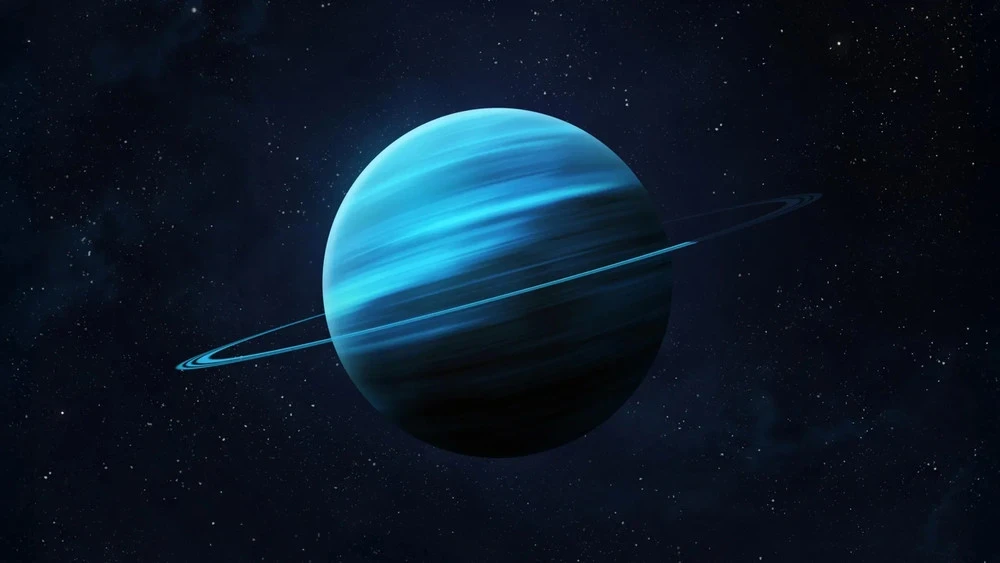
The solar system is traditionally divided into groups based on composition: four rocky planets (Mercury, Venus, Earth, and Mars), two gas giants (Jupiter and Saturn), and two ice giants (Uranus and Neptune). However, new research suggests that Uranus and Neptune may have a much rockier structure than previously thought.
The study does not claim that these planets are necessarily rich in rocks or water. Rather, it emphasizes that the existing notion of an icy core as the only possible model is not definitive. This interpretation is also consistent with findings about the dwarf planet Pluto, which is primarily composed of rocky materials.
To analyze the internal structure of Uranus and Neptune, scientists applied a unique modeling technique. "The classification of ice giants is overly simplified, as Uranus and Neptune are still not well understood," noted Luca Morf, a PhD student at the University of Zurich and the lead author of the study.
The modeling process involves randomly generating a density profile for each planet. The team then determines the gravitational field corresponding to the observed data based on this profile and uses it to infer possible composition. This cycle is repeated until the model becomes as accurate as possible according to the available data.
By applying an unbiased and physically grounded approach, the researchers concluded that the internal structure of ice giants is not limited to just ice, which is typically perceived as water. "We began proposing this hypothesis nearly 15 years ago, and now we have numerical data to support it," added Professor Ravit Helled from the University of Zurich and the project's initiator. The results indicate that each of the planets may have both water and rocky layers.
Additionally, the new data provide a deeper understanding of the magnetic fields of Uranus and Neptune. Unlike Earth's magnetic field, which has two distinct poles, the magnetic fields of these planets are more complex and multipolar. Helled noted that the models include layers of "ionic water," which create magnetic dynamo effects that explain the observed anomalies in the magnetic fields. Furthermore, it was found that Uranus's magnetic field may have a deeper source than Neptune's.
Despite the new interpretations, uncertainties remain. "One of the main issues is that physicists do not yet fully understand how materials behave under the exotic temperatures and pressures observed in the planets' cores, which may affect our conclusions," emphasized Morf.
The results obtained open new possibilities for understanding the internal structure of planets, challenging long-held assumptions and highlighting important aspects in materials science under planetary conditions. "Uranus and Neptune can be both rocky and icy giants, depending on the models we use. Currently, there is not enough data to distinguish between them, which underscores the need for special missions to these planets to uncover their true nature," concluded Ravit Helled.