About Kyrgyzstan

{title}
State structure
{title}
National symbols
{title}
Government
{title}
Armed forces
{title}
National currency
{title}
Banknotes
{title}
Circulation coins
{title}
Collectible coins
{title}
Political organization
{title}
Domestic policy
{title}
Foreign policy
{title}
History
{title}
Kyrgyz in antiquity
{title}
Kyrgyz in the VI-XII centuries
{title}
Kyrgyz in the XIII—first half of XVIII century
{title}
The struggle for the independence of the Kyrgyz
{title}
Kyrgyzstan as part of Russia
{title}
Kyrgyzstan during the Soviet period
{title}
Kyrgyzstan — a sovereign state
{title}
Historical records
{title}
Kurmanjan Datka
{title}
Chagatai Ulus. Haidu State. Moghulistan
{title}
History and archeology of the ancient Tien Shan
{title}
Peoples movements of Central Asia in the XIX century
{title}
Kyrgyzstan during the Great Patriotic War
{title}
Kyrgyzstan in the 1920s
{title}
1937 in Kyrgyzstan
{title}
Shabdan Baatyr
{title}
Territory, geography and administrative division
{title}
Chuy Region
{title}
Attractions of Chuy Region
{title}
Issyk-Kul Region
{title}
Sights of Issyk-Kul
{title}
Naryn Region
{title}
Attractions of Naryn Region
{title}
Talas Region
{title}
Attractions of Talas Region
{title}
Osh Region
{title}
Attractions of Osh Region
{title}
Batken Region
{title}
Attractions of Batken Region
{title}
Jalal-Abad Region
{title}
Attractions of Jalal-Abad Region
{title}
Cities
{title}
Bishkek
{title}
Streets of Bishkek
{title}
Pishpek - Frunze - Bishkek
{title}
History of the capital of Kyrgyzstan in documents
{title}
Osh
{title}
Osh - 3000
{title}
Naryn
{title}
Jalal-Abad
{title}
Batken
{title}
Talas
{title}
Karakol
{title}
Tokmok
{title}
Cholpon-Ata
{title}
Uzgen
{title}
Kochkor
{title}
Kemin
{title}
Balykchy
{title}
Kyzyl-Kiya
{title}
Mailuu-Suu
{title}
Sulukta
{title}
Tash-Kumyr
{title}
Toktogul
{title}
Kara-Kul
{title}
Kara-Balta
{title}
Kara-Balta - Black Ax
{title}
Kant
{title}
Villages
{title}
Population
{title}
Language
{title}
Diaspora
{title}
Nature
{title}
Climate
{title}
Natural ecological complexes
{title}
Water resources
{title}
Rivers
{title}
Lakes
{title}
Secrets of Issyk-Kul Lake
{title}
Reservoirs
{title}
Waterfalls
{title}
Mineral waters
{title}
Flora
{title}
Fauna of Kyrgyzstan
{title}
Mammals of Kyrgyzstan
{title}
Birds of Kyrgyzstan
{title}
Fish of Kyrgyzstan
{title}
Amphibians and reptiles of Kyrgyzstan
{title}
Insects of Kyrgyzstan
{title}
Mountains and glaciers
{title}
Mountain ranges
{title}
Mountain peaks
{title}
Mountain passes
{title}
Glaciers
{title}
Caves
{title}
Gorges
{title}
National parks and reserves
{title}
Pastures and valleys
{title}
Soil and minerals
{title}
Red Book
{title}
Fungi and higher plants
{title}
Animals
{title}
Arthropods
{title}
Fish
{title}
Amphibians and reptiles
{title}
Birds
{title}
Mammals
{title}
Economy of Kyrgyzstan
{title}
Entrepreneurship
{title}
Agriculture
{title}
Finance
{title}
Construction
{title}
Industry
{title}
Transport and communications
{title}
Socio-economic resources
{title}
Tourism industry
{title}
Healthcare
{title}
Education
{title}
Sports
{title}
Science
{title}
Environmental science
{title}
Mass media
{title}
Art
{title}
Dances
{title}
Ballet
{title}
Decorative and applied arts
{title}
Musical instruments
{title}
Architecture
{title}
Painting
{title}
Music
{title}
Theater
{title}
Cinema
{title}
Sculpture
{title}
Circus
{title}
Literature
{title}
Photography
{title}
Culture
{title}
Epigraphy
{title}
Folklore
{title}
Kyrgyz heroic epic "Manas"
{title}
The epic "Manas" in prose
{title}
Poetic retelling of the epic "Manas"
{title}
"Semetey" - poetic story
{title}
"Semetey" in prose
{title}
Religion
{title}
Ethnography
{title}
National games
{title}
Customs
{title}
Myths and legends
{title}
Kyrgyz fairy tales
{title}
Kyrgyz cuisine
{title}
Meat and offal dishes
{title}
Soups of Kyrgyzstan
{title}
Main dishes of Kyrgyzstan
{title}
Sweet dishes of Kyrgyzstan
{title}
Drinks of Kyrgyzstan
{title}
Salads and appetizers
{title}
Flour products
{title}
Miscellaneous information about Kyrgyzstan
{title}
Historical and holiday dates of Kyrgyzstan
{title}
Famous personalities of Kyrgyzstan
{title}
Women of Kyrgyzstan
{title}
Historical figures
{title}
Heroes of Kyrgyzstan
{title}
Hero of the Kyrgyz Republic
{title}
Heroes internationalists
{title}
Heroes of Kyrgyzstan in World War II
{title}
Kyrgyzstanis — Full cavaliers of the Order of Glory
{title}
Writers of Kyrgyzstan
{title}
Inventors of Kyrgyzstan
{title}
Scientists of Kyrgyzstan
{title}
Architects of Kyrgyzstan
{title}
Artists of Kyrgyzstan
{title}
Musicians of Kyrgyzstan
{title}
Cinematographers of Soviet Kyrgyzstan
{title}
Actors of Kyrgyzstan
Poet Alexander Zaitsev
Writers of Kyrgyzstan

Poet Alexander Zaitsev

Poet A. Zaitsev was born on February 3, 1935, in the city of Kyzyl-Kiya, Osh region, in a family of civil servants. Having lost his parents at an early age, he was raised in Frunze by his grandfather. In 1949, he graduated from seven grades in Frunze, in 1951 — from a vocational school in Voroshilovgrad, and in 1977 — from the correspondence department of the A. M. Gorky Literary Institute under the USSR Union of Writers in Moscow. From 1954 to 1957, he served in the ranks of the Soviet Army.

02.03.2015, 07:50
The Poet Kudaibergen Jumanaazarov
Writers of Kyrgyzstan

The Poet Kudaibergen Jumanaazarov

Poet K. Jumanaazarov was born on July 5, 1937, in the village of Jetigen, Toktogul district, Osh region, in a peasant family. In 1954, he graduated from the A. M. Gorky School No. 1 in Uch-Terek, in 1958 — from Frunze Technical School No. 1, and in 1966 — from the correspondence department of journalism at the Philological Faculty of KGU. He began his labor biography as a worker at the Frunze Agricultural Machinery Plant in 1954. From 1958 to 1960, he worked as a concrete worker at the

02.03.2015, 07:46
The Poet Anasbek Jumaliev
Writers of Kyrgyzstan

The Poet Anasbek Jumaliev

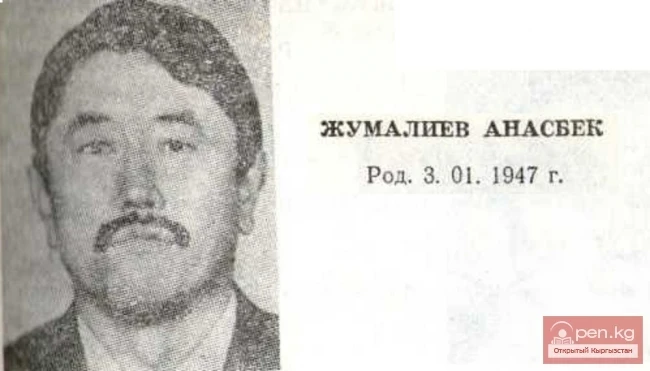
Poet A. Jumaliev was born in the village of Bala-Saru (now Manas District of Talas Region) in a farmer's family. In 1965, he graduated from Chon-Kurgan Secondary School in Kirov District, and in 1973, he completed the correspondence department of the philological faculty of KSU. He began his career as a senior pioneer leader at an eight-year school in his native village. Since 1968, he worked there as a teacher of his native language and literature, and since 1983, he has been the deputy

02.03.2015, 07:34
Critic, Literary Scholar Alexander Zhirkov
Writers of Kyrgyzstan

Critic, Literary Scholar Alexander Zhirkov

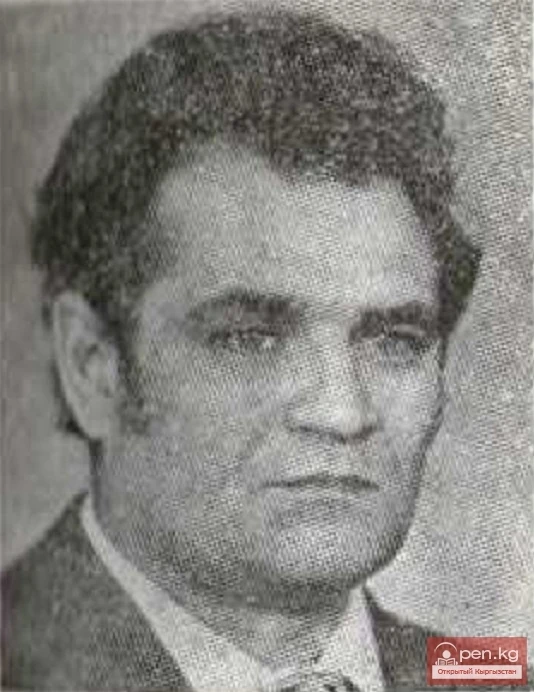
Critic, literary scholar A. Zhirkov was born on March 25, 1935, in the village of Ostrovskoye, Karaganda region of the Kazakh SSR, in the family of a rural teacher. In 1951, he graduated from high school in Kok-Yangak (Osh region of the Kyrgyz SSR), in 1956 he graduated from the philological faculty of KSU, and in 1963 he completed his postgraduate studies at KSU. In 1965, he defended his dissertation for the degree of Candidate of Philological Sciences. He began his career as the responsible

02.03.2015, 07:26
Poet Nurpais Zharkynbaev
Writers of Kyrgyzstan

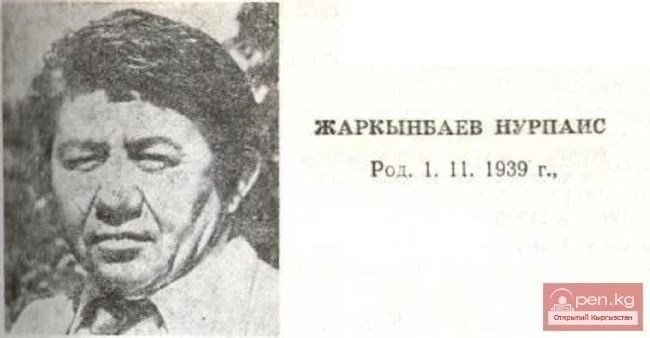
Poet Nurpais Zharkynbaev

Poet N. Zharkynbaev was born in the village of Dzhanay-Aryk in the Jumgal district of the Naryn region in a peasant family. He graduated in 1957 from Kyrgyz Secondary School No. 5 named after A. S. Pushkin in Frunze, and in 1962 from the philological faculty of K. GU. From 1973 to 1975, he was a listener at the Higher Party School of the Central Committee of the CPSU in Moscow. He began his labor biography in 1962 as a proofreader at the editorial office of the newspaper "Leninchil

02.03.2015, 07:11
Prose Writer, Poet Zhilkychi Zhapiev
Writers of Kyrgyzstan

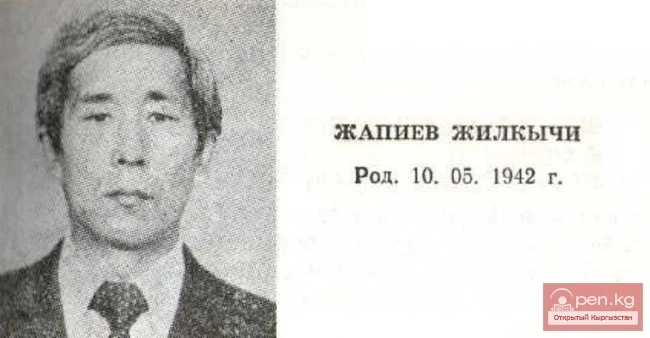
Prose Writer, Poet Zhilkychi Zhapiev

Prose writer and poet Z. Zhapiev was born in the village of Sary-Bulak in the Kalinin district of the Kyrgyz SSR to a collective farm worker's family. In 1960, he graduated from Erkin-Sai Secondary School, and in 1976, he completed the correspondence department of the philological faculty of the Kyrgyz State University named after the 50th anniversary of the USSR. He began his labor biography in 1960 as a pioneer leader in an eight-year school in his native village. From 1963 to 1966, he

02.03.2015, 07:03
Dramatist, Screenwriter, Prose Writer Beksultan Zhakiev
Writers of Kyrgyzstan

Dramatist, Screenwriter, Prose Writer Beksultan Zhakiev

Playwright, screenwriter, prose writer B. Zhakiev was born on January 16, 1936, in the village of Bokonbaev, Ton district, Issyk-Kul region, in a peasant family. In 1953, he graduated from high school in his native village, and in 1958, he graduated from the philological faculty of KGU. From 1960 to 1962, he was a student at the Higher Scriptwriting Courses in Moscow. He began his labor biography as a teacher at KGMU in 1958. Since 1963, he has been a member of the script-repertoire board of

27.02.2015, 13:46
Poet, Prose Writer Sandzhi Eginaliyev
Writers of Kyrgyzstan

Poet, Prose Writer Sandzhi Eginaliyev

Poet and prose writer S. Eginaliyev was born on December 9, 1925, in the village of Shalta, now part of the Sokuluk district of the Kyrgyz SSR, in a peasant family. In 1943, he graduated from 9th grade of secondary school, in 1949 he completed the Kyrgyz Secondary School No. 5 named after A. S. Pushkin in Frunze as an external student, and in 1953 he graduated from the philological faculty of KGU. In 1943, he was drafted into the ranks of the Soviet Army and participated in the Great Patriotic

27.02.2015, 13:26
Prose Writer, Poet, Screenwriter, Translator Leonid Dyadyuchenko
Writers of Kyrgyzstan

Prose Writer, Poet, Screenwriter, Translator Leonid Dyadyuchenko

Prose writer, poet, screenwriter, translator L. Dyadyuchenko was born on February 16, 1934, in Leningrad in a military family. Since 1938, he has lived in Frunze. In 1952, he graduated from Frunze Secondary School No. 6, and in 1957, he graduated from the mining and geology faculty of the FPI. He began his career as a geological engineer at the Institute of Geology of the Academy of Sciences of the Kyrgyz SSR. Since 1961, he worked as a special correspondent for the newspaper "Soviet

27.02.2015, 13:17
The Poet Shailoobek Duyyshev
Writers of Kyrgyzstan

The Poet Shailoobek Duyyshev

Poet Sh. Duyshiev was born on February 29, 1950, in the village of At-Bashi, At-Bashi District, Naryn Region, in a working-class family. In 1968, he graduated from high school in his native village, and in 1980, he graduated from the philological faculty of K. GU named after the 50th anniversary of the USSR. From 1968 to 1970, he served in the ranks of the Soviet Army. From 1970 to 1975, he worked as a laborer at MCO, a concrete worker at PMC, and a correspondent for the district newspaper in

27.02.2015, 12:06
Poet-Writer Abylkasyim Zhutakeev
Writers of Kyrgyzstan

Poet-Writer Abylkasyim Zhutakeev

Poet-writer A. Zhutakeev was born in 1888—1933 in the village of Jan-Bulak in the current Tian-Shan district of the Naryn region, in a poor family. Having lost his parents early, he worked as a laborer for wealthy landowners and manaps. He began composing his poems around the age of 13. At 15, while serving a village mullah named Budaychi, he learned to read and write and started recording his compositions from that point on. By the age of 20, he was known among his fellow villagers as a

27.02.2015, 11:40
Prose Writer Kenesh Dzhusupov
Writers of Kyrgyzstan

Prose Writer Kenesh Dzhusupov

Prose writer K. Dzhusupov was born on April 14, 1937, in the village of On-Arch, Tian-Shan district of Naryn region, in a peasant family. In 1954, he graduated from Otkuk Secondary School, and in 1961, he graduated from the philological faculty of KSU. He began his labor biography in 1957 as an accountant in his native collective farm, worked as a rural librarian, and as the secretary of the primary Komsomol organization. Since 1961, he has been a literary employee at the editorial office of

27.02.2015, 09:05
The Poet Sooronbay Jusuyev
Writers of Kyrgyzstan

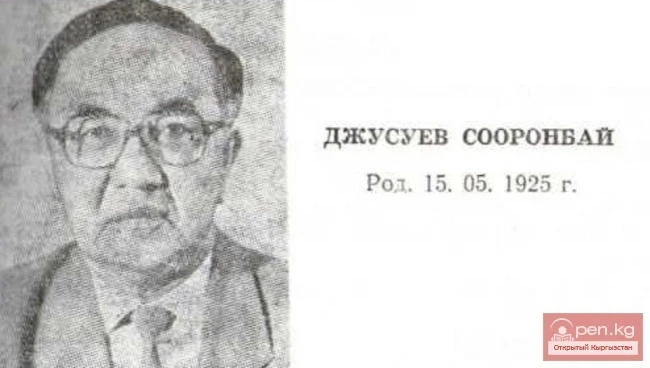
The Poet Sooronbay Jusuyev

Poet S. Dzhusuev was born in the wintering place Kyzyl-Dzhar in the current Soviet district of the Osh region. He studied at a rural school, graduated from the Osh Teacher Training Institute in 1949, and in 1956— from the A. M. Gorky Literary Institute under the USSR Writers' Union in Moscow. S. Dzhusuev is a participant of the Great Patriotic War, serving as a signalman in the Guards Division of General Panfilov from 1943 to 1945, and was wounded twice. From 1945 to 1947, he worked as

27.02.2015, 08:55
Prose Writer Kubatbek Dzhusubaliev
Writers of Kyrgyzstan

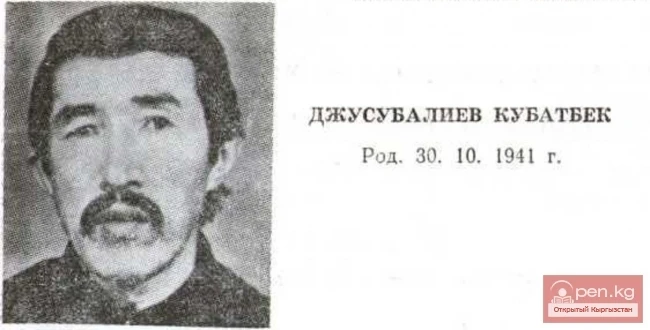
Prose Writer Kubatbek Dzhusubaliev

Prose writer K. Dzhusubaliev was born in the village of Kerdegey in the Alay district of the Osh region in a teacher's family. In 1957, he graduated from Kerdenginskaya Secondary School, and in 1963, he completed the journalism department of the philological faculty of KSU. From 1965 to 1967, he was a student at the higher screenplay courses in Moscow. He began his work biography in 1957 as a collective farmer, and from 1963, he worked as a teacher at the eight-year school

27.02.2015, 08:31
Poet Kanibek Junushev
Writers of Kyrgyzstan

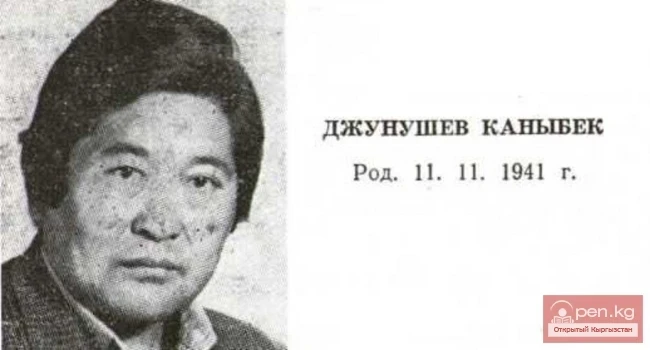
Poet Kanibek Junushev

Poet K. Junushev was born in the village of Kosh-Dyube in the Kochkor district of the Naryn region in a peasant family. In 1958, he graduated from the "Elektr" secondary school in his native village, and in 1963, he graduated from the agronomy faculty of the Kyrgyz State Agricultural Institute named after K. I. Skryabin. In 1963, he was assigned to the collective farm named after Zhdanov in the Tian-Shan district of the Naryn region as the chief agronomist. From 1965, he worked as a

27.02.2015, 08:25
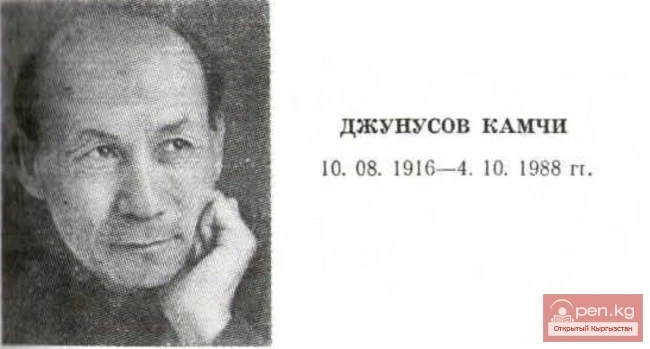
The Poet Kamchi Junusov
Writers of Kyrgyzstan

The Poet Kamchi Junusov

Poet K. Junusov was born in the village of Besh-Badam in the Nookat district of the Osh region into a peasant family of poor farmers. Having lost his parents early, he was raised in the Jalal-Abad orphanage starting from 1929. In 1937, he graduated from two courses of the agronomic (now agricultural) technical school in Osh, in 1938 — from the Republican Party School under the Central Committee of the Communist Party of Kyrgyzstan, and in 1943 — from a military-political school. From 1955 to

27.02.2015, 08:11
Poet Ninakan Jundubaeva
Writers of Kyrgyzstan

Poet Ninakan Jundubaeva

The poet N. Jundubaeva was born on October 20, 1917, in the village of Kochkorka in the Kochkorka district of the Naryn region, in a family of poor peasants. From 1929 to 1934, she was raised in the Naryn orphanage, and until 1936, she studied at the ShK.M in Kochkorka. In 1956, she graduated from the Republican Party School under the Central Committee of the Communist Party of Kyrgyzstan, and in 1967, she completed the correspondence department of the Almaty Higher Party School. From 1936 to

27.02.2015, 08:01
The Poet Usenkul Jumabaev
Writers of Kyrgyzstan

The Poet Usenkul Jumabaev

Poet U. Jumabaev was born on March 23, 1923—August 20, 1976, in the village of Kara-Dyube, Chui region of the Kyrgyz SSR, in a family of a poor peasant. In 1941, he graduated from the Dzhanay-Alysh Secondary School, and from 1949 to 1951, he studied at the Higher Party School under the Central Committee of the Communist Party of Kyrgyzstan, and in 1956, he graduated from the correspondence department of the Higher Party School under the Central Committee of the CPSU in Moscow. He began his

27.02.2015, 07:49
In Memory of the Poet - Frontline Soldier. St. Dzh. Turusbekov
Streets of Bishkek

In Memory of the Poet - Frontline Soldier. St. Dzh. Turusbekov

IN MEMORY OF THE POET-FRONTLINE SOLDIER TURUSBEKOV The street stretches from the railway line to Leningradskaya. There are still many one-story residential houses on it, but gradually the traces of old Pishpek are fading into the past. Whole blocks of old houses are being demolished. Here and there, multi-story buildings are rising. Especially intensively in recent years, the blocks from the railway line to Kirova Street have been developed. Here, the street is increasingly taking on modern

26.02.2015, 17:02
"Here Began 'Dunganovka'. N. Isanova St."
Streets of Bishkek

"Here Began 'Dunganovka'. N. Isanova St."

THIS IS WHERE "DUNGANOVKA" BEGAN The street stretches from north to south from the Big Chui Canal to the railway line. Until 1924, it was named Georgievskaya, then it became Pushkinskaya. In 1938, it was renamed and received the name Molotov, and since 1957 it has been called 40 Years of October. Most of the street is lined with one-story residential houses. If you look closely at them, you can see signs of former blind, windowless, adobe Dungan houses, which have now been remodeled

26.02.2015, 16:45
She Lives in the Hearts of People. St. B. Beishenaliev.
Streets of Bishkek

She Lives in the Hearts of People. St. B. Beishenaliev.

FROM ZAVODSKAYA TO BEISHENALIEVA The appearance and name of the former Zavodskaya Street are associated with the years 1921-1923. During these years, the street began to be developed, and it was named so because it passed by the brewery, which now occupies an entire block. It stretches from the Ala-Archa River to Ryskulov Street. Instead of the unremarkable houses on the eastern side of the street, multi-story residential buildings with shops on the ground floors grew in the 1960s and 1970s:

26.02.2015, 16:22
Street with a Great Future. M. Gorky St.
Streets of Bishkek

Street with a Great Future. M. Gorky St.

STREET WITH A GREAT FUTURE Maxim Gorky Street, named after the great proletarian writer, begins in the west at Mira Avenue and runs in a straight line to the Alamidin River. Here, beyond the river, it curves along the eastern branch of the Big Chui Canal to the edge of the city limits. It appeared in the post-war years and is mostly built up with one-story houses with private plots up to the Alamidin River. Beyond that is an industrial zone. At its "baptism," it was named

26.02.2015, 16:03
It Appeared on the Wasteland. I. Akhunbaev Street
Streets of Bishkek

It Appeared on the Wasteland. I. Akhunbaev Street

STONE STREET - IT APPEARED ON A WASTELAND 50th Anniversary of October Street was previously called Stone Street and then Yaroslavskaya until 1967. It emerged in the post-war years on a stony site. Hence its first name. It stretches from the Ala-Medin River in the east to Chapayev Street in the west. Straight as a string, it is built up with both individual and multi-story houses. Multi-story construction particularly expanded from the 1960s and is mainly concentrated between Zhukeev-Pudovkin

25.02.2015, 20:06
In the Name of Our Friend Fucik. Y. Fucik Street
Streets of Bishkek

In the Name of Our Friend Fucik. Y. Fucik Street

YULITSA IMENI NASHOGO DRUGA FUCIKA Yulitsa im. Yuliusa Fucika begins at the meat processing plant buildings. Bypassing the park from the eastern side, it crosses Lenin Avenue and, smoothly bending, heads northwest to the edge of the city. The eastern side of the street opposite the park of the same name is built up with multi-storey buildings, while beyond Lenin Avenue it takes on a rural appearance - here are individual residential houses with household plots. Between the meat processing

25.02.2015, 18:29
Street - Relic. A.S. Pushkin St.
Streets of Bishkek

Street - Relic. A.S. Pushkin St.

STREET - A RELIC In the city of Frunze, there is Pushkin Street. We will tell you about the part of it that runs from Soviet Street to Panfilov Street. It passes by the monument to the Fighters of the Revolution, along the southern side of Dubovy Park and the central square, past the monument to F.E. Dzerzhinsky and the Friendship Monument. There are no residential buildings on it. There is the former House of the Union of Writers and the building of the Historical Museum of the Kirghiz SSR.

25.02.2015, 17:59
In Honor of the Hero City of Moscow. Moscow Street.
Streets of Bishkek

In Honor of the Hero City of Moscow. Moscow Street.

IN HONOR OF THE HERO CITY OF MOSCOW This is one of the busiest streets in the city. Stretching from the Alamedin River to Fuchik Street, it is spacious, lined with greenery, and bears no resemblance to the dusty street that was once called Iskakovskaya. Before the revolution, there were the same mud huts in the Dunganovka area, and nice single-story mansions on a brick foundation belonging to wealthy residents in the eastern part of the street. Some of them can still be seen today - some have

25.02.2015, 15:03
Street of Truth - formerly Kuznetskaya. S. Ibraimov St.
Streets of Bishkek

Street of Truth - formerly Kuznetskaya. S. Ibraimov St.

PRAVDY STREET - FORMERLY KUZNECHNAYA We will begin the story of this street with the remnants of the Kokand fortress of Pishpek, located at its beginning on the eastern side. What did it represent in the late 1920s and early 1930s? According to local residents, it was a quadrangular mound about 15-20 meters high, with a flat top and hills at the corners, with sloping sides. The length of the sides reached one hundred meters or more. In some places, especially on the western side, the fortress

25.02.2015, 14:42
One of the Three Octobers. K. Tynystanova St.
Streets of Bishkek

One of the Three Octobers. K. Tynystanova St.

FORMER PUSHCHINSKAYA In the capital, there are three streets named in honor of the Great October Socialist Revolution - Krasnooktabrskaya, 40 Years of October, and 50 Years of October. We will tell you about Krasnooktabrskaya Street, which has its own rather interesting history. Before the revolution, the street was considered one of the main ones and was named Pushchinskaya, after the name of the Pishpek district chief, Colonel Pushchin. In the year of the celebration of the 100th anniversary

25.02.2015, 14:20
The road that turned into an avenue. Mira Avenue
Streets of Bishkek

The road that turned into an avenue. Mira Avenue

THE ROAD THAT GREW INTO A BOULEVARD Once, this was a road leading to the Airport, further on to the agricultural exhibition (since 1956, the Exhibition of Achievements of National Economy) and up to the "20 Years of Kyrgyzstan" Rest House. In the 1930s, on the right, beyond the railway line, a repair and mechanical plant was built. This is essentially where the street began. In the post-war years, enormous changes began for this multi-kilometer road. Year by year, its appearance

25.02.2015, 12:11
Updated Street. Pr. Manas
Streets of Bishkek

Updated Street. Pr. Manas

UPDATED KEY STREET Belinsky Street today is one of the central city thoroughfares, always bustling, crowded, filled with the noise of business and the movement of cars and trolleybuses. Behind the rows of poplars and elms that line it, beautiful modern buildings can be seen - residential houses, institutions, dormitories, and shops. Nothing here reminds of the former Key Street. Key... Where it began, behind Tashkent Street, there used to be a group of springs - keys. One of them, the largest,

25.02.2015, 09:07
Former Meshchanskaya. A. Orozbekov St.
Streets of Bishkek

Former Meshchanskaya. A. Orozbekov St.

FORMER MESHCHANSKAYA An article titled "The Treasure of the Pishpek Constable" was published in the newspaper "Komsomolets of Kyrgyzstan" on July 18, 1958, telling the story of a resident of the city, M. A. Shavrin, who, while digging a pit, discovered an iron box at a depth of 70 cm. Inside were silver goblets, glass holders, cases, tea and table spoons, forks, a metal box with coins and medals... This was in one of the houses on Kyrgyz Street. The treasure reminded people

25.02.2015, 08:48
Named after the First of May. I. Razzakov Street
Streets of Bishkek

Named after the First of May. I. Razzakov Street

VASILEVSKAYA - NAMED AFTER THE FIRST OF MAY - RAZZAKOV The townspeople love this street. Located in the very center of the city, lined with trees, bordered by lawns and a green hedge, it is not quiet by city standards. Until 1924, the street was called Vasilevskaya. According to the memories of local resident I. P. Deza, it was named after the penultimate city mayor, agronomist I. D. Vasilev. Before October, several mansions of the city nobility stood on it, and two pharmacies operated - a

25.02.2015, 08:35
In Honor of Friends. Intergelpo St.
Streets of Bishkek

In Honor of Friends. Intergelpo St.

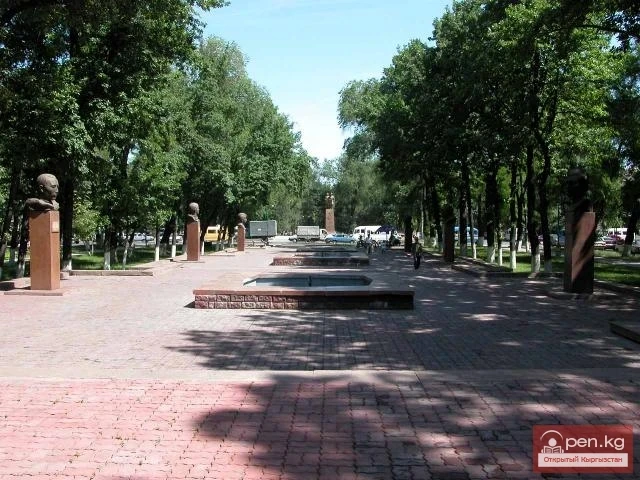
IN HONOR OF FRIENDS FROM CZECHOSLOVAKIA April 24, 1925. Pishpek Station. A crowd of people. A train with the first group of Czechoslovak cooperators has arrived - 14 cars with equipment and 13 with people. Warm, friendly words from the welcoming committee. Thus began the epic of the Czechoslovak production cooperative "Intergelpo" ("Mutual Aid"). Its creation was a response from Czechoslovak workers to V. I. Lenin's call for assistance to the young Soviet state in
25.02.2015, 08:11
In Memory of the Poet-Patriot. Ul. Dzh. Bokonbaeva
Streets of Bishkek

In Memory of the Poet-Patriot. Ul. Dzh. Bokonbaeva

IN MEMORY OF THE POET-PATRIOT BOKONBAEV In the late 1920s and early 1930s, Upper Street was the last street before the railway line. Beyond that, towards the line and beyond, stretched the steppe. Apparently, it was named for the reason that it is upper, i.e., the farthest in the southern part of the city. Stretching from east to west from the Alamedin River to the present-day Krasnoznamennaya, Upper Street was developed with individual houses during these years, many of which were made of

25.02.2015, 07:52
In honor of the hero of the civil war. Y. Logvinenko Street
Streets of Bishkek

In honor of the hero of the civil war. Y. Logvinenko Street

Hospital Street in Logvinenko Old-timers surely remember that this street was originally named Hospital Street because here, on the outskirts of the city, at Kazarmen Square, above the current Moscow Street, the first and only hospital with 23 beds was opened in 1913 before the revolution. It begins at T. Kulatov Street and stretches to Lenin Avenue, where it is interrupted by Panfilov Park. From Frunze Street, it continues to the Big Chuy Canal.

25.02.2015, 07:44
In Memory of the Great Akin. Toktogul Satylganov Street
Streets of Bishkek

In Memory of the Great Akin. Toktogul Satylganov Street

IN MEMORY OF THE GREAT AKYN TOKTOGUL Toktogul Street... It stretches from east to west from the Ala-Too River to Fuchik Street. In the past, it was called Gryaznovskaya - named after the district chief of Pishpek, and it justified its name - it was dirtier than dirty. However, to be fair, there were many such streets in Pishpek, if not all. There were many vacant lots on it, and houses were rarely wooden, mostly modest mud huts of the townsfolk. Only at the end of the street, on the Ala-Archa

25.02.2015, 06:53
The Influence of Stars on People's Lives
Ethnography

The Influence of Stars on People's Lives

Tootaydyn Ogu (stars I and V, located below the Belt of the Three Kings). The ancient Kyrgyz were unable to explain many natural phenomena, deifying celestial bodies and the mysterious processes occurring in the heavens. For example, many shining celestial bodies were transformed into Kudai — God and his apostles. Lunar and solar eclipses, the movement, and "wandering" of planets in the sky — all of this was attributed to the influence of supernatural forces.

22.02.2015, 17:30
Horses in the Lives of Kyrgyz People
Ethnography

Horses in the Lives of Kyrgyz People

The Kyrgyz determined a person's age using the muchel — a 12-year animal cycle. It was also used to predict a person's future. It was believed that in the first year of each cycle, one should not undertake significant endeavors, as the outcome would be negative. In the epic "Manas," there was a warning to the hero Jolo, whose year of birth coincided with the beginning of the animal cycle, that going on a campaign was considered dangerous. The seer emphasized that the month

22.02.2015, 16:00
Astrological Concepts in the Knowledge System of the Kyrgyz People
Ethnography

Astrological Concepts in the Knowledge System of the Kyrgyz People

Astrology was considered a false teaching among us, and the ban on it lasted for 60 years, starting from 1929. Interest in astrology is currently expanding, as many facts of modern science cannot explain certain phenomena. It is known that we are in the field of radiation from the Sun and other celestial bodies, which affect our biorhythms. It has been proven that a person lives in a magnetic web, and in every cell of their body, there exists a small magnetic field that reacts to the vast

22.02.2015, 15:05
In Memory of the Young Guards. M. Gandhi St.
Streets of Bishkek

In Memory of the Young Guards. M. Gandhi St.

IN MEMORY OF THE YOUNG GUARDSMEN Atbashinskaya Street... wide, more than a hundred meters, completely overgrown with grass, with low, somewhat blind one-story houses. A haven for various domestic animals. That’s how it was until the spring of 1940. The first attempts to create an alley here date back to the early 1930s, but they were unsuccessful. On March 18, 1940, more than a thousand townspeople - workers from the "Intergelpo," "2nd Five-Year Plan," and other enterprises

22.02.2015, 15:02
At the site of the barracks... T. Moldov Street
Streets of Bishkek

At the site of the barracks... T. Moldov Street

AT THE SITE OF THE BARRACKS... Togolok Moldov Street is rightly considered a sports street. Its main attractions are the V. I. Lenin Sports Palace and the "Spartak" Stadium. The Sports Palace is a unique structure adorned with original elements of external and internal design. It serves as a center for sports and various concert-theatrical performances, with a hall that accommodates up to 3,000 people. The grand opening of the Palace took place on November 2, 1974. It was inaugurated

22.02.2015, 14:41
The Renewal of the Old Street. D. Shopokov St.
Streets of Bishkek

The Renewal of the Old Street. D. Shopokov St.

THE NEW OF THE OLD STREET OF THE BANK There is an unremarkable street in the city. Almost entirely built up with one-story houses, there are many such streets in the city. Starting from the 50th Anniversary of the Kyrgyz SSR Avenue, it stretches to the railway line, passing by the "Druzhba" restaurant, the new circus, "Victory" square, and the five-story "Ay-Churek" department store. Once it was called the Bank Street. This name is associated with a river

22.02.2015, 14:27
"When the Cholpon Star Descends to Earth"
Myths and legends

"When the Cholpon Star Descends to Earth"

According to legends and traditions, the planet Venus also influenced the fates of people. One of the legends tells of a smart, sensitive, and remarkably beautiful girl who lived on Earth. People consulted her, and the young men, struck by her intelligence and beauty, sought to marry her. This led to disputes among them. Hating the enmity on Earth, Cholpon flew to the sky and turned into a star. The people remembered Cholpon's words:

22.02.2015, 13:55
The Fate of District Street. T. Abdumunov Street
Streets of Bishkek

The Fate of District Street. T. Abdumunov Street

THE FATE OF KOŠČIYNA STREET The residents of Frunze are well acquainted with Kirov Street. Until the 1980s, participants in demonstrations and parades marched along it to the Central Square in festive columns. In the mornings, city dwellers hurry to work along it, and in the evenings, theater lovers rush to the start of performances. In recent years, it has transformed. Where old adobe houses once stood, parks have emerged. An eight-story hotel "Kyrgyzstan" with 650 rooms was built,

22.02.2015, 13:41
Reviving Old Pages. M.V. Frunze Street
Streets of Bishkek

Reviving Old Pages. M.V. Frunze Street

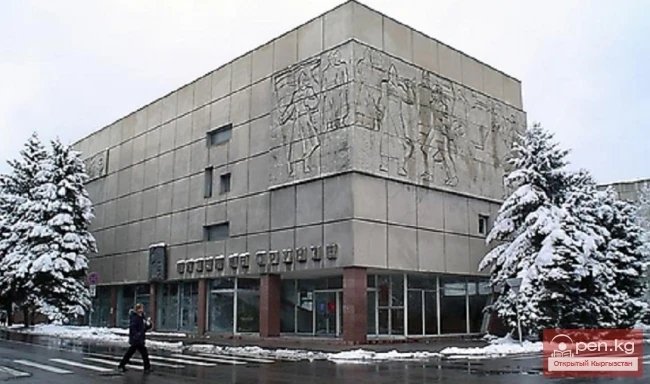
REVIVING GLORIOUS PAGES Frunze Street is not characterized by heavy urban traffic. There are no industrial enterprises here either. However, it is known not only to the locals. Thousands of tourists come here. They are attracted by the memorial museum of M.V. Frunze. The new pavilion, opened on October 29, 1967, is built in the shape of a rectangle resting on columns, the space between which is filled with glass and granite; on the facade walls, there is a thematic bas-relief depicting scenes

22.02.2015, 13:13
"Unrecognizable Former Bazarnaya, Baytik Baatyr Street"
Streets of Bishkek

"Unrecognizable Former Bazarnaya, Baytik Baatyr Street"

UNRECOGNIZABLE FORMER BAZAR STREET Sovetskaya Street is one of the main thoroughfares of the city, linking its old and new parts. It stretches from the foothills of the Kyrgyz Ala-Too to the Big Chui Canal (below BChK since 1974 - Baku Street). The street has expanded and rejuvenated in recent years. Almost all one-story houses built before the revolution in its center have disappeared, and those that remain are living out their last days. Entire blocks are being demolished, making way for new

22.02.2015, 13:04