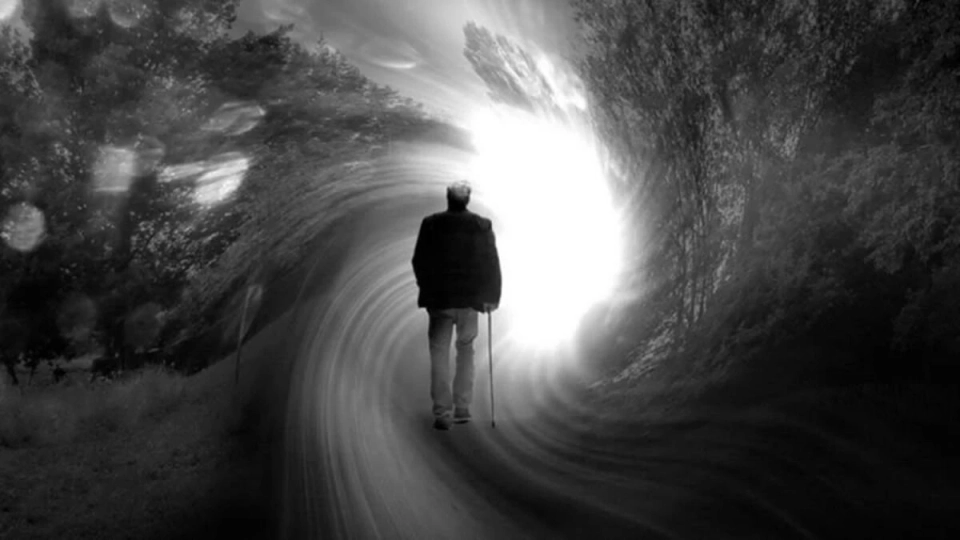
At the moment when the girl hugged her father before his flight on that fateful business trip, she already knew she would never see him alive again. His dark eyes, filled with emptiness, stared ahead, and despite being a small child, she could not help but realize the horror she suppressed during their last meeting at the airport.
This little girl was me, and that strange experience I had that night became one of my first manifestations of precognition.
When I came to in the darkness of the hallway, I understood that the fear I felt was not imaginary. How could a child remain calm and not cry upon hearing about her father's death thousands of miles away? I realized I would never again weave tents from his shirts or smell his cologne.
Fearing that I would be considered abnormal, I shared my story with neuroscientist Julia Mossbridge, Ph.D. She listened to me attentively and, as if I were her subject, began asking questions about my experience. Was this your first precognition? How often do you experience such episodes? How do you know that something is about to happen? Soon she admitted that she herself had similar experiences, which prompted her to study this topic.
According to Mossbridge, she had encountered precognition in two forms since the age of seven: through dreams that predicted the future and in a waking state when she suddenly knew what was going to happen. These abilities allowed her to anticipate events she otherwise would not have known about. She claims that such memories of the future challenge the notion of time as a linear process.
“Understanding precognition is not difficult,” says Mossbridge, a senior researcher at the Center for the Future of AI, Mind, and Society at Florida Atlantic University. “It is harder for those who have not experienced such phenomena to believe in it. We do not understand how time actually works, and even physicists admit that it is a mystery. We are stuck in the idea of linear time, but is it really that way? Much of the skepticism about precognition is related to fear of the unknown and the idea that reality may be completely different from what we imagine.”
Unlike carnival fortune-tellers who use social media to create the illusion of clairvoyance, scientists such as psychologists and neuroscientists are trying to understand what lies behind precognition, which is considered a form of extrasensory perception. This feeling that something will happen has been familiar to shamans and mystics since ancient times, but science has yet to explain its nature.
According to parapsychologist Dean Radin, Ph.D., and chief scientist at the Institute of Noetic Sciences in California, precognition indicates that our consciousness may extend beyond the linear perception of time. Radin, who has been researching consciousness for many years and is the author of several books on the subject, believes that this phenomenon requires further study.
Radin and Mossbridge, working together at IONS, aim to validate the theory of precognition using statistical data from their experiments, supporting the idea of nonlinear time.
“Time is not what we perceive it to be,” asserts Radin, who also teaches integral and transpersonal psychology at the California Institute. “In the quantum world, time may not even exist in the way we understand it. Time behaves much stranger than we can imagine. This could mean that our consciousness interacts with something larger than our earthly perception of time, capable of receiving information from the past or the future.”
In the mid-1990s, Radin conducted an experiment at the University of Nevada to prove his hypothesis. He proposed that if consciousness truly transcends time, then reactions to a future stimulus should appear before the stimulus itself. Participants in the experiment were connected to electroencephalograms and asked to press a button to display a random image on the screen. The image could be either positive or negative.
The EEG recorded brain activity five seconds before the image was shown. When anticipating a positive image, there were slight changes in brain activity, while negative images caused sharp spikes in activity that occurred even before they were shown.
“Mossbridge's research has shown that most people are capable of a certain level of precognition.”
Since then, similar studies on precognition have been repeated about forty times. In 1995, the CIA even published its own studies on precognition, which confirmed their statistical validity.
When statistics confirm the existence of a phenomenon, it is a compelling argument, believes Mossbridge, who is also the founder of the Mossbridge Institute, which focuses on experimental psychology and neurobiology. She recalls how one physicist doubted her conclusions, believing that time is linear. Nevertheless, Mossbridge's research confirms that many people possess a certain predictive ability, which society often considers strange or even insane.
Advertisement — Read more below
Different cultures view precognition differently. Radin, for example, studied Tibetan oracles who predict the future. He concluded that clairvoyance, known in scientific circles as "remote viewing," is the ability to perceive not only temporal but also spatial events. Shamans who could predict the weather or enemy attacks did so long before modern methods of information dissemination emerged. In some traditions, psychoactive substances such as psilocybin mushrooms or ayahuasca are used to activate the "second sight."
Percognition can also be explained as a form of quantum entanglement, according to Radin. Entangled particles exchange information and act synchronously, even when separated by significant distances, which Einstein referred to as “spooky action at a distance.”
Radin believes this may explain why we can experience events that have not yet occurred. “Some believe that precognition is our brain entangled in the future, as entanglement pertains not only to space but also to time,” he adds. “If it can be entangled in the future, then in the present we may feel something akin to a memory of an upcoming event.”