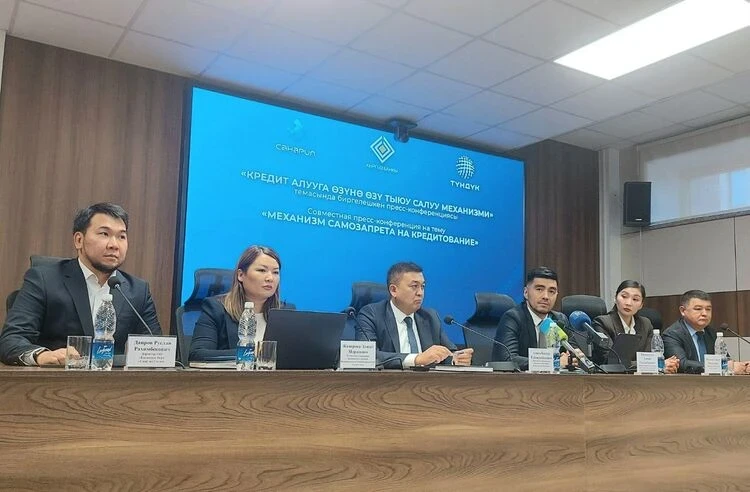
The new option, which allows individuals to limit their ability to take out loans, became available to Kyrgyz citizens on November 1 of this year. The service has proven to be in demand, as many people seek to avoid unexpected debt to financial institutions.
It is worth noting that starting November 1, 2025, a rule came into effect in Kyrgyzstan allowing individuals to voluntarily limit the issuance of loans and credits in their own name. The Kyrgyz Republic became one of the first countries in Central Asia to implement this mechanism.
Citizens can easily establish or lift the ban through the State Electronic Services Portal (the "Tunduk" mobile application) at any time. Once the application is submitted, the self-ban takes effect immediately. However, it will take 12 hours to lift it.
This approach helps avoid hasty decisions and increases user security. Financial organizations are required to check for an active ban before issuing a loan. If a ban is in place, the lender refuses to enter into a contract, stating the reason.
If a loan is issued while an active ban is in effect, such a contract will be considered invalid. The citizen is not obliged to fulfill the obligations under it, and the lender cannot demand the return of funds. The responsibility for the violation lies with the lender.
To date, many Kyrgyz citizens actively use this service to protect themselves from fraudulent activities.
The editorial team of 24.kg spoke with citizens who have already imposed a self-ban to find out how convenient it is and why they consider it necessary.
Ibrahim Lebuzov from Bishkek:
“Previously, I often left photocopies of my ID card at various organizations, including banks. Knowing about the methods of fraudsters, I was pleased to see this opportunity and decided to use the self-ban on lending. The procedure is completely free and takes just a couple of minutes. It took me only a few minutes to complete everything. It is also important to me that I can lift the self-ban myself, but I will have to wait 12 hours — that’s the cooling-off period.”
Pensioner Vasily Beloshapkin:
“Recently, cases of fraud have increased. Honestly, I am scared for my data. Therefore, when I learned about this service, I immediately imposed a self-ban. I have never taken out loans and do not intend to do so.”
Teacher Diana Raimbekova:
“I never thought I would become a victim of fraudsters. They called me around lunchtime, introduced themselves as employees of the banks where I am a client, and named my passport details. They said that a loan had been issued in my name and that I needed to cooperate with them to catch the criminals. I didn’t believe them, hung up, and planned to go to the bank myself, but they persuaded me and even threatened me. I agreed to a video call to help them with the investigation.
They needed access to my applications to return my money. In the end, they issued a loan in my name.
Diana Raimbekova
When it was all over, I realized that they were fraudsters, not bank employees. Two online loans were issued in my name for a total of 260,000 soms. A year has passed, I filed complaints with the police and the banks, and changed two lawyers. The first court hearing for my case is scheduled for the end of December. During this time, I met many other victims and created a group on social media where we discuss the progress of our cases.
I still cannot understand how I fell for the fraudsters' bait, as I was aware of their schemes. Friends told me about the self-ban, and I intend to impose it soon to avoid becoming a victim of fraudsters again.”
According to Diana, there are quite a few cases like hers. Therefore, the self-ban on lending is an optimal solution. Specialists from the National Bank note that it can be established even if there is an active loan, allowing one to pay it off while simultaneously protecting oneself from fraudulent schemes. Even in the case of identity theft, a previously established self-ban will prevent the issuance of an online loan.
The main objectives of implementing this mechanism:
Action algorithm through the "Tunduk" application:
1
How to impose a self-ban:
Log in to Tunduk → select the service "Self-ban on lending" → click "Submit application" → choose a credit bureau → confirm the action.
Protection is activated immediately.
2
How to lift the ban:
Log in to Tunduk → select the service "Self-ban on lending" → choose a credit bureau → click "Lift self-ban".
The lifting will occur automatically after 12 hours. During this time, you can cancel the application — the protection will remain active.