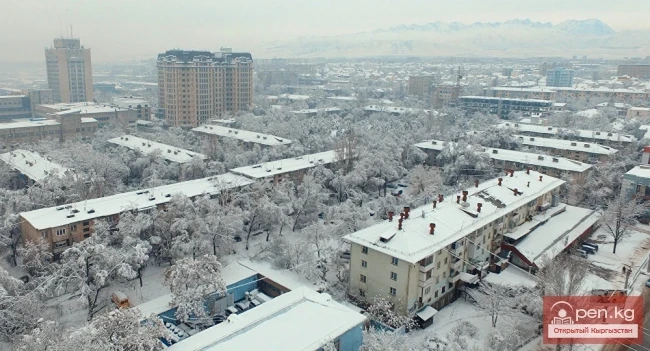
This is already the third snowfall of the current winter season. Yesterday, December 8, snow began falling around 15:30 and continued until late at night, forming a snow cover of 15–20 centimeters.
According to the traditional Kyrgyz calendar, winter begins on December 13 with a period known as "tokson," which lasts for 90 days. Twenty-five days after it begins, the "childe" (period of severe frosts) arrives, lasting for 40 days. If we count another 25 days after the end of "childe," we arrive at March 13—thus forming three winter months. A well-known Kyrgyz proverb states: "The beginning of tokson and the end of childe is hard" (It is difficult when "tokson" starts, and until "childe" ends).
Some folk astronomers believe that "tokson" lasts from December 18 to March 18. During this time, the weather changes sharply, and the cold becomes noticeable. Usually, severe frosts precede the beginning of "tokson" by a week. People say: "Send greetings to the shoemaker, and I will go myself to the one who has no boots," implying the approach of cold weather.
// Turmush
"Tokson" is divided into three phases:
- the first phase — from December 13 to January 8,
- the second phase — from January 8 to February 18,
- the third phase — from February 18 to March 13.
Thus, the total duration is 90 days. Hence the name "tokson" ("ninety"). There is a saying: "As long as 'tokson' does not leave, the frost will not weaken" (Kyrgyz: "Tokson ketpey, ton ketpeit").
From February 18 to March 13, the time comes when the "old man from tokson" (Kyrgyz: "Toksondogu chal") leaves us, and the weather begins to warm up a bit: sometimes yellowish snow (Kyrgyz: "sary kar") or light rain falls. This is described by the people as "The old man from tokson groans, turning from one side to the other" (Kyrgyz: "Toksondogu abyshtka ontop ary-beri bir yptasynan ekinchi yptasyna oodarylyp atat"). After March 13, they say: "Tokson has gone — the frost has gone" (Kyrgyz: "Tokson ketip ton ketti").
// Turmush
Additionally, the Kyrgyz people highlight 40 days of severe frosts known as "childe," which occur from January 8 to February 18 and are referred to as "Temir ayaz" ("iron frost").
The structure of these 40 days is as follows:
- "Kyrdach" — frosts lasting six days.
- "Adynyn alty uulu" — another six days of severe cold, ending on January 19. The period from January 15 to 19 coincides with the Orthodox Epiphany frosts. In Kyrgyz culture, "childe suu" is water collected on the coldest days (from December 25 to February 5). It was believed that such water has healing properties and can be stored for years.
- "Zhedinin zheti uulu" — frosts recorded from January 20 to 26.
- "Kangtar" — one day - January 27, which symbolizes the middle of the forty-day "childe."
- "Üt" — the period from January 28 to February 11, when a lot of snow falls.
- "Apkyt sapkyt alty kün" — a six-day period from February 12 to 17. After this, on February 18, "childe" ends.
The days from February 19 to 27 are known as "müyüz ayaz" — "horned frosts."
From February 28 to March 13, this period is called "kiyiz ayaz" — "felt frost."