API error: no response
Curl error: HTTP/2 stream 0 was not closed cleanly: INTERNAL_ERROR (err 2)
In recent years, the experienced poster master F. Zubakhin has been actively working. In political posters, he developed ideas of worldview, moral, and patriotic education of the masses — “May Day — Day of Solidarity of Workers” (1972); “50 Years of the Kyrgyz SSR” (1974); “On Guard for Peace” (1974); “The Union of Soviet Socialist Republics is the state of workers and peasants” (1976); “Leninism — the banner of millions” (1977); “I Serve the Soviet Union” (1977); “Glory to the Leninist
In the 1970s and 1980s, with a trend of steadily increasing ideological and artistic levels of visual agitation, political posters became increasingly widespread. During this period, their role in the development of political and labor activity among the masses, in ideological struggle and the movement for peace, in organizing socialist competition, implementing the party's agrarian policy, spreading patriotic initiatives, strengthening production discipline, and promoting the
In the 1960s, A. Turumbekov successfully made his mark in poster art, working extensively as a master of satirical magazine drawing. His political posters from 1969, "Freedom," "Voice of America," "Junta," and "American-style Freedom," were awarded a Silver Medal at the International Exhibition "Satire in the Struggle for Peace" (Moscow, Leningrad, Sofia, 1969). They are characterized by sharp satirical focus, expressiveness of grotesque means,
In the system of any visual art, the poster occupies an important place, sharply responding to the social moods of the time, experiencing a surge during periods of restructuring life, nationwide struggle, or creation. This art, accessible to all, is intended to mobilize the people for necessary public actions, and it was the first to develop in the history of visual arts in Kyrgyzstan, attracting the attention of graphic artists and painters. It began to strengthen in the 1960s with the
Dozens of exhibited drawings were created by painters S. Chuykov (“Drawing,” 1963, canvas), G. Aitiev (“At the Monument to Mickiewicz,” 1959; “Gate to the Palace of Versailles,” 1964; marker; “Louvre,” 1965, marker), D. Fleckman (“Old Man,” 1971, charcoal; “Boy,” 1972, pastel), A. Ignatiev (“Street in Brașov (Romania),” 1973, marker; “Street in a Working District of Naples,” 1969), A. Usubaliev (“Girl with a Book,” 1970, canvas; “Damira,” 1970, canvas), B. Jumabaev (“Friends,” 1978, pen, ink;
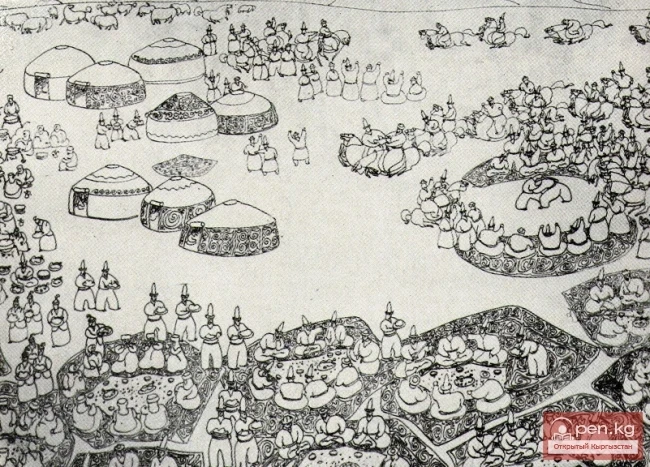
The feather and pencil drawings by B. Koshoyev are distinctive, abundant with mass scenes, character types, details from folk life, and panoramic landscapes of nature (“Toys,” 1968, ink; “Mountains,” 1974, pencil; triptych “Spring of the 60th Anniversary of October,” 1977, gouache; series “Kyrgyz National Games,” 1979, gouache, etc.). Despite the conventionality of the images, they are characterized by a delicate observation, precision of the contour line outlining figures and objects with a
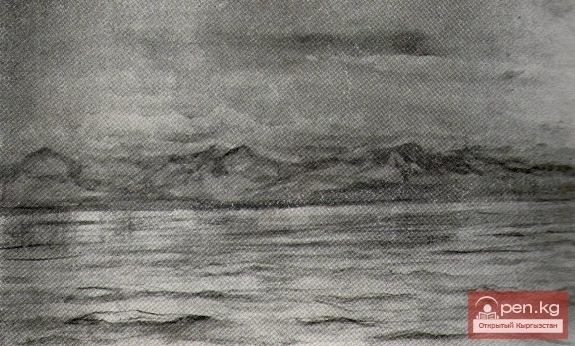
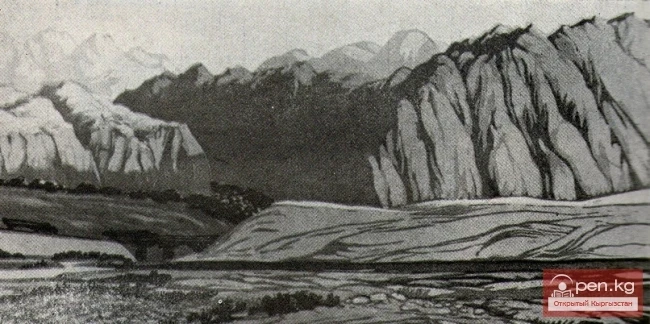
One of the steadfast proponents of natural drawing is T. Herzen. He is characterized by both quick, lively sketches and detailed drawn compositions. In his best landscape drawings done in pencil and pastel, he is sensitive to the life of nature and lyrical. His panoramic-epic landscape pastels from the cycle "Mountain Motifs of Kyrgyzstan" (1980-1981) create a majestic image of mountain nature, rich in colors and forms. The motifs of these sheets are mainly inspired by the places
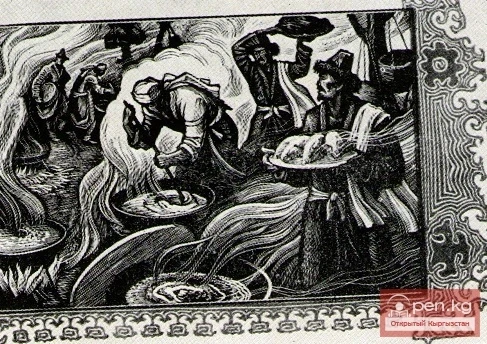
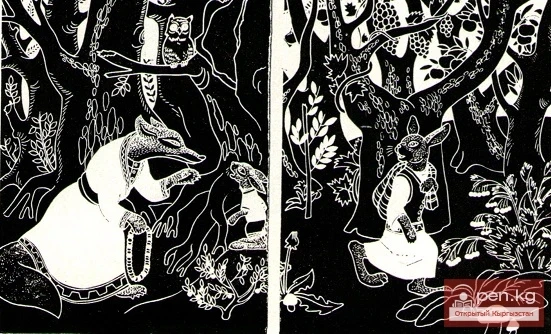
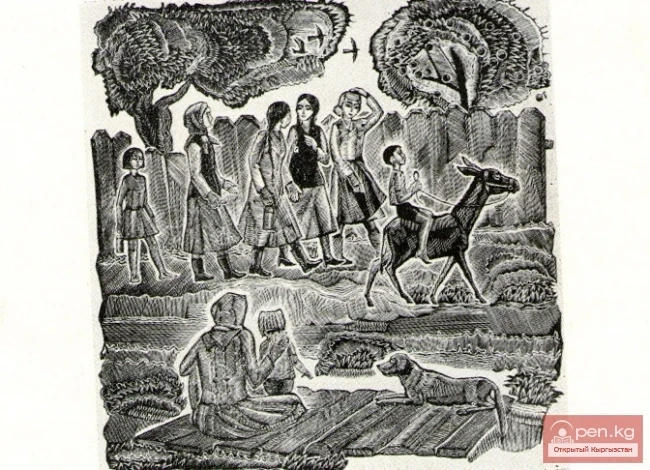
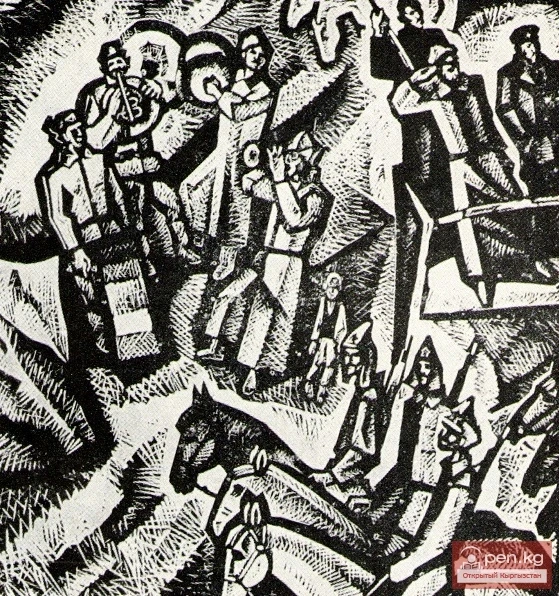
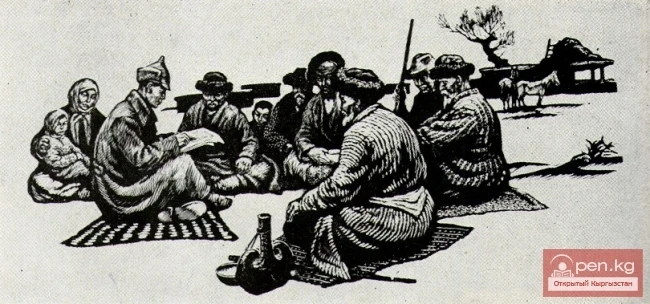
The pencil drawings by E. Kuzovkin, as noted by critics, "clearly reveal the hand of an engraver... capable of seeing and interpreting the phenomena of reality, making adjustments for the peculiarities of technique and the nature of the material right in the process of work." The evolution of his drawings is linked to his development as a master of linocut. For instance, the series of spatial narrative sketches "Aunt Dora's Estate" (1972) is closer to the artist's
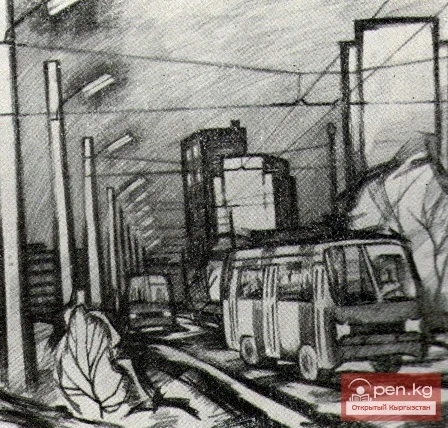
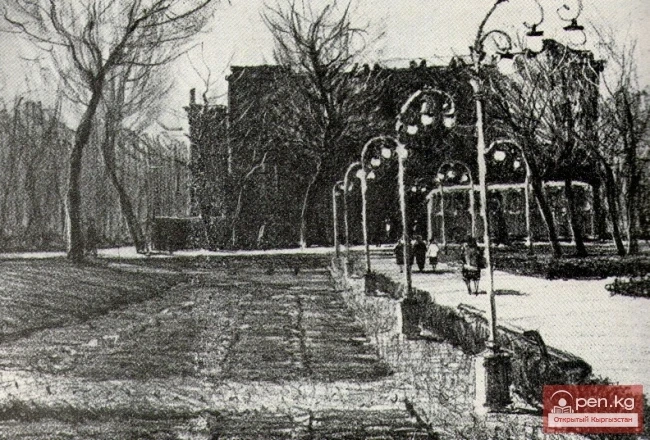
Natural and compositional drawing is a subject of close attention from R. Nudel, a multifaceted artist who is constantly evolving. In the 1950s, due to serious work on industrial themes in watercolor, he created a multitude of landscape and interior drawings in pencil, in which he aimed to aesthetically comprehend the achievements of the technical age in Kyrgyzstan ("Evening Rhythms" from the series "Everyday Life of the Capital," 1970, drawing 198; "Factory
Nature drawing is the foundation of the cycles of engravings and lithographs by A. Sgibnev. He was accustomed to traveling extensively throughout the republic, creating hundreds of lively sketches with a pen, pencil, and marker during his trips. He often held exhibitions in high mountain pastures, field camps, and border outposts. The vast factual material captured in his drawings was creatively interpreted and transformed into compositional easel sheets. Sgibnev also created finished drawings
One of the leading masters of drawing in the collective of graphic artists of Kyrgyzstan in the 60s and 70s was A. Mikhalev. In his modest life drawings, primarily landscapes and less frequently portraits, the artist aimed to convey the characteristic aspects of nature, as well as his relationship to artistic form. "The artist, in working on form, deals with two things — the object and space. These two opposites are the main components of the image. Space struggles with the object, trying
B. Jumabaev was a talented artist. His vibrant compositional gift allowed him to work with equal ease from life and from imagination. His drawings are compositional and imbued with a lively line that always clearly creates form both in its movement and in harmony with other forms. Even his early drawings from the 1960s bear the mark of talent — these are artistically drawn with line, unexpectedly fresh, and precise pencil and ink drawings ("At the Market," 1960, canvas;
The work of L. A. Ilyina, who operates in easel and book engraving without detailed sketch development, is significantly complemented by drawings in pencil, ink, pastel, marker, sanguine, and black watercolor. Here, she also works with precise and economical means, but more freely, sometimes in a more intimate manner. Without losing the individuality of her artistic thinking, Ilyina is extraordinarily versatile in drawing, rich in ways of understanding nature. In the 1960s, Ilyina draws a lot
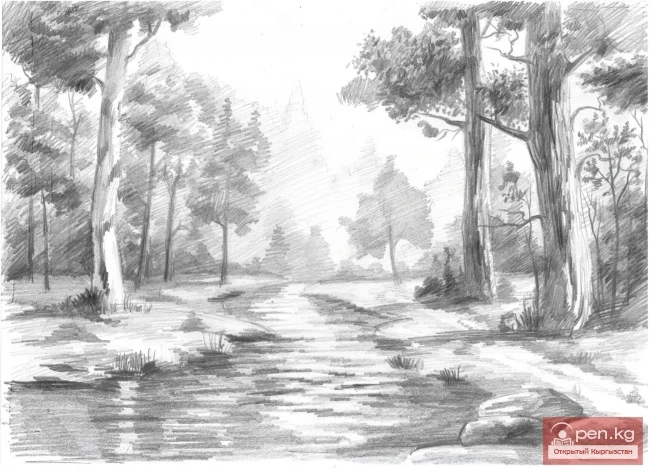
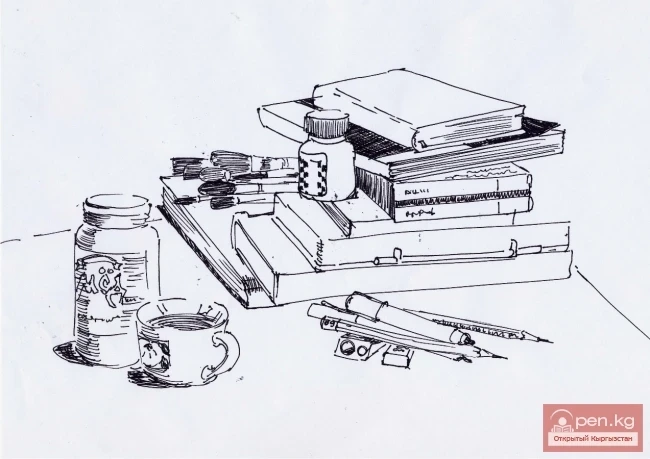
Drawing has always held a fundamental place in Kyrgyz visual art, which from its very beginnings has followed the path of direct study of life and its realistic representation. Remarkable life drawings that vividly reveal the principle of realistic artistic thinking were created by S. Chuykov, V. Obraztsov, B. Witz, L. Mesarosh, and G. Aitieva. Interest in drawing increased with the arrival in Kyrgyzstan in the late 1930s of professional graphic artists L. Ilyina and A. Mikhalev. During the
The experienced book artists include M. Akhmedov, who illustrated the works of Ch. Aitmatov and other Kyrgyz writers and poets, Yu. Kim, K. Seitaliev, A. Yeroshchenko, who pay much attention to the design of children's books and folk tales. A number of engaging illustrations for children's publications were created by D. Dzhumabaev, who possesses a lively, expressive drawing style (A. Usenbaev. Man and Tiger. 1977, gouache). In recent years, young artists such as A. Biymyrzaev (Ch.
Vladimir Grigoryevich Rogachev was actively engaged in the field of book art in the 1960s. He designed and illustrated over fifty publications. He also did significant work as an art editor. His illustrations for children's books were typically amusing, colorful watercolors and gouaches (M. Menshikov. "There is such a girl," "Mektep," 1965; K. Abdrakhmanov. "Why doesn't water break?" "Mektep," 1968; Ya. Zemlyak. "Are there any kids like
Curl error: HTTP/2 stream 0 was not closed cleanly: INTERNAL_ERROR (err 2)
V. Gladkov is known in the republic as an illustrator and designer of books, paying attention to both the figurative and substantive aspects of illustrations and the organization of the entire ensemble of the book. He is characterized by broad creative interests, thoughtful reading of literary works, and an active search for expressiveness in graphic language. He has illustrated both books by Kyrgyz writers and works of Russian and world classics. His creative success includes the
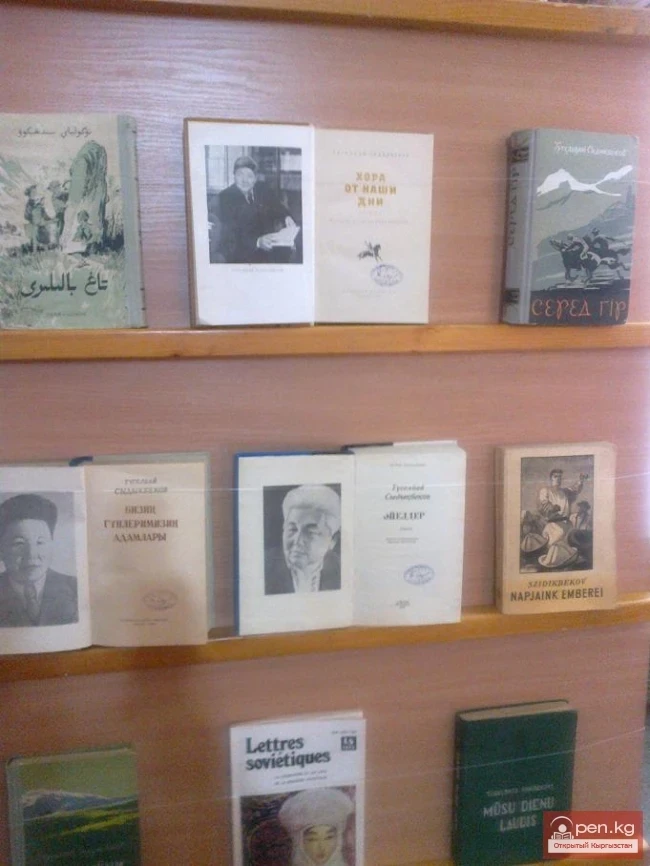
A. Misyurev fruitfully designed books published by republican publishing houses. He illustrated works by Kyrgyz writers Ch. Aitmatov ("Soldatenok," 1974, linocut), A. Tokombaev ("My Republic," 1974, linocut), T. Sydykbekov ("Address to Man," 1969, linocut), B. Zhakiev ("Meetings in the City of Winds," 1969, monotype), and other representatives of multinational Soviet literature (L. Tatyanycheva. "Zoryanka," 1973, wood engraving). He
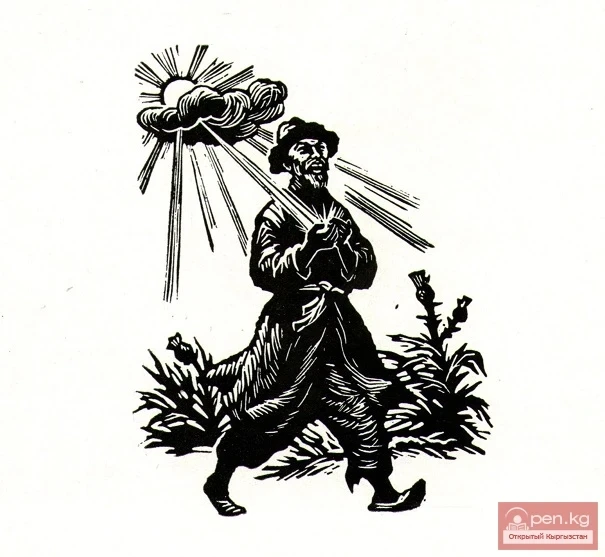
The talented illustrator of the Kyrgyz book was Belek Jumabaev, who possessed a unique perception of life and art, with a light, artistic drawing style. After familiarizing himself with various graphic techniques, he focused on drawing and zincography, in which he created his main works in book graphics. He quickly mastered the culture of book design, but saw his main task in the imagery of the illustrations, in their harmony with the idea and style of the literary work. He illustrated the
Curl error: HTTP/2 stream 0 was not closed cleanly: INTERNAL_ERROR (err 2)
The art of book illustration in Kyrgyzstan until the turn of the 50s and 60s was almost exclusively represented by the works of L. Ilyina, who mainly collaborated with central publishing houses. In the 60s, due to the overall rise of publishing and the general culture of book graphics in the country, as well as local prerequisites—strengthening the printing base and the emergence of specialists in the field of artistic book design—book illustration developed more diversely in the republic and
Belek Koshoev mastered the technique of etching with great finesse. His etchings "Catching a Horse" (1970), "Mountains" (1974), "Yurt by the River" (1974) are characterized by an elegant linear rhythm, sharpness, and precision in conveying the movements of form, with a subtle stylization reminiscent of medieval graphics of the peoples of the Far East. Their main virtue is the imagery that reveals the artist's love for folk life and cultural traditions. In
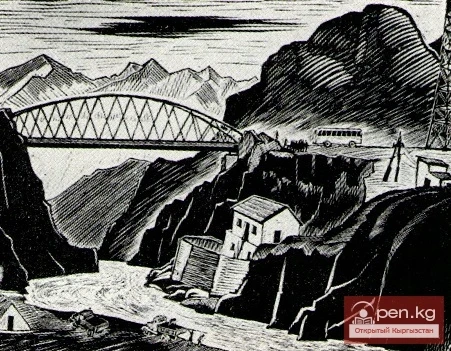
In printmaking, Myrsa Omorkulov has repeatedly tested his skills, although his favorite technique is watercolor. In the 1960s, he created colored linocuts for the series "The Road from Frunze to Osh" (1961). Here, the artist faced challenges related to mastering a new technique that required a certain discipline of thought and plastic generalizations. In the best sheet of the series "A Bridge is Being Built," the author managed to "convey his admiration for the
Among the artists of specifically realistic vision of life is Melis Haidarovich Akhmedov, who has been working in easel and book graphics since the early 1970s. As an easel artist, like other masters, he predominantly works on thematic series, which he always creates based on natural material. His work is characterized by a narrative-plot nature of the image, knowledge of folk life, and interest in details and ethnographic specifics. The object-spatial fullness of the sheet and factuality have
Curl error: HTTP/2 stream 0 was not closed cleanly: INTERNAL_ERROR (err 2)
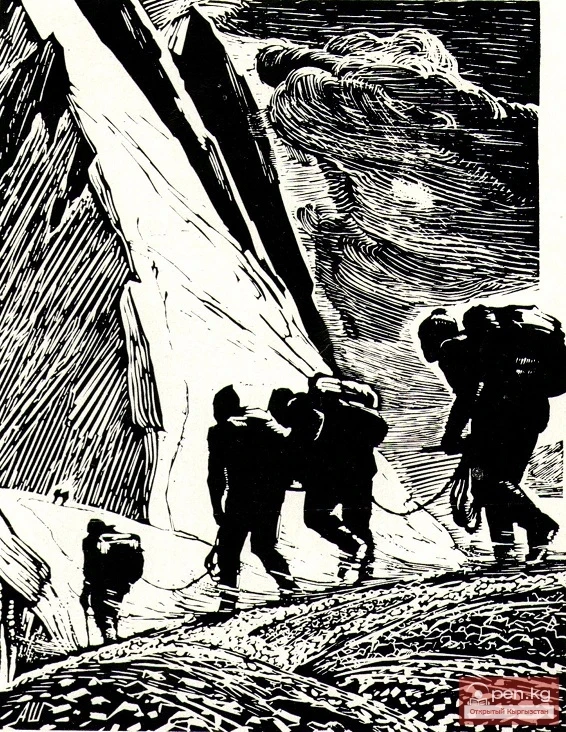
The singer of the mountain nature of Kyrgyzstan was the prematurely deceased artist-climber Afanasy Lazarevich Shubin, who worked in linocut, lithography, and etching. In his best prints, he created a romantic image of the highlands and the courage of people. The difficulties of hiking life, the brilliance of unconquered peaks, the sharp taste of risk, a moment of silence before the assault, the triumph of victory—all of this naturally and effortlessly found its way onto his sheets. This was
Curl error: HTTP/2 stream 0 was not closed cleanly: INTERNAL_ERROR (err 2)
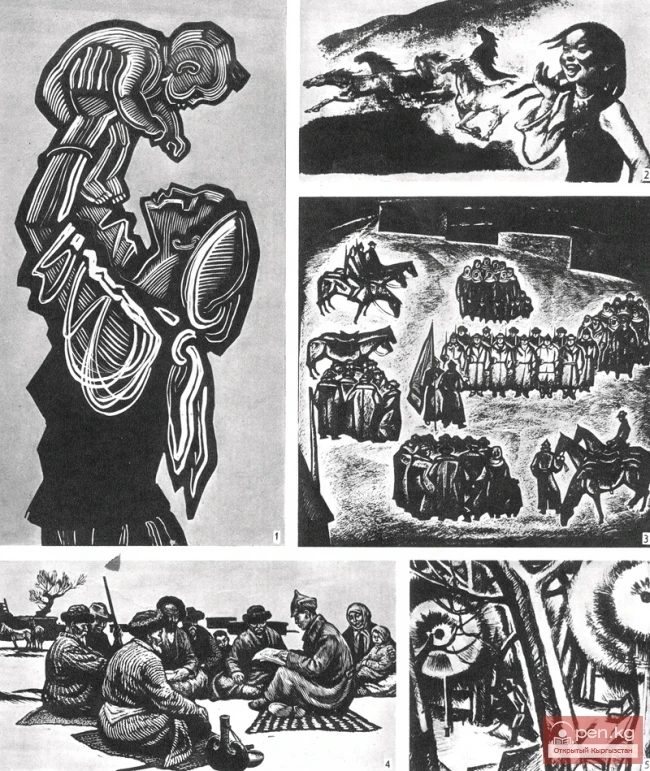
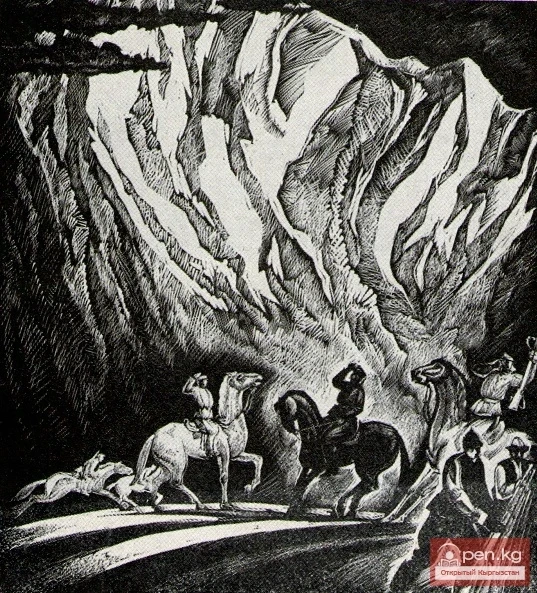
Akim Alekseevich Sgibnev mastered various types of graphic techniques, focusing primarily on linocut in its black-and-white and colored variants. His sheets from the 60s and 70s are rich in natural observations, character types, genre scenes, and landscape motifs drawn from numerous trips across the republic. Sgibnev is unique both in his choice of thematic aspects and in his interpretation of graphic form. The absence of a professional school for this artist is compensated by his study of
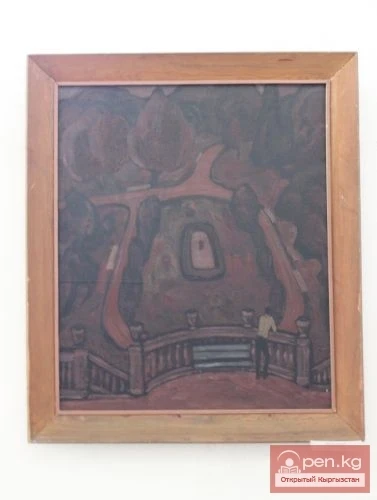
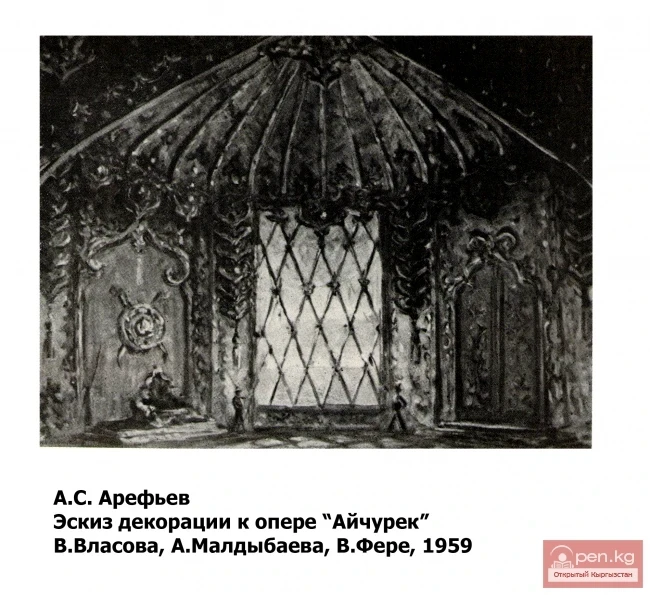
In the photo: A.S. Arefyev, sketches of the decorations for the opera "Aychurek". V. Vlasov, A. Maldybaev, V. Fere, 1959
Alexander Illarionovich Ignatiev — one of the leading artists of the republic — also achieves the greatest success in landscape painting. At the creative conference of the Union of Artists of Kyrgyzstan, held in Moscow in 1946 during the opening of the All-Union Exhibition, G. Aitiev spoke about Ignatiev's works: "I consider Ignatiev's thematic landscapes... Such small landscapes can stand alongside large thematic works." In his paintings, man and nature live in harmonious
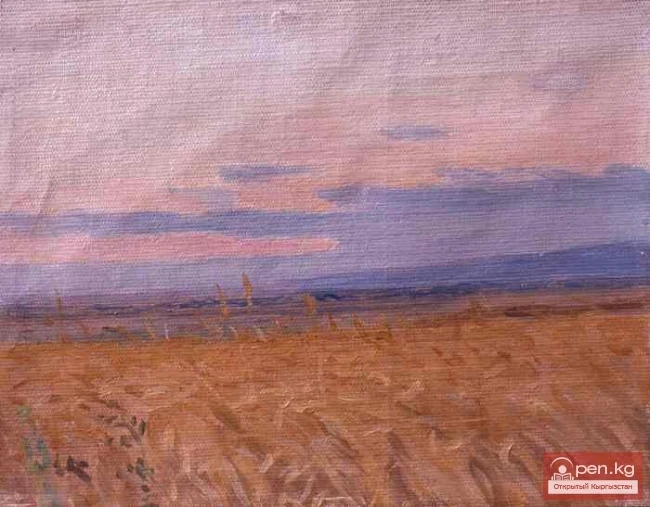
Paintings by Sabyrbek Akylbekov In the paintings of Sabyrbek Akylbekov, the color palette is restrained but built on complex subtle shades. The landscapes are soft and harmonious in color, and although the artist avoids bright colors, his painting palette is tense and accurately expresses the majestic, strict hues of the native nature. The canvas "In the Fields of Kyrgyzstan" (1953) is the pinnacle of his creativity during this period. In this work, the features of the new life of