About Kyrgyzstan

{title}
State structure
{title}
National symbols
{title}
Government
{title}
Armed forces
{title}
National currency
{title}
Banknotes
{title}
Circulation coins
{title}
Collectible coins
{title}
Political organization
{title}
Domestic policy
{title}
Foreign policy
{title}
History
{title}
Kyrgyz in antiquity
{title}
Kyrgyz in the VI-XII centuries
{title}
Kyrgyz in the XIII—first half of XVIII century
{title}
The struggle for the independence of the Kyrgyz
{title}
Kyrgyzstan as part of Russia
{title}
Kyrgyzstan during the Soviet period
{title}
Kyrgyzstan — a sovereign state
{title}
Historical records
{title}
Kurmanjan Datka
{title}
Chagatai Ulus. Haidu State. Moghulistan
{title}
History and archeology of the ancient Tien Shan
{title}
Peoples movements of Central Asia in the XIX century
{title}
Kyrgyzstan during the Great Patriotic War
{title}
Kyrgyzstan in the 1920s
{title}
1937 in Kyrgyzstan
{title}
Shabdan Baatyr
{title}
Territory, geography and administrative division
{title}
Chuy Region
{title}
Attractions of Chuy Region
{title}
Issyk-Kul Region
{title}
Sights of Issyk-Kul
{title}
Naryn Region
{title}
Attractions of Naryn Region
{title}
Talas Region
{title}
Attractions of Talas Region
{title}
Osh Region
{title}
Attractions of Osh Region
{title}
Batken Region
{title}
Attractions of Batken Region
{title}
Jalal-Abad Region
{title}
Attractions of Jalal-Abad Region
{title}
Cities
{title}
Bishkek
{title}
Streets of Bishkek
{title}
Pishpek - Frunze - Bishkek
{title}
History of the capital of Kyrgyzstan in documents
{title}
Osh
{title}
Osh - 3000
{title}
Naryn
{title}
Jalal-Abad
{title}
Batken
{title}
Talas
{title}
Karakol
{title}
Tokmok
{title}
Cholpon-Ata
{title}
Uzgen
{title}
Kochkor
{title}
Kemin
{title}
Balykchy
{title}
Kyzyl-Kiya
{title}
Mailuu-Suu
{title}
Sulukta
{title}
Tash-Kumyr
{title}
Toktogul
{title}
Kara-Kul
{title}
Kara-Balta
{title}
Kara-Balta - Black Ax
{title}
Kant
{title}
Villages
{title}
Population
{title}
Language
{title}
Diaspora
{title}
Nature
{title}
Climate
{title}
Natural ecological complexes
{title}
Water resources
{title}
Rivers
{title}
Lakes
{title}
Secrets of Issyk-Kul Lake
{title}
Reservoirs
{title}
Waterfalls
{title}
Mineral waters
{title}
Flora
{title}
Fauna of Kyrgyzstan
{title}
Mammals of Kyrgyzstan
{title}
Birds of Kyrgyzstan
{title}
Fish of Kyrgyzstan
{title}
Amphibians and reptiles of Kyrgyzstan
{title}
Insects of Kyrgyzstan
{title}
Mountains and glaciers
{title}
Mountain ranges
{title}
Mountain peaks
{title}
Mountain passes
{title}
Glaciers
{title}
Caves
{title}
Gorges
{title}
National parks and reserves
{title}
Pastures and valleys
{title}
Soil and minerals
{title}
Red Book
{title}
Fungi and higher plants
{title}
Animals
{title}
Arthropods
{title}
Fish
{title}
Amphibians and reptiles
{title}
Birds
{title}
Mammals
{title}
Economy of Kyrgyzstan
{title}
Entrepreneurship
{title}
Agriculture
{title}
Finance
{title}
Construction
{title}
Industry
{title}
Transport and communications
{title}
Socio-economic resources
{title}
Tourism industry
{title}
Healthcare
{title}
Education
{title}
Sports
{title}
Science
{title}
Environmental science
{title}
Mass media
{title}
Art
{title}
Dances
{title}
Ballet
{title}
Decorative and applied arts
{title}
Musical instruments
{title}
Architecture
{title}
Painting
{title}
Music
{title}
Theater
{title}
Cinema
{title}
Sculpture
{title}
Circus
{title}
Literature
{title}
Photography
{title}
Culture
{title}
Epigraphy
{title}
Folklore
{title}
Kyrgyz heroic epic "Manas"
{title}
The epic "Manas" in prose
{title}
Poetic retelling of the epic "Manas"
{title}
"Semetey" - poetic story
{title}
"Semetey" in prose
{title}
Religion
{title}
Ethnography
{title}
National games
{title}
Customs
{title}
Myths and legends
{title}
Kyrgyz fairy tales
{title}
Kyrgyz cuisine
{title}
Meat and offal dishes
{title}
Soups of Kyrgyzstan
{title}
Main dishes of Kyrgyzstan
{title}
Sweet dishes of Kyrgyzstan
{title}
Drinks of Kyrgyzstan
{title}
Salads and appetizers
{title}
Flour products
{title}
Miscellaneous information about Kyrgyzstan
{title}
Historical and holiday dates of Kyrgyzstan
{title}
Famous personalities of Kyrgyzstan
{title}
Women of Kyrgyzstan
{title}
Historical figures
{title}
Heroes of Kyrgyzstan
{title}
Hero of the Kyrgyz Republic
{title}
Heroes internationalists
{title}
Heroes of Kyrgyzstan in World War II
{title}
Kyrgyzstanis — Full cavaliers of the Order of Glory
{title}
Writers of Kyrgyzstan
{title}
Inventors of Kyrgyzstan
{title}
Scientists of Kyrgyzstan
{title}
Architects of Kyrgyzstan
{title}
Artists of Kyrgyzstan
{title}
Musicians of Kyrgyzstan
{title}
Cinematographers of Soviet Kyrgyzstan
{title}
Actors of Kyrgyzstan
Prose Writer Nina Platonova
Writers of Kyrgyzstan

Prose Writer Nina Platonova

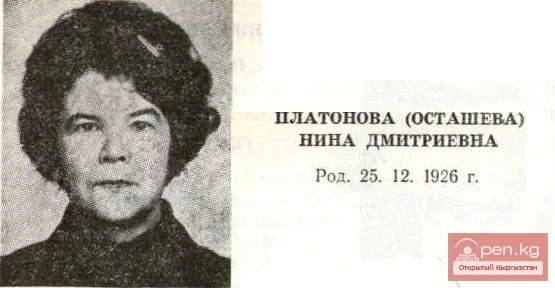
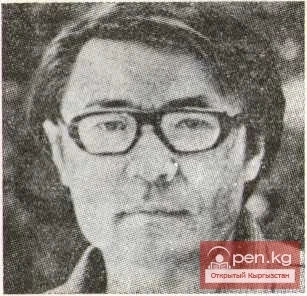
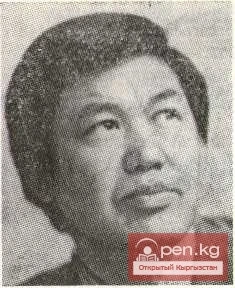
Prose writer N. Platonova was born in Tbilisi in a family of a military journalist and a political worker of the Red Army. In 1945, she graduated from high school in Saratov, and in 1950— from the historical faculty of Saratov State University. Since 1950, she collaborated with the youth newspaper "Young Stalinist" (Saratov) and worked as a freelance contributor for the ParGolovo district committee of the Komsomol near Leningrad. Since 1955, she has lived in Frunze. From that moment

10.07.2016, 14:32
Prose Writer Gennady Petrukhin
Writers of Kyrgyzstan

Prose Writer Gennady Petrukhin

Prose writer G. Petrukhin was born on December 17, 1934, in the city of Aktobe in a military family. In 1950, he graduated from high school, and in 1957— from the historical faculty of KazGU named after S. M. Kirov. From 1960 to 1962, he was a student at the Central Committee School under the Central Committee of the Komsomol. He began his career as a librarian in a high school in 1950, in 1957 he worked as the responsible secretary of the Aktobe district newspaper "Krasnoe Znamya,"

10.07.2016, 13:49
Prose Writer, Playwright Vasily Parshkov
Writers of Kyrgyzstan

Prose Writer, Playwright Vasily Parshkov

Prose writer, playwright V. I. Parshkov was born on January 14, 1897, in the village of Marchuki in the former Skopin district of the Ryazan province, into a peasant family of the poor. Since 1907, he lived in Kyrgyzstan. In 1909, he graduated from the 2nd grade of a church parish school, and in 1920, he completed courses for middle-level party personnel in Tashkent, later engaging in self-education. From the age of 12, he worked as a laborer for wealthy peasants and did earthworks for

10.07.2016, 13:40
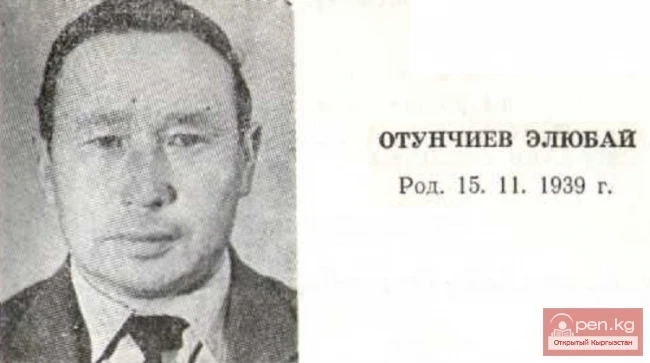
Prose Writer Eelyubai Otunchiev
Writers of Kyrgyzstan

Prose Writer Eelyubai Otunchiev

Prose writer E. Otuncheyev was born in the village of Chimbkent in the Kirov district of the Talas region in a peasant family. In 1956, he graduated from high school in his native village, and in 1953— from the journalism department of the philological faculty of KSU. From 1977 to 1979, he was a student at the Higher Party School of the CPSU in Moscow. He began his labor biography in 1956 as a collective farmer. From 1963, he worked in the Alamedin and Kirov District Committees of the Komsomol

10.07.2016, 13:12
Carpet Products among the Kyrgyz
Decorative and applied arts

Carpet Products among the Kyrgyz

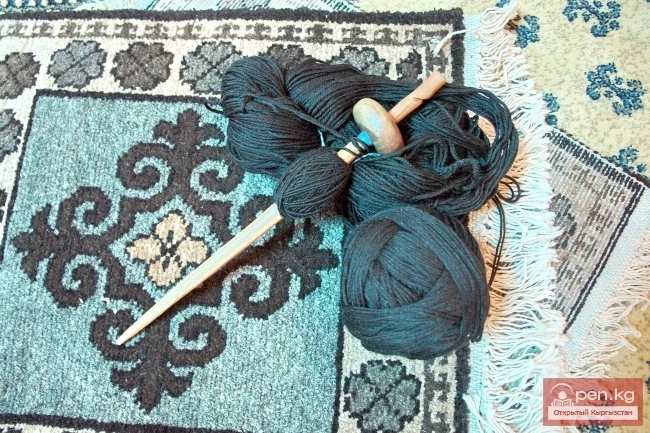
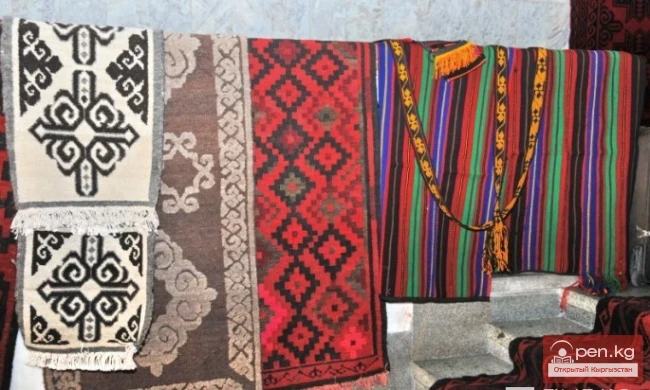
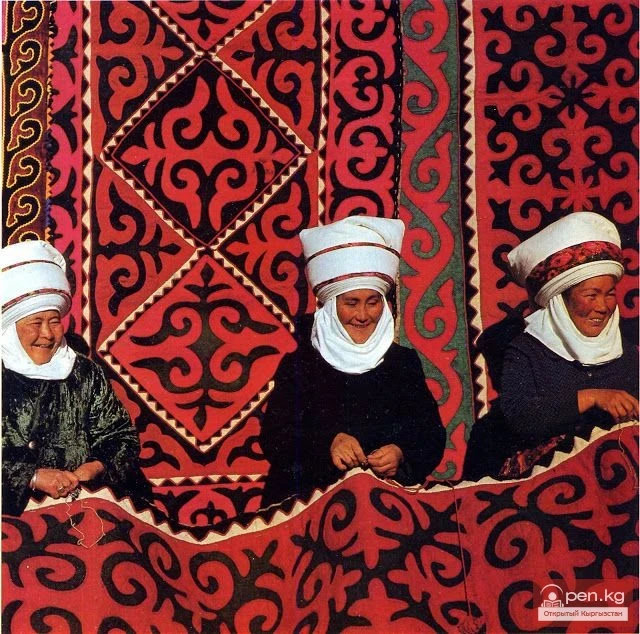
The production of pile carpet products among the Kyrgyz was closely linked to the needs of a nomadic lifestyle. Each item was adapted primarily to this, while also meeting the aesthetic needs of the Kyrgyz people. Carpet products gradually began to replace felt items, displacing some of them, although the production of the latter is much simpler and requires significantly less time.

20.03.2016, 20:21
Carpet Weaving among the Kyrgyz
Decorative and applied arts

Carpet Weaving among the Kyrgyz

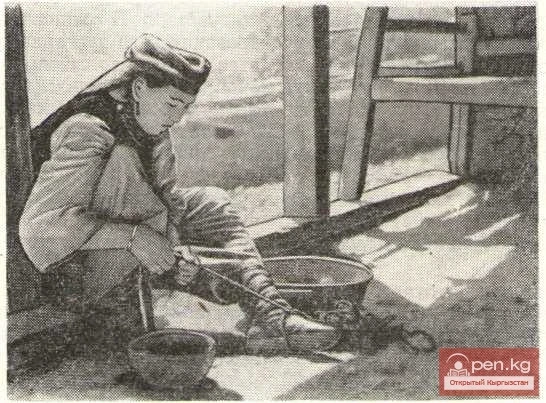
In the 19th century, especially in its second half, carpet weaving in southern Kyrgyzstan was widespread and was entirely in the hands of women. Originating from the needs of nomadic life, carpet weaving among the Kyrgyz initially developed in conditions of semi-subsistence farming, characterized as home production intended to meet the needs of individual families. However, even at that time, carpet products were mainly acquired by the upper class of society—the Kyrgyz nobility.

20.03.2016, 19:40
The Spread of Kyrgyz Pile Weaving
Decorative and applied arts

The Spread of Kyrgyz Pile Weaving

Pile weaving has long been known to the Kyrgyz living in the territory of the modern Osh region, and it is widespread in the southern areas, while in the northern regions (the former Jalal-Abad region), it is practiced by Kyrgyz inhabiting areas closer to the Fergana Valley.

20.03.2016, 19:35
Narrow Yurt or Spacious? (A Parable)
Myths and legends

Narrow Yurt or Spacious? (A Parable)

A very sad young man approached the wise elder. - Help me, elder. I have a yurt, but my family is very cramped in it. Besides me, my wife and children, my grandfather and grandmother also live with us. Therefore, we live in terrible tightness. Please give me advice on how to expand the yurt? - Do you have the opportunity to build a new yurt and live separately from the elders? - No, I cannot leave my grandfather and grandmother alone. They have no one else but me. - Alright, do you have any

20.03.2016, 18:59
Scientific Interest in Kyrgyz Carpet Weaving
Decorative and applied arts

Scientific Interest in Kyrgyz Carpet Weaving

Kyrgyz Carpet Weaving All three types of patterned fabrics, briefly described by us, are artistically unique and attractive. Currently, patterned weaving is in decline; primitive techniques are losing their strength literally every day. Only a transition to factory production (Jacquard machine) could preserve the age-old folk traditions and create beautiful decorative fabrics that fully meet modern tastes. In the most substantial works related to the applied art of the peoples of Central Asia,

04.01.2016, 01:44
The Poet Alykul Osmonov
Writers of Kyrgyzstan

The Poet Alykul Osmonov

Poet A. Osmonov was born in the village of Kaptal-Aryk in what is now the Panfilov District of the Kyrgyz SSR into a poor family. Orphaned at an early age, he was raised in the Pishpek and Tokmak orphanages. From 192E to 1933, he studied at the Frunze Pedagogical College. From 1932 to 1936, he worked in the editorial offices of the magazine "Chabuul" and the newspaper "Leninchil zhas," and from 1937 to 1940, he served as the secretary of the board of the Union of Writers of

29.12.2015, 22:08
Prose Writer Kachkynbay (KYRGYZBAI) Osmonaliev
Writers of Kyrgyzstan

Prose Writer Kachkynbay (KYRGYZBAI) Osmonaliev

Prose writer K. Osmonaliev was born on March 5, 1929, in the village of Chayek, Jumgal district, Naryn region, in a family of a civil servant. In 1953, he graduated from the Toktogul Satylganov Secondary School in Naryn. In 1958, he graduated from the philological faculty of KGU. From 1960 to 1962, he was a student at the VLK at the USSR Academy of Sciences in Moscow. From the age of 12, he worked in a collective farm as an accountant and a foreman. From 1957 to 1959, he served as the personal

29.12.2015, 21:56
Poet Kalibai (BARKTABAS) Osmonaliev
Writers of Kyrgyzstan

Poet Kalibai (BARKTABAS) Osmonaliev

Poet K. Osmonaliev was born on May 27, 1938, in the village of Kichi-Kemin, Kemin District of the Kyrgyz SSR, in a peasant family. In 1956, he graduated from high school in his native village, and in 1963, he graduated from the journalism department of the philological faculty of KGU. From 1964 to 1967, he studied at the Central Committee School of the Komsomol in Moscow, and from 1977 to 1979, at the Higher Party School in Almaty. Since 1963, he worked as an instructor, head of a lecture

29.12.2015, 21:35
Translator, Prose Writer Oldjobai Orozbaev
Writers of Kyrgyzstan

Translator, Prose Writer Oldjobai Orozbaev

Translator and prose writer O. Orozbaev was born on December 5, 1920, in the village of Temirovka, Issyk-Kul district, Issyk-Kul region, in a peasant-poor family. In 1937, he graduated from the Kyrgyz Pedagogical Technical School in Frunze. From 1937, he worked as a teacher at Kyrgyz Secondary School No. 5 named after A.S. Pushkin in Frunze. In 1939, he was drafted into the ranks of the Soviet Army. He participated in the Great Patriotic War. After being wounded in 1944, he was demobilized

29.12.2015, 21:25
Translator, Prose Writer Bekpo Orozaliev
Writers of Kyrgyzstan

Translator, Prose Writer Bekpo Orozaliev

Translator, prose writer B. Orozaliev was born on March 11, 1923, in the village of Zindan, Ak-Suu district of the Issyk-Kul region, in a family of a poor peasant. In 1938, he graduated from a seven-year school in his native village, in 1941— from the Tyup Agricultural Technical School, in 1958— from the Higher Party School under the Central Committee of the Communist Party of Kyrgyzstan, and in 1962— from the journalism department of the Higher Party School under the Central Committee of the

29.12.2015, 21:16
The Secret of Chon-Tash. June 12, 1991
Historical records

The Secret of Chon-Tash. June 12, 1991

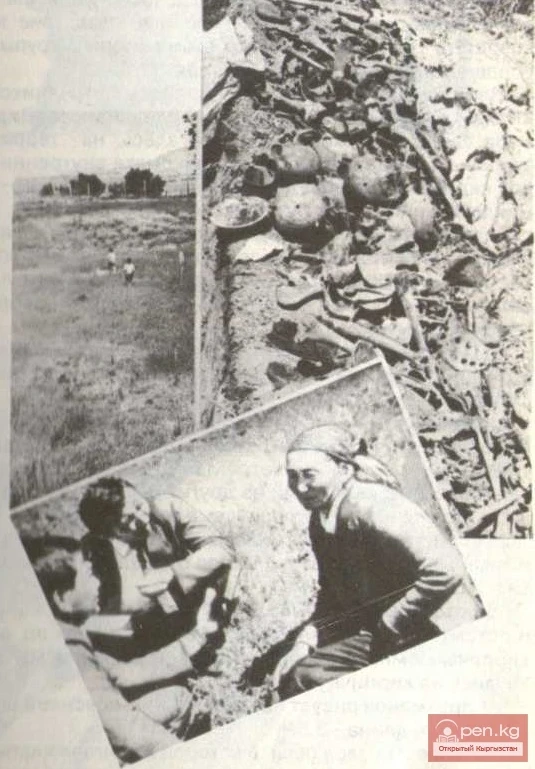
The Mystery of Chon-Tash. In the summer of '91, in the suburbs of the capital of Kyrgyzstan – Bishkek, near the village of Chon-Tash, a mass grave of human remains was discovered. A series of articles about the mysteries of the Chon-Tash area (translated from Kyrgyz as Big Stone), published in the republican newspaper “Slovo Kyrgyzstana,” sparked widespread public interest. The residents of the republic finally learned the truth about the tragic fate of their fathers, husbands, brothers,

27.12.2015, 14:12
Prose Writer, Screenwriter Kadyrkul Omurkulov
Writers of Kyrgyzstan

Prose Writer, Screenwriter Kadyrkul Omurkulov

Prose writer, screenwriter K. Omurkulov was born on February 16, 1941, in the village of Jilaymish, Sokuluk District of the Kyrgyz SSR, in a family of civil servants. In 1958, he graduated from Secondary School No. 28 in Frunze, and in 1965, he graduated from the scriptwriting faculty of VGIK. He began his labor biography in 1958 as a locksmith-assembler at the "Krasny Metallist" factory. Since 1966, he has worked in the State Cinema system, and from 1971 in the system of the State

26.12.2015, 22:33
Poet, Prose Writer Anatoliy Omurkanov
Writers of Kyrgyzstan

Poet, Prose Writer Anatoliy Omurkanov

Poet and prose writer A. Omurkanov was born on June 2, 1945, in the village of Chesh-Dyube, Manas district, Talas region, in a peasant family. In 1961, he graduated from Aral Secondary School, and in 1966, he graduated from the philological faculty of KSU. He began his labor biography as a teacher at a Kyrgyz secondary school in the Murghab district of the Tajik SSR. Since 1970, he has been a correspondent and head of department at the editorial office of the newspaper "Sovettik

26.12.2015, 21:39
How Kyrgyz People Capture and Train Hunting Birds
Customs

How Kyrgyz People Capture and Train Hunting Birds

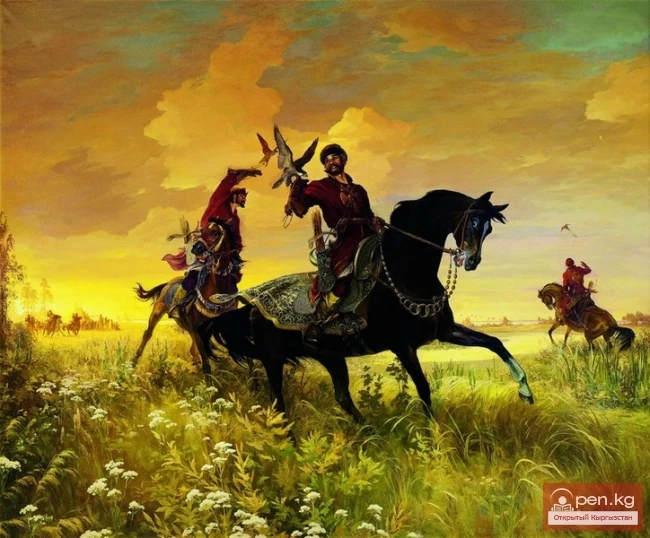
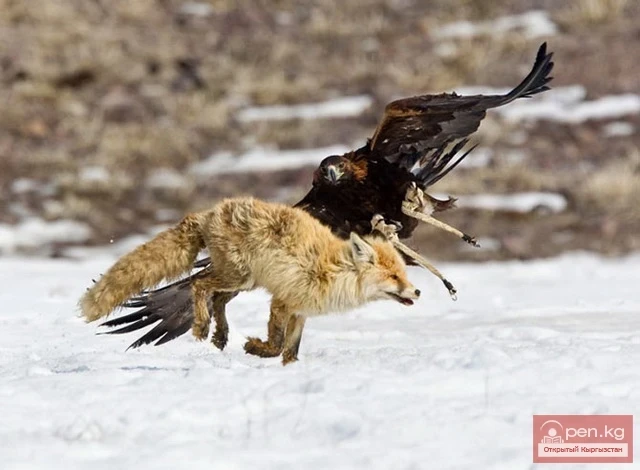
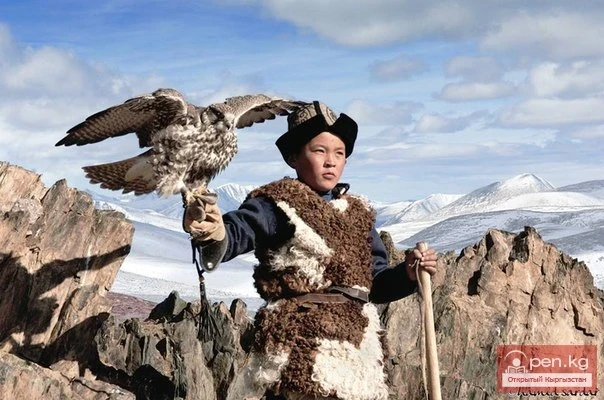
Hunting with Trained Birds According to the beliefs of the Kyrgyz, some particularly gifted individuals knew the language of our smaller brothers and could freely communicate with them, establishing contact; that is, our ancestors placed animals and birds on the same level as humans. Kyrgyz people not only had a good ability to differentiate trained birds by their behavior and agility, but they also distinguished them magnificently by age (kushtun tulogu). For example, they identified the age

05.12.2015, 21:43
About the Golden Eagle and the Daughter of the Mongoose Hunter
Myths and legends

About the Golden Eagle and the Daughter of the Mongoose Hunter

The daughter of the famous munushker married a simple, yet well-off man, who was neither a hunter nor a berkutchi and did not keep hounds — taigans. Several unremarkable years passed... One evening, the sound of a dog barking was heard. The kayinata (father-in-law) asked to check what the noise was. The woman went out, then quickly returned to the yurt and said:

05.12.2015, 21:31
Kyrgyz Hunting Birds of Prey
Birds

Kyrgyz Hunting Birds of Prey

Kyrgyz hunters distinguished 13 species of birds of prey — the gyrfalcon: baybaktuu shunkar — gyrfalcon with noticeable hairs on its legs, kuiko shunkar (this is a very valuable bird — in ancient times, the winner of a competition was gifted 9 birds of prey, and this nine was led by the kuiko shunkar), kazy shunkar — true gyrfalcon, kara shunkar — gyrfalcon with black plumage (very difficult to train), taza shunkar — pure gyrfalcon without admixture, moynoktyu shunkar — gyrfalcon with a light

05.12.2015, 21:21
The Legend of Kuu-Kumpa
Myths and legends

The Legend of Kuu-Kumpa

There is a legend among the people. The itelgi and the berkut were enemies, as the berkut often devoured the chicks of the itelgi when the parents were absent. One day, the cry of the itelgi was heard in the sky, having seen that the berkut was eating the chicks from her nest. The people living in the mountains noticed that the itelgi, after making a bit of noise, flew towards a high cliff. Before long, a strong whistling sound was heard in the sky. When the people looked up, they saw a bird

05.12.2015, 20:53
Kyrgyz Practical Ornithology
Ethnography

Kyrgyz Practical Ornithology

Kyrgyzstan is one of the mountainous republics of the CIS. The mountainous terrain, sharp elevation changes, the presence of plains and highlands in a relatively small area, numerous water bodies, and eternal glaciers, along with vast oases, give Kyrgyzstan a picturesque and unique appearance. The region is rich in animal life, distributed across natural landscape zones with a diverse plant cover. Although scientific study of the fauna of our region began in the late last century, the

05.12.2015, 20:48
Prose Writer Sagyndyk Omurbaev
Writers of Kyrgyzstan

Prose Writer Sagyndyk Omurbaev

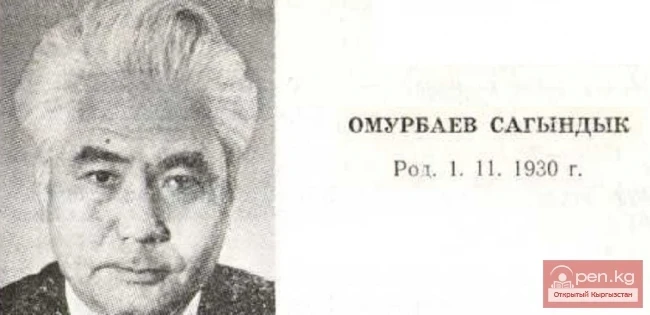
Prose writer S. Omurbaev was born in the village of Ak-Kuduk in the Kochkor district of the Naryn region into a peasant family. In 1947, he graduated from the Ortok Secondary School, and in 1951 — from the Kyrgyz State Pedagogical Institute. He began his labor biography as an editor in the department of original artistic literature at Kirgosizdat, and from 1951 worked as an editor in the children's and youth literature department of the "Mektep" publishing house, from 1966 — as

05.12.2015, 14:53
The title translates to: "Dramatist Baku Omuraliyev."
Writers of Kyrgyzstan

The title translates to: "Dramatist Baku Omuraliyev."

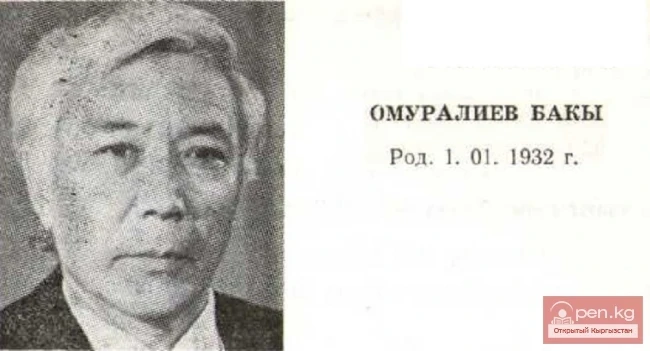
Dramatist B. Omuraliev was born in the village of Jany-Aryk in the Jumgal district of the Naryn region in a family of civil servants. Having lost his parents at an early age, he was raised in the Chayek orphanage from 1941 to 1949. In 1951, he graduated from high school in the village of Chayek, and in 1955 he graduated from the Tashkent State Institute of Theatre and Art named after A. Ostrovsky. From 1973 to 1975, he was a student at the Higher Literary Courses under the Union of Writers of

05.12.2015, 14:29
Critic, Literary Scholar Evgeny Ozmityel
Writers of Kyrgyzstan

Critic, Literary Scholar Evgeny Ozmityel

Critic, literary scholar E. Ozmitel was born on August 9, 1926, in Alma-Ata in a family of civil servants. In 1943, he graduated from high school, and in 1952 — from the philological faculty of KSU, continuing his education in graduate school. In 1957, he defended his dissertation for the degree of candidate, and in 1972 — for the degree of doctor of philological sciences. In 1943, he was drafted into the ranks of the Soviet Army. He was a participant in the Great Patriotic War. From 1947 to

05.12.2015, 14:15
Prose Writer Cholponbap Nusupov
Writers of Kyrgyzstan

Prose Writer Cholponbap Nusupov

Prose writer Ch. Nusupov was born on August 22, 1957, in Frunze in a family of civil servants. In 1974, he graduated from Frunze Secondary School No. 24, and in 1979, he graduated from the philosophical and economic faculty of KazGU named after S. M. Kirov. From 1980 to 1983, he studied in the graduate school of Moscow State University named after M. V. Lomonosov. He is a Candidate of Philosophical Sciences (1983). Since 1979, he has worked as a lecturer at the Department of Dialectical

05.12.2015, 12:04
Kyrgyz cuisine

How to Properly Butcher a Sheep

Since ancient times, Kyrgyz people have placed great importance on the presentation of meat. If served incorrectly or in violation of hierarchy, it could destroy the relationships between tribes and even turn them into irreconcilable enemies. These traditions pertain not only to the culture of serving food but also to the culture of relationships between elders and juniors, women and men, relatives and close ones. Therefore, we believe it is important for modern youth to know the rules of

27.11.2015, 20:35
Qualities of Pasture Grasses
Flora

Qualities of Pasture Grasses

The foundations of the herding system for livestock grazing, widely recommended by modern botany, were established and used by the Kyrgyz for a long time. They had a good understanding of the qualities of pasture grasses and their usefulness for livestock. For example, regarding sedge grass, the Kyrgyz said: "Until a horse grazes on sedge pastures, it does not gain fat."

10.11.2015, 23:27
Use of Pastures by Kyrgyz People
Ethnography

Use of Pastures by Kyrgyz People

The natural conditions themselves suggested how to use the pastures more effectively, considering their seasonality. The non-simultaneous growth of vegetation in different zonal areas historically determined the sequential use of pastures: koktoo — spring pastures, jaiyloo — summer pastures, kuzdoo — autumn pastures, and kyshtoo — winter pastures, the boundaries of which have mostly remained unchanged to this day. Driving animals to seasonal pastures better provided them with forage, while the

10.11.2015, 23:20
Botanical Knowledge of the Kyrgyz
Ethnography

Botanical Knowledge of the Kyrgyz

Plants are the primary source of life on Earth. Using solar energy, water, and carbon dioxide, they create the initial mass of organic matter, which sustains all other organisms. Generation after generation, people have observed plants, determining their harmfulness or usefulness, and utilizing them for their needs. Historically, a careful and respectful attitude towards vegetation, herbs, and the green cover of the Earth has been natural for the herder—nomad. It was said among the people:

10.11.2015, 23:09
The title translates to "Fabric 'Besh Keshte'."
Decorative and applied arts

The title translates to "Fabric 'Besh Keshte'."

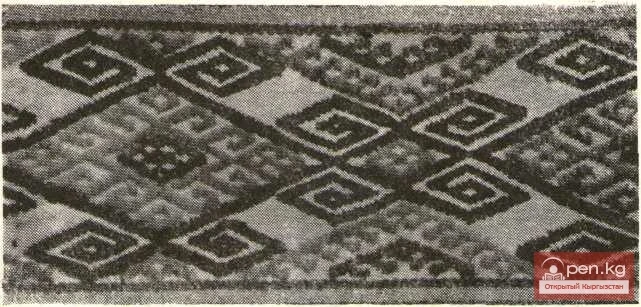
Sample of patterned fabric 'besh keshté'. Nookat District. The most vibrant and colorful of all types of patterned fabrics among the southern Kyrgyz is 'besh keshté' (The words 'besh keshté' mean 'a lot of embroidery' ('besh' — a lot, 'keshté' — from 'kashida' — the work of hand embroidery).

21.10.2015, 23:31
The title translates to "Khadzhary Fabric."
Decorative and applied arts

The title translates to "Khadzhary Fabric."

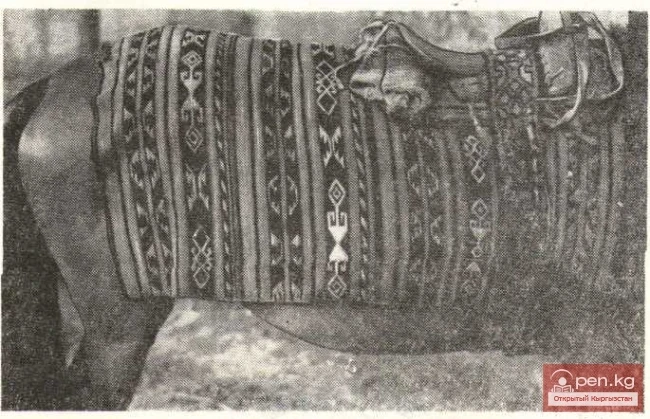
A saddle blanket made from strips of "kadjary" fabric Fabrics made using the "kadjary" technique are widely spread in southern Kyrgyzstan, known to the Pamir Kyrgyz, and are produced by Kyrgyz living in southern Xinjiang. Uzbeks, Kazakhs, and Karakalpaks also use a similar technique.

13.10.2015, 19:52
Pre-Islamic Beliefs of the Kyrgyz
Religion

Pre-Islamic Beliefs of the Kyrgyz

Research on the issues of pre-Islamic beliefs among the Kyrgyz has always been of great interest and at the same time accompanied by difficulties for specialists. According to S.M. Abramzon, the study of the "complex of religious representations among the Kyrgyz, which is commonly referred to as 'pre-Islamic beliefs,' is characterized by particular complexity and multi-stage nature, conditioned by the peculiar and equally complex ethnic history of the Kyrgyz people." It

07.10.2015, 00:22
Kegety Gorge and Köl-Tor Lake
Gorges

Kegety Gorge and Köl-Tor Lake

Another one of the most beautiful gorges in Kyrgyzstan, Kegety Gorge is located on the northern side of the Kyrgyz Ridge, 90 kilometers from the city of Bishkek. Its picturesque nature makes it very interesting and attractive for tourists. A turbulent river with the same name flows through Kegety Gorge, which has many tributaries. The largest of them is the right tributary Köl-Tor, which forms a very beautiful independent gorge, at the headwaters of which there is a lake with turquoise water.

20.09.2015, 15:29
Poet Alexander Nikitenko
Writers of Kyrgyzstan

Poet Alexander Nikitenko

Poet A. Nikitenko was born on April 5, 1948, in Dushanbe in a family of a civil servant. Since 1951, he has lived in Kyrgyzstan. He graduated from Lebedinovskaya Secondary School in the Alamudun district in 1966 and from the philological faculty of KSU in 1971. He began his work biography in 1971 as an adjuster at the Frunze drill factory, then worked as an editor for the factory's mass-circulation newspaper. Since 1977, he has worked as an editor at the State Publishing House of the

15.09.2015, 13:54
Translator, publicist Sagyn Namatbaev
Writers of Kyrgyzstan

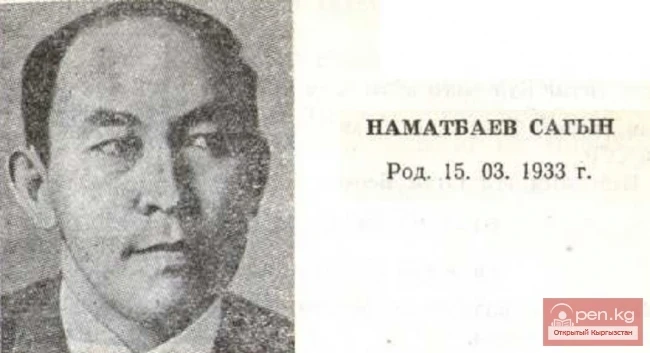
Translator, publicist Sagyn Namatbaev

Translator and publicist S. Namatbaev was born in the village of Chon-Aryk in the Moscow district of the Kyrgyz SSR in a peasant family. In 1951, he graduated from Kyrgyz Secondary School No. 5 named after A. S. Pushkin in Frunze, and in 1955, he graduated from the historical faculty of KGU. He began his labor biography in 1955 as a teacher at a secondary school in the city of Osh. From 1958, he worked as head of the lecture group, secretary of the Osh regional committee of the Komsomol,

15.09.2015, 13:47
Akin-improviser, storyteller-manaschi Moldobasan Musulmankulov
Writers of Kyrgyzstan

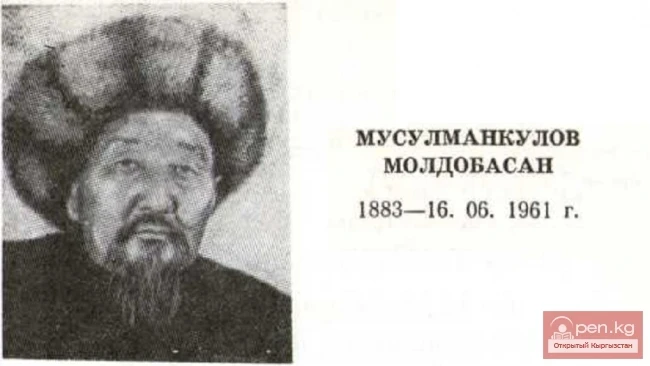
Akin-improviser, storyteller-manaschi Moldobasan Musulmankulov

Akin-improviser, storyteller-manashchi M. Musulmankulov was born in the village of Terek in the current Ak-Talinsky district of Naryn region into a peasant family. From the age of 17, he became known as a performer of folk songs, komuz player, and improvisational singer. In his more mature years, he gained fame as a storyteller of small epics and became recognized as a manashchi. In 1932, he was invited as a singer to Naryn Radio, in 1933 he was accepted as a soloist in the Kyrgyz Drama

15.09.2015, 13:40
Prose Writer Musa Murataliev
Writers of Kyrgyzstan

Prose Writer Musa Murataliev

Prose writer M. Murataliev was born in the village of At-Bashi in the Naryn region to a family of a forestry worker. In 1959, he graduated from Secondary School No. 1 named after Toktogul Satylganov in Naryn, and in 1970— from the A. M. Gorky Literary Institute. He began his labor biography in 1959 as a metal detector at the Chimbulak geological party of the Chui exploratory expedition. He then worked as a concrete worker at SMU No. 5 in Frunze, as a monitor-controller at the Frunze RES, and

14.09.2015, 01:20
Prose Writer Toktobai Mulkubatov
Writers of Kyrgyzstan

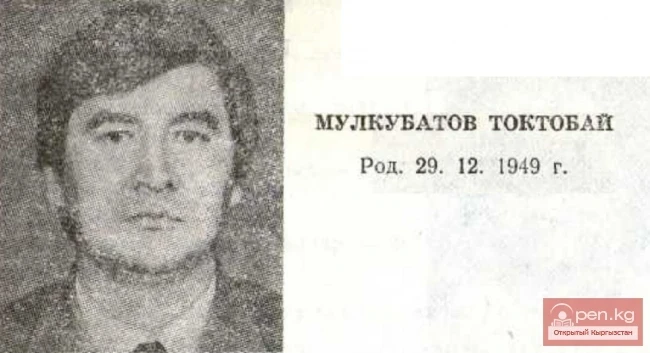
Prose Writer Toktobai Mulkubatov

Prose writer T. Mulkubatov was born in the village of Kyzyl-Suu in the Toktogul district of the Osh region into a peasant family. In 1966, he graduated from Kuybyshev Secondary School, and in 1974 — from the historical faculty of the Kyrgyz State University named after the 50th anniversary of the USSR. He began his labor biography in 1966 as a carpenter at the Toktogul Construction and Installation Management, while also collaborating with the district newspaper "Uchkyn." Since 1974,

14.09.2015, 01:14
Poet Rosa Mukasheva
Writers of Kyrgyzstan

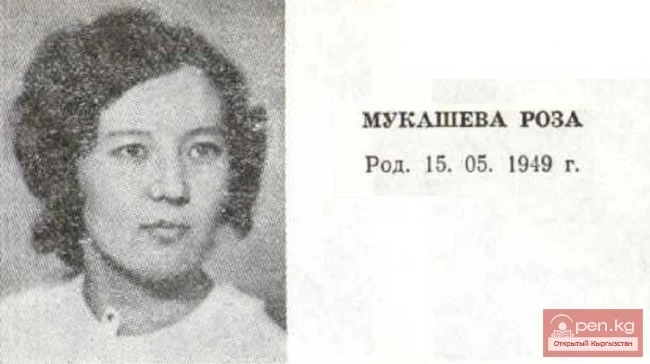
Poet Rosa Mukasheva

Poet R. Mukasheva was born in the village of Bokonbaev in the Ton district of the Issyk-Kul region in a peasant family. In 1966, she graduated from A. M. Gorky Secondary School in her native village, and in 1971, she graduated from the technological faculty of the FPI. She began her career as a technology engineer at a canning factory in the Sokuluk district, and from 1973, she worked as an editor in the industrial department of the State Committee for Television and Radio of the Kyrgyz SSR.

14.09.2015, 01:08
The Poet Gulsaira Momunova
Writers of Kyrgyzstan

The Poet Gulsaira Momunova

Poet G. Momunova was born in the village of Ken-Aral in the Leninpol district of the Talas region in a peasant family. In 1955, she graduated from Secondary School No. 1 in the city of Talas, and in 1960 from the V. Mayakovsky Kyrgyz State Pedagogical Institute. From 1961 to 1969, she worked as a literary employee at the editorial office of the newspaper "Sovettik Kyrgyzstan," and from 1971 as an editor at the "Kyrgyzstan" publishing house. From 1973, she served as the

14.09.2015, 01:01
Poet Turgunaly Moldobaev
Writers of Kyrgyzstan

Poet Turgunaly Moldobaev

Poet T. Moldobaev was born on March 15, 1934, in the village of Tegene, Jangi-Jol District, Osh Region, in a peasant family. In 1952, he graduated from high school in Jalal-Abad, and in 1957, he graduated from the philological faculty of KGU. Since 1957, he has worked in the editorial office of the Jalal-Abad regional newspaper "Kommunizm tuusu," then as a literary employee in the editorial office of the newspaper "Kyrgyzstan pioneri," and as a senior editor of the literary

12.09.2015, 01:16