Last week, three people were executed in Singapore for drug-related crimes, bringing the total number of executions this year to 17 — the highest level since 2003, according to information from the BBC.
This event occurred just a week before a hearing on the constitutionality of the death penalty for drug offenses.
Singapore has some of the strictest drug laws in the world, which authorities claim are an important deterrent against drug crime, a serious problem in other Southeast Asian countries.
Under Singapore's laws, anyone convicted of drug trafficking, including the sale, transfer, transportation, or consumption of more than 15 grams of diamorphine (heroin), 30 grams of cocaine, 250 grams of methamphetamine, or 500 grams of cannabis, is subject to the death penalty.
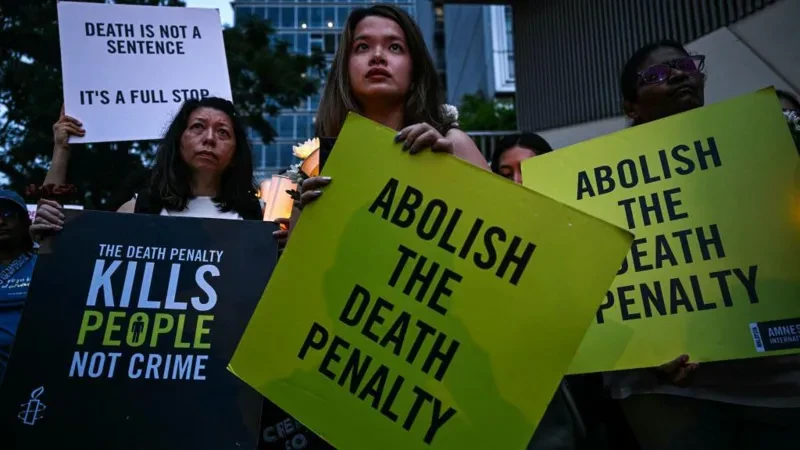
A group of seven activists who filed a lawsuit challenging the constitutionality argue that the mandatory death penalty violates citizens' constitutional rights to life and equal protection.
According to the constitution, "no one shall be deprived of life or liberty except in accordance with the law."
Activists from the local organization Transformative Justice Collective stated that "Singapore's barbaric drug policy is losing ground in the global context," emphasizing that it is one of the few countries where executions for drug offenses continue.
The Singaporean government argues that abolishing the death penalty could worsen the crime situation.
Home Minister K. Shanmugam stated earlier this year that it could lead to an increase in violence and drug-related deaths, including tragic cases involving innocent children.
"As politicians, we must set aside our personal feelings and do everything possible to protect the majority... We cannot remain idle if we take a step that will lead to more innocent victims in Singapore," he wrote on Facebook in January.
Among those executed last week was Saminathan Selvaraju, a logistics driver convicted of transporting 301.6 grams of diamorphine, known as heroin, from Malaysia to Singapore on the night of November 21, 2013.
Saminathan claimed he was driving his trailer that day, but not at the time the drugs were imported. He stated that several drivers used the same vehicle.
During a search of his car, pre-filled immigration cards with his signature were found, one of which listed an address in Singapore where the drugs were later discovered. However, he claimed he did not fill out those documents.
The judge rejected his defense, and on Thursday, Saminathan was hanged.
For many years, he participated in various civil lawsuits against the death penalty, including a constitutional challenge he filed along with three other convicts in 2022.
Thus, under the law, if a person is found with drugs above the established threshold, they are considered a trafficker unless they can prove otherwise.
Additionally, if a person has keys to a location where drugs are found, they are considered the owner until they can refute this.
In August, Singapore's highest court rejected an appeal, noting that the law is designed to combat a problem perceived as a disaster for society.
In September, Saminathan and three other inmates submitted a clemency petition to the president, but it was denied, as are most such petitions in the country.
The death penalty in Singapore is also applied for murders and kidnappings, but its application for drug offenses attracts the most attention.
Critics argue that the laws primarily punish low-level drug couriers, who often come from marginalized communities, and do not target the leaders of criminal organizations.
Lawyer Mervyn Chong, who represents death row inmates, noted that he sometimes finds it difficult to understand why mandatory sentences are applied for certain drug offenses, while punishments for more serious international crimes are not as strict.
He reminded that under the Rome Statute, ratified by 125 countries, the maximum penalty for serious crimes such as genocide and war crimes is life imprisonment.
The European Union delegation in Singapore expressed the view that the recent executions mark a "significant increase in the application of the death penalty" in the country.
"The application of the death penalty for drug offenses is contrary to international law, as these offenses do not reach the level of 'most serious crimes,'" the statement said, also emphasizing that such a measure makes rehabilitation impossible.
Nevertheless, the Singaporean government insists that the death penalty has made the country one of the safest in the world, and the Ministry of Home Affairs claims that this punishment is applied solely for crimes that "pose the greatest threat to victims and society."
A survey conducted by the ministry in 2023 showed that about 69% of the 2,000 respondents agree that the death penalty is an adequate punishment for those convicted of serious drug offenses.