In the new World Bank ranking, Mongolia ranks 47th out of 217 countries, rising from the 52nd position it held in 2023.
This growth of 5 positions illustrates improvements in the statistical infrastructure and governance in the country.
Every year, the World Bank releases a ranking based on statistical efficiency (The Statistical Performance Indicators – SPI), which is formed based on official international data. These indicators provide up-to-date information on global development, including national, regional, and global assessments.
The statistical performance indicators demonstrate the capabilities of the national statistical system and cover aspects such as data use, services provided, statistical products, sources, and data infrastructure. Ratings range from 0 to 100, where 100 indicates a high level.
In 2024, Norway topped the ranking with 94.1 points, followed by Sweden with 92.7. Both countries have risen 3 positions compared to 2023. At the lower end are South Sudan with 27.1 points and Turkmenistan with 29.7.
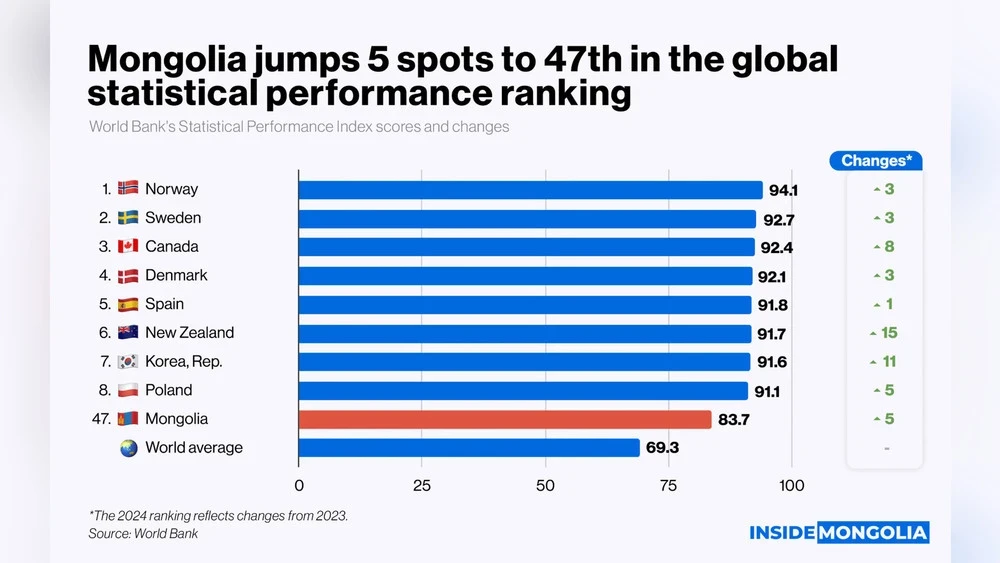
According to the latest data, Mongolia scored 83.7 points out of 100, exceeding the global average by 14.4 points. In this area, the country achieved 96.3 points for data transmission services, although the transmission infrastructure remained the weakest link with 70 points. In a regional context, Mongolia outperforms the averages for East Asia and the Pacific by 17.1 points, as well as by 14.8 points compared to upper-middle-income countries, highlighting its competitiveness.
The statistical potential of Mongolia continues to develop, allowing the country to occupy increasingly competitive positions on the international stage. The improvement in five key indicators gives hope for a repeat of the success of 2016, when Mongolia ranked 36th in the world.
Tatar S. Maidar
source: MiddleAsianNews