Kaktus.media analyzed the number of credit and grant agreements signed since the beginning of the year and identified the main donors willing to provide funds to the republic.
Funding Areas
Despite positive economic indicators and increased budget revenues, Kyrgyzstan continues to seek support from international donors for the implementation of various projects. Most of the funds are directed towards the development of energy, education, and business support.Here is a list of key organizations and projects for which the republic has received approval for funding:
- A $9 million loan to settle debts with contractors for the CASA-1000 project;
- A loan from the Islamic Development Bank for inclusive education;
- A loan for the construction of two substations in the Issyk-Kul region from the Islamic Development Bank allocated to Kyrgyzstan;
- A loan for the modernization of education and the development of inclusive education from the Islamic Development Bank amounting to $25 million;
- Modernization of the "Sulaiman-Too" museum complex funded by a loan from the World Bank;
- A loan from the Asian Development Bank for improving water supply in the Naryn region amounting to $323 million;
- Allocation of $121 million for the first phase of the "Universal Access to Water Supply and Sanitation" program from the World Bank;
- A project for developing a sustainable financial market for SMEs in Kyrgyzstan with $120 million allocated from the World Bank;
- The Asian Development Bank allocates $147.2 million for investment projects;
- A loan for the modernization of substations from the European Bank for Reconstruction and Development;
- An additional loan from the World Bank for updating the feasibility study for the construction of the Kambar-Ata HPP-1;
- Funding for the reconstruction and automation of the Western Big Chui Canal amounting to 15.23 million euros from the European Bank for Reconstruction and Development and the EU;
- Socio-economic projects amounting to $500 million from South Korea;
- A loan for the implementation of the National Community Initiative Project.
Grant Funding
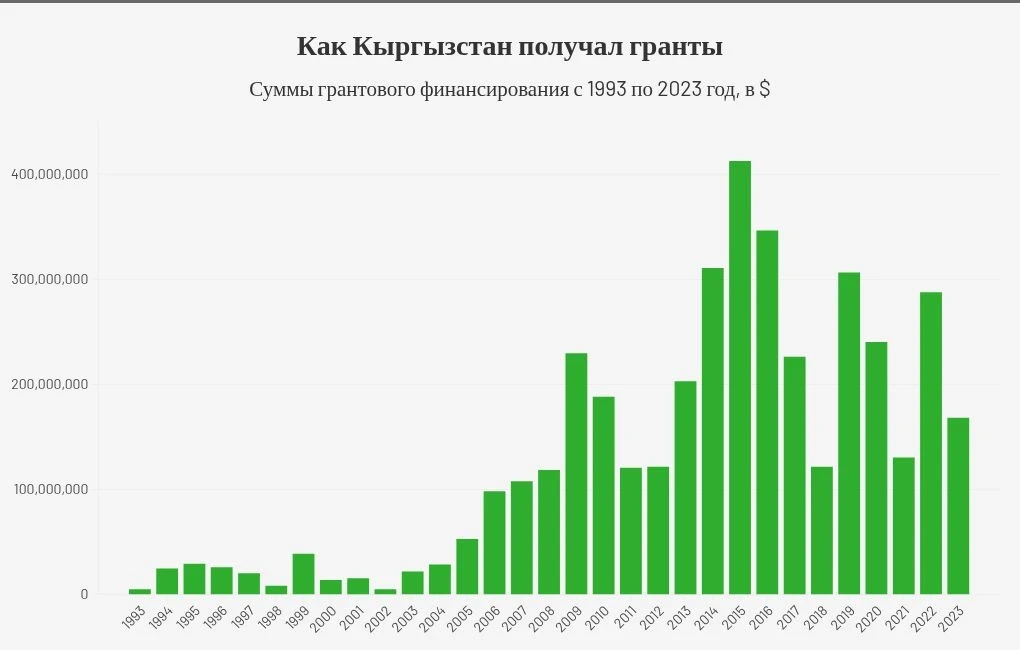
It should be noted that almost every loan agreement includes a grant component that does not need to be repaid. Although government agencies do not always provide complete data on the size of grants, our editorial team has gathered known information.Here is a list of key organizations and projects for which the republic has received approval for grants this year:
- Switzerland allocates over $2.7 million for reforms in water resource management;
- A grant from Qatar amounting to $9.2 million for the construction of an additional building for a hospital in Bishkek;
- Grants for inclusive education from the Global Partnership and the Islamic Development Bank;
- A grant for the "Rural Water Supply and Sanitation Development Program" project in the Naryn region from the Asian Development Bank;
- The Asian Development Bank allocates nearly $75 million in grant funding for investment projects;
- An additional grant from the World Bank for updating the feasibility study for the construction of the Kambar-Ata HPP-1;
- The European Bank for Reconstruction and Development and the EU allocated 8.6 million euros for financing the reconstruction of the Western Big Chui Canal;
- The World Bank allocates a grant for the implementation of the National Community Initiative Project;
Main Donors
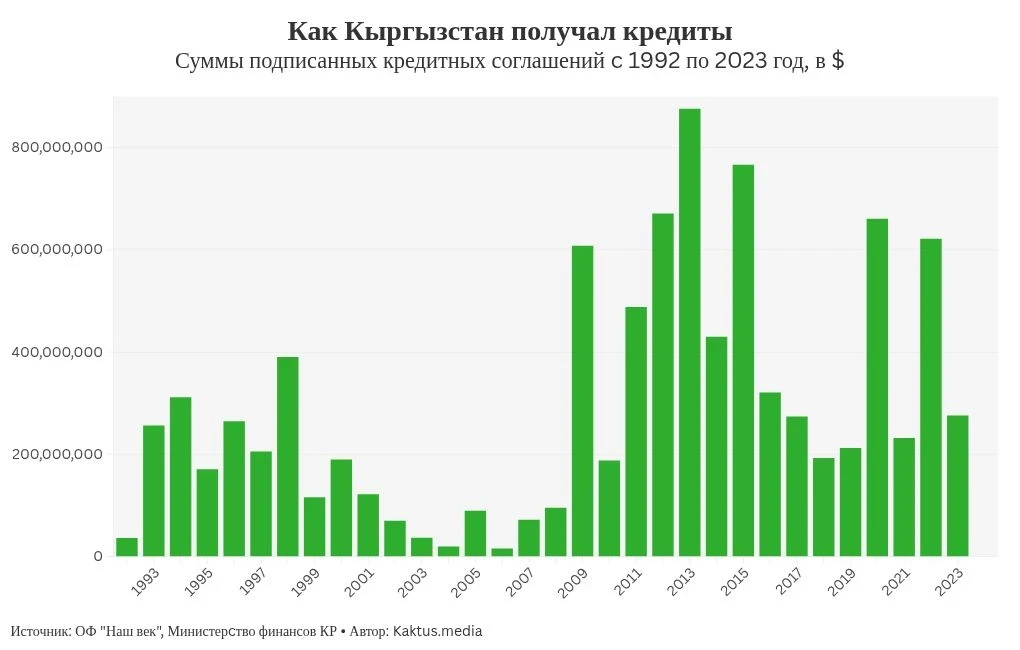
Since the beginning of the year, Kyrgyzstan has signed agreements for loans and grants totaling $1.2 billion. Of this, $1 billion 93.8 million are loans and $12.2 million are grants. The main donor is South Korea, which plans to finance projects in Kyrgyzstan amounting to $500 million over the next four years.In the first 18 years of independence, the republic was cautious in attracting external loans. From 1992 to 2009, loan agreements totaling $3 billion 69.6 million were signed, while from 2010 to 2023, this figure doubled, reaching $6 billion 210 million.