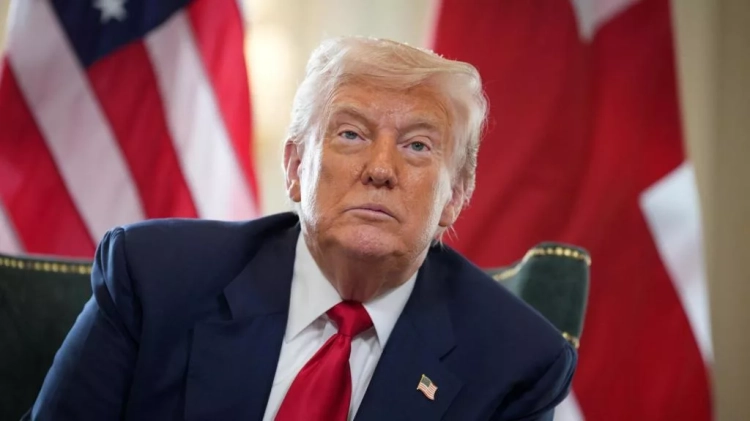
U.S. President Donald Trump published an extensive post on his Truth Social page, commenting on the recent Israeli attack on the South Pars gas field in Iran, which occurred on Wednesday evening.
In response to this attack, Iran carried out a strike on Ras Laffan in Qatar, where the world's largest liquefied natural gas (LNG) processing plant is located.
In his sharp statement, Trump claims that the U.S. "had no idea" about the Israeli strike, threatening escalation if Iran attacks Qatar again.
He describes the Israeli strike as "brutal" and linked to "anger over what is happening in the Middle East." Trump also noted that Qatar "was neither involved nor aware" of the impending attack.
In his message, he emphasizes that Iran's retaliatory actions against the attack in Qatar's Ras Laffan are "unjustified and unfair."
Trump also stated in capital letters that Israel will not attack the South Pars gas field "unless Iran recklessly decides to attack" Qatar.
In the event of another attack by Iran on Qatar, he threatens to "massively explode the entire South Pars gas field with a force that Iran has never seen." Trump added that he does not want to apply "such a level of violence," but is prepared to do so if the Qatari plant becomes a target again.
The FBI has launched an investigation into former counter-terrorism unit employee Joe Kent.
According to CBS, former director of the National Counterterrorism Center Joe Kent is under investigation by the FBI.
The investigation is related to leaks of classified information and began before his recent resignation linked to the conflict in Iran.
Previously, Kent discussed with conservative commentator Tucker Carlson that the U.S. and Israel's operation to eliminate Iran's Supreme Leader Ali Khamenei "was the last step we should have taken."
At the time of CBS's publication, the FBI had not commented on the situation.
The Pentagon has requested approval from the White House for funding exceeding $200 billion for the war in Iran, as reported by a senior administration official to the Washington Post.
This amount significantly exceeds the expenses for the current campaign of the Trump administration and will be used for "urgent" increases in the production of critically important weapons.
Over the past two weeks, the Pentagon has made several funding requests, and according to the Post, the latest request may provoke serious political disagreements in Congress.
Testing the Japan-U.S. Alliance: Trump's Meeting with the Prime Minister of Japan.
Jack Barton
Reporting from Seoul, South Korea.
This will be an important test for relations, as it is Trump's first meeting with a key ally since the conflict began.
The preliminary agenda covering tariffs, trade, and financial aid to Japan is likely outdated. Trump is expected to pressure Prime Minister Sanae Takaichi again to send military ships to the Strait of Hormuz.
Japan relies on energy resources, as about 90% of its supplies come from this region. The Japanese navy, as an ally of the U.S., is one of the most powerful in the world.
It includes many convoy ships, about 49 frigates and destroyers equipped with Aegis systems and modern missiles, significantly surpassing the capabilities of the UK and France.
Although Takaichi does not require parliamentary approval to send ships, over 80% of Japanese voters oppose this, which could negatively impact her political rating. Additionally, the pacifist constitution limits the navy's actions, allowing participation only in anti-piracy efforts, but not in military conflicts.
Japan has good relations with Iran, so some analysts suggest that it may try to negotiate with Tehran for safe passage of its cargoes in exchange for refraining from involvement in the conflict with the U.S.
Analysts believe that South Korea may also consider a similar option. Although it has not rejected Trump's request to send military ships to the region, most politicians in the ruling party consider it a violation of South Korean laws.
Sirens Sound Across Israel
According to Israeli media, sirens began to sound in several regions of the country after the Israeli army detected rockets launched from Iran.
This was the sixth rocket strike carried out by Iran since midnight.
The Next Threat of War with Iran: Food and Water — The Atlantic.
A prolonged blockade of the Strait of Hormuz could trigger a humanitarian crisis.
Leaders of Arabian Peninsula countries previously relied on oil revenues to create prosperous modern societies, attracting specialists from around the world, providing jobs, security, and a favorable climate.
Those who have visited Dubai or Doha know the successes achieved over the past 30 years: the region's population has more than doubled to about 60 million people, with further growth expected.
However, the war with Iran has revealed the main vulnerability of this model.
The harsh oil-rich deserts make it almost impossible to develop agriculture, leaving states almost entirely dependent on food imports.
A large portion of these supplies passes through the Strait of Hormuz — a narrow waterway that is effectively closed to commercial shipping due to threats of attacks from Iran and its allies.
Kuwait Reports Work on Intercepting Missiles and Drones.
The Kuwaiti army reported that its air defense systems "are responding to enemy missile and drone attacks," about an hour after the National Guard reported intercepting several drones.
The army urges citizens to adhere to "safety instructions," stating that any audible explosions are the result of interceptions.
The U.S. Federal Reserve Revises Inflation Forecast Amid Economic Uncertainty.
The U.S. Federal Reserve has raised its inflation forecast while keeping interest rates unchanged, citing an "uncertain" economic outlook due to the war with Iran.
Fed Chair Jerome Powell noted that people "will have to wait and see" how the U.S. and Israel's war against Iran will affect the country's economy.
"We are at the early stages of this process, and we do not know how extensive it will be and how long it will last," he added.
"It could have either a significant or a minor impact on the U.S. economy."
South Korea Concerned About Loss of Petrochemical Products Necessary for Exports.
Jack Barton
Reporting from Seoul, South Korea.
It is no surprise that local officials were alarmed after the Israeli strike on the South Pars gas field in Iran, and this concern has grown following retaliatory attacks on Saudi Arabia, Qatar, and the UAE, which have affected a significant part of the energy infrastructure the country heavily relies on — not only in terms of energy but also in petrochemicals and helium used in semiconductors. Overall, this concerns all exported goods.
Emergency meetings have become a regular occurrence. At the latest meeting, government representatives reiterated the need to expand the list of energy importers and discussed the possible introduction of price caps on oil coming from local refineries.
This is the first instance of price caps being imposed on refineries since the Asian financial crisis of 1997… The market here is indeed shaken significantly.
The government is considering additional measures, including rationing supplies for vehicles, but the UAE has provided support by organizing some supplies bypassing the Strait of Hormuz: one has already reached [South Korea], and another is on the way.
In total, about 24 million barrels of oil and a shipment of naphtha — critical for industries such as plastic manufacturing — are en route, but these stocks are limited.
The Ministry of Health of Lebanon has published data on the number of casualties from Israeli attacks on several areas of the country over the past two days.
They are as follows:
- In Deir Zahani, three people were killed, including two children, and 15 were injured.
- In Sidon, two people were killed and five were injured.
- In Kharu, six people were killed and 10 were injured.
- In Jebchit, seven people were killed, including four Syrian citizens, and two were injured.
- In Baalbek, four people were killed and seven were injured.
- In Sahmara, nine people were killed and 23 were injured.
- In the city of Jmaye, three people were killed and four were injured.
- In Beirut, 11 people were killed, 45 were injured, including 14 children.
Iranian Foreign Minister Araqchi Held Phone Conversations with Several Colleagues.
Iran's Foreign Minister Abbas Araqchi held phone conversations with his counterparts from Turkey, Egypt, and Pakistan.
In a statement from the Iranian Foreign Ministry, it was reported that Araqchi discussed with the ministers "the military aggression of the U.S. and Israel against Iran and its consequences," as well as "the need for coordination of actions among countries in the region in light of these threats."
Additionally, Araqchi had a phone conversation with Swedish Foreign Minister Maria Malmer Stenergard, who previously expressed "concern" regarding the execution of a Swedish citizen accused of espionage for Israel.
Araqchi called the support given by Stenergard to this individual "regrettable."
QatarEnergy Reports "Significant Fires" Following Iranian Missile Strikes.
QatarEnergy reports major fires that have broken out at several liquefied natural gas (LNG) production facilities following recent Iranian attacks on the industrial city of Ras Laffan.
QatarEnergy noted that these attacks occurred "in addition to the previous attack on Ras Laffan on Wednesday," which "caused significant damage to the Pearl GTL (gas-to-liquids) plant."
The new attacks inflicted "significant additional damage," and "emergency response teams were immediately deployed," with no casualties reported, QatarEnergy added.
Qatar States That Iran Has Crossed "Red Lines" and Calls for De-escalation.
The Qatari Foreign Ministry issued a statement following Iran's attack on the gas facility in Ras Laffan.
The statement said that "the brutal Iranian attacks on countries in the region have crossed all red lines, as their targets are civilians, infrastructure, and vital facilities."
"The ministry emphasizes the need to rid the region of the consequences of these unjustified attacks and to work towards de-escalation to restore regional and international security."
Saudi Arabia Reserves the Right to "Military Action" After Iranian Attacks.
Saudi Foreign Minister Prince Faisal bin Farhan Al Saud stated that Riyadh reserves the right to take military action against Iran if necessary, following attacks on two oil refineries in the capital.
Speaking to reporters after a meeting of foreign ministers in Riyadh, he noted that Iran must "reconsider its erroneous decisions," emphasizing that such attacks will not benefit Tehran.
Prince Faisal added that Iran "does not believe in dialogue with its neighbors" and instead "tries to exert pressure on them," which he believes will not succeed and "will backfire on Tehran."
Brief Overview of Recent Events
- Qatar ordered the expulsion of Iranian security personnel and military attachés following a missile strike on the main gas storage facility in Ras Laffan.
- The United Arab Emirates closed the Habshan gas terminals in Abu Dhabi after the Iranian strike, while Saudi Arabia reported an attack on two of its oil refineries in Riyadh.
- These events occurred after Israel's attack on the Iranian navy in northern Bandar Anzali and on the South Pars gas field, while Iranian President Masoud Pezeshkian warned of "uncontrollable consequences" for the entire world.
- As a result of Iran's retaliatory attacks on Israel in Tel Aviv and the occupied West Bank, four people were killed.
- Israeli forces continue bombings in Beirut and southern Lebanon, with the death toll rising to 968 people.
- Israeli Defense Minister Israel Katz reported that Iran's intelligence minister Esmail Khatib was killed as a result of the Israeli attack.
- U.S. National Intelligence Director Tulsi Gabbard informed the Senate Intelligence Committee that the Iranian government "appears to have maintained its integrity but has significantly degraded."
The post Trump threatens to "massively explode" a major gas field in Iran. What else happened? first appeared on K-News.