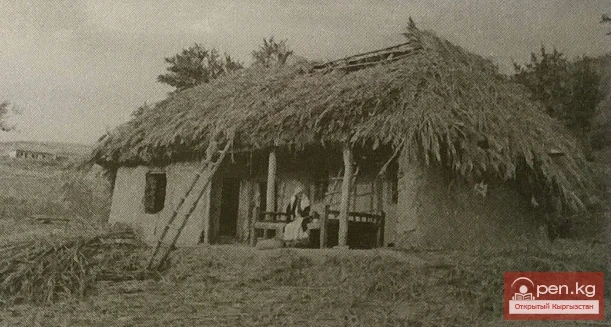
Located at 6 Orozov Street, this house is one of the oldest residential buildings in the city, built in 1897, when Karakol was actively developing. The architecture of the building reflects the characteristic features of small county towns of that time. This wooden structure, treated with plaster, has a straight facade, symmetrically arranged windows, and strict proportions.
Initially, the house was used as housing, likely for specialists — doctors, teachers, and officials. Such buildings shaped the appearance of the city, creating a sense of order and stability.
However, in the second half of the 20th century, during the Soviet period, the building was repurposed into a children's consultation center. Preventive examinations, vaccinations, and consultations for parents were conducted here, making it an important element of the city's healthcare system. For many elderly residents, this place is associated with unforgettable memories of health care in childhood.
With the collapse of the Soviet Union and changes in the healthcare system, this facility was closed, and the building became residential again. Local residents claim that the historical atmosphere is still felt within its walls.
Currently, the Issyk-Kul Regional Bureau of Forensic Medical Examination is located here.
Turmush previously wrote that on March 7, 1889, by the decree of the emperor, the city of Karakol was named Przhevalsk.
As Kaulbars noted: “I am proud that the city of Karakol was named after Przhevalsky – a famous explorer of Asia and traveler.”
In 1874, the first school opened in Przhevalsk based on two classes, and by 1879, the number of classes increased to four. A school called "Maktab" was established in the Tatar mosque, where the basics of the Quran, as well as history, geography, and mathematics, were taught.
From 1890, people began to settle here from the central provinces of Russia and Ukraine. By 1897, the population reached over 8,000 people, and by 1919, it had already grown to 11,610 residents.
The first elder of the city, elected in 1894, was Nikolai Mikhailovich Barsov, who significantly contributed to the development of local infrastructure. At his initiative, a dramatic circle was created in the same year, and the construction of schools, libraries, and boarding houses began. In 1895, a park named in his honor appeared in the city (now it is Pushkin Park).
Military doctor Barsov was also one of the initiators of the opening of the Przhevalsk City Public Library, the opening ceremony of which took place on May 14, 1902.
On March 19, 1908, the coat of arms of the city of Karakol was approved at a meeting of the Council of Ministers of the Russian Empire, and for some time it became the coat of arms of the entire Issyk-Kul district.
In 1909, V.A. Ivanov was in charge of the district, his assistant was A.I. Belyaev, and the elder of the city became E.S. Lokshakov. Residents engaged in agriculture, fishing, and beekeeping, and that same year, 5,200 poods of honey were produced. Trade also began to develop.
In 1913, the first magazine "Przhevalsky Rural Host" was published. In 1918, 7 new schools, a women's gymnasium, an educational institution for men, and 4 madrasahs opened, making the city a center for scientific research on Asia.
At a rally on May 25, 1918, it was announced that Soviet power had been established in Przhevalsk.