The field of scientific computing has changed significantly over the past few decades, and high-performance servers have become the primary tool capable of transforming vast amounts of data into scientific achievements and technological innovations.
In our field, there are often companies that simply need a "powerful server." However, for scientific computing, this approach can be misguided—while the server may appear powerful, it may not meet specific needs. HPC servers (High Performance Computing) represent a distinct class of equipment with unique characteristics, capabilities, and secrets for effective application.
HPC systems are more than just "very fast computers." They are specialized complexes designed to solve problems that ordinary servers cannot handle or will do so extremely slowly.
Imagine that you need to model climate changes for the next 100 years or conduct a genome analysis for personalized medicine. To tackle such tasks, you require:
Processing petabytes of data
Performing trillions of operations per second
Executing complex parallel computations
Utilizing specialized optimization algorithms
An ordinary server in this context is like a bicycle in Formula 1 racing. It is also a mode of transport, even more environmentally friendly, but... you understand.
Comparison of HPC and Standard Servers
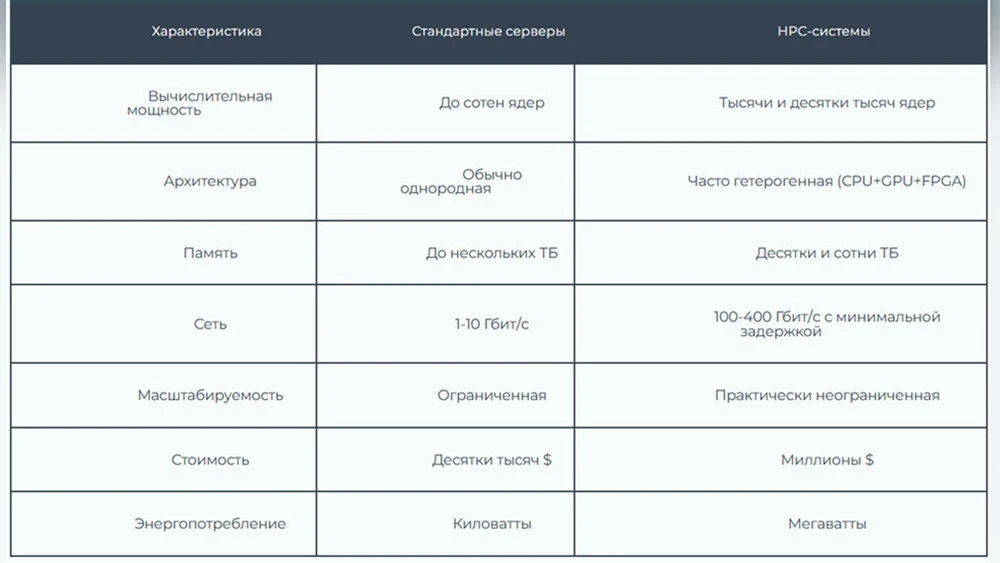
Despite the differences, this does not mean that every scientific task requires a supercomputer the size of a gym. Today's HPC solutions range from compact systems to large complexes, and it is important to choose what is suitable for your specific tasks.
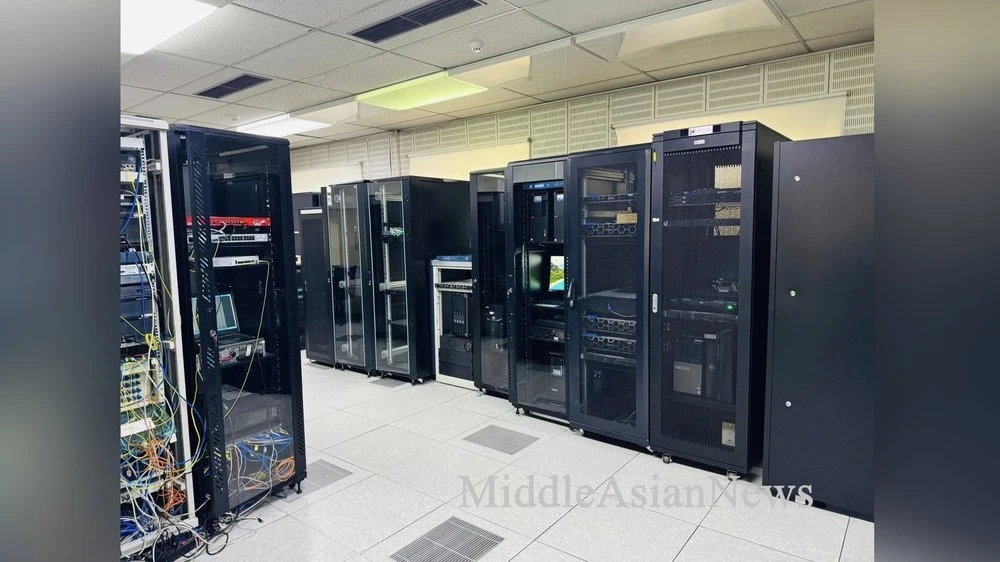
The recently installed HPC supercomputer has 3072 processors, 2 petabytes of memory, and a computing speed of 96 teraflops (TFLOPS) per second. It is 16 times faster than its predecessor, the Cray XE6, installed in 2011, with four times the number of processors and 20 times the storage capacity.
The Agency for Meteorological and Environmental Research of Mongolia has implemented a high-performance computing (HPC) system capable of forecasting climate conditions 20, 50, and 100 years into the future.
This year, the new HPC agency replaced the old supercomputer installed in 2011, and now its computing power is 16 times greater, the number of processors is four times larger, and the memory capacity is 20 times greater.
This has allowed for an increase in the accuracy of meteorological forecasts in the country from five to ten days, and geographical accuracy from five to one and a half kilometers.
Prime Minister Zandanshatar Gombojav, in response to a request from meteorologists, instructed Environment and Climate Change Minister Batbaatar Baatar to prepare a proposal for the Cabinet of Ministers regarding the training of specialists and IT personnel working with high-tech equipment and software in meteorological and environmental analyses, as well as issues related to wage social protection.
He also instructed the Cabinet of Ministers to implement artificial intelligence technologies, satellite data, and radar technologies in their activities, propose funding for expanding the network of automatic observation stations, and improve the timeliness of weather forecasts for target groups, as well as prepare a proposal to revise the wage structure for employees of the Meteorological and Environmental Research Service.
Today, there is a diversity in the world of HPC:
CPU-oriented systems: Use powerful server processors like Intel Xeon, AMD EPYC, or ARM-based solutions. Modern models have up to 128 cores per processor and support advanced instruction sets for scientific calculations.
GPU-accelerated systems: Utilize NVIDIA graphics processors (A100, H100 series) or AMD (Instinct). These systems are particularly well-suited for machine learning, modeling, and visualization tasks, where one GPU can replace an entire group of CPUs.
Hybrid architectures: Combine CPUs, GPUs, and sometimes specialized accelerators like FPGAs or ASICs for an optimal blend of versatility and performance in specific calculations.
The choice of processor architecture affects not only speed but also energy efficiency, cost of ownership, and programming complexity. There are no universal solutions here—only compromises that depend on specific tasks.
Tatar S. Maidar
source: MiddleAsianNews