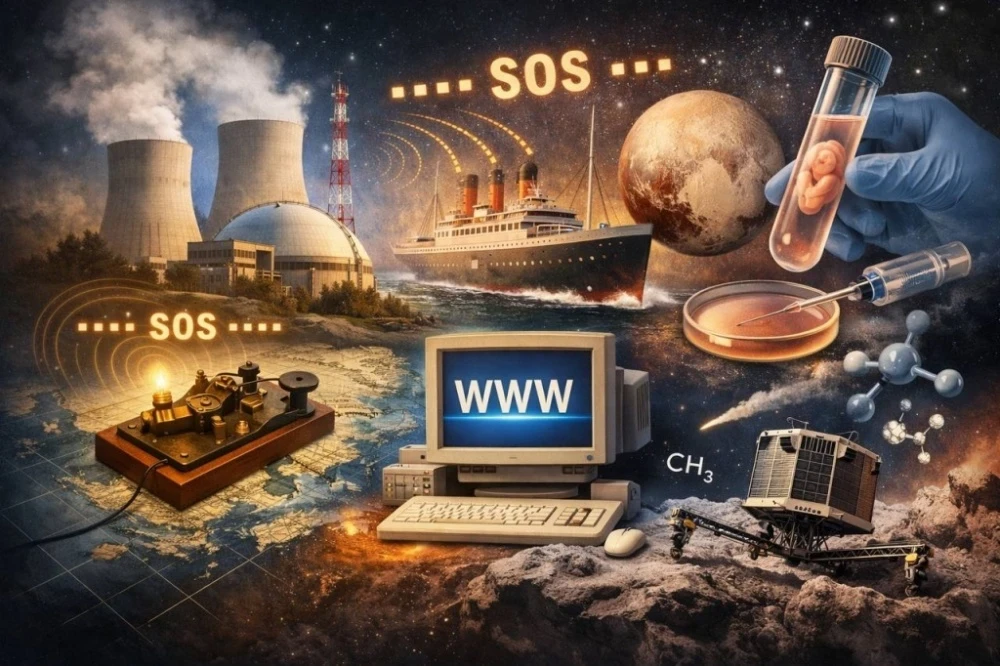
According to the Eastern calendar, the year of the Horse is associated with dynamics and radical changes. It is a symbol that embodies movement — sometimes risky, sometimes bold, but almost always defining. If we set aside mystical interpretations and turn to the facts, we can notice that every 12 years humanity faces powerful jolts, when scientists embark on bold experiments, engineers overcome natural obstacles, and doctors and researchers pave new horizons.
“Podrobno.uz” presented seven significant events that occurred in the years of the Horse — stories of scientific and technological achievements that radically changed the world.
SOS: the only distress signal (1906)
At the beginning of the 20th century, the oceans were not only dangerous but also deaf. Radio communication already existed, but each fleet used its own distress signals, resembling the Tower of Babel. The British sent CQD, the Italians sent SSS, and the Germans sent SOE, and in stormy conditions, these signals often got lost.
Maritime historians claim that up to 50% of distress signals did not reach their recipients or arrived too late. Radio operators could simply ignore codes, considering them unreliable.
This chaos was overcome in 1906 at the International Radiotelegraphic Conference in Berlin, where representatives from 29 countries reached an agreement: the sea should not be divided by borders or languages, and the world needed a single, easily recognizable distress signal.
Thus, SOS was introduced.
Contrary to popular belief, this signal did not mean "Save Our Souls" or "Save Our Ship." Its selection was technical: three dots and three dashes formed a unique rhythm in Morse code that was easily perceived audibly and almost impervious to distortion.
With the introduction of SOS, maritime safety reached a new level, establishing the first global rescue standard, understandable to all, regardless of language and flag. This "horse leap" became the foundation for future universal protocols, from aviation to digital technologies.
The discovery of Pluto: a planet for the stubborn (1930)
On February 18, 1930, the Solar System acquired a new planet — Pluto. However, the path to this discovery was not easy.
Clyde Tombaugh, who grew up on a farm in Kansas, dreamed of astronomy but lacked the means for an education. He constructed his first telescope from improvised materials, which led him to work at the Lowell Observatory in Arizona, where he was tasked with searching for the mysterious planet X.
Tombaugh spent long nights studying the celestial sphere, comparing photographs and searching for the slightest shifts. And he found it.
Pluto turned out to be small and distant, but its discovery was a triumph of human persistence. The name of the planet was suggested by an 11-year-old girl from Oxford, Venetia Burney, who chose the name of the god of the underworld.
Although Pluto was later "demoted" to a dwarf planet, this discovery demonstrated that even one person can change our understanding of the Universe.
The first nuclear power plant: the atom that lit the light (1954)
On June 26, 1954, an event took place in Obninsk that changed humanity's views on the atom.
Previously, the atom was perceived as a symbol of destruction, reminding people of the tragedies of Hiroshima and Nagasaki, and nuclear energy was considered dangerous and frightening.
However, a group of Soviet scientists led by Igor Tamm decided to demonstrate that the atom could serve humanity.
The project was named AM-1 — "Peaceful Atom." The station was created as an experimental one, and engineers faced many uncertainties.
On the day of the launch, when superheated steam first hit the turbine, there was an unusual silence. The turbine began to operate, and the first five megawatts flowed into the power grid — the beginning of a new era of peaceful atomic energy.
When all systems showed stability, Tamm uttered the famous phrase: "With light steam!" meaning the start of the peaceful use of atomic energy.
The Obninsk Nuclear Power Plant operated for 47 years and became a model for many plants around the world, changing global energy.
"Luna-9": the first step on the Moon (1966)
In the mid-1960s, science was still debating whether a spacecraft could land on the Moon. There were concerns that its surface might be too dusty.
In 1966, the Soviet station "Luna-9" disproved these assumptions by landing on a solid, rocky surface and transmitting the first panoramic images.
This data laid the foundation for planning future manned missions.
Louise Brown: a breakthrough in medicine (1978)
On July 25, 1978, Louise Brown was born in the UK — the first child conceived through in vitro fertilization. This event was the result of years of work and thousands of experiments.
Dr. Robert Edwards and gynecologist Patrick Steptoe faced harsh criticism but did not stop, and their work opened new horizons for many families.
Louise became a symbol of science's victory over prejudice and ushered in a new era in reproductive medicine.
WWW (1990)
In 1990, at the European Organization for Nuclear Research (CERN), British physicist Tim Berners-Lee created the World Wide Web, which forever changed the world.
He developed HTML, the addressing system, and the first browser, but the most important decision was to make his development open to everyone.
This led to the rapid development of the internet, and by the late 1990s, it had become a familiar part of everyday life.
Rosetta: landing on a comet (2014)
In November 2014, the Rosetta mission first placed an artificial device into orbit around a comet and sent the Philae module to its surface. This became possible after a long journey, and Philae successfully landed, albeit with some difficulties.
Subsequently, important data was obtained, including the discovery of organic molecules, which provided new insights into the chemical composition of ancient bodies in the Solar System.
Instead of an epilogue
The years of the Horse in history represent not just luck, but risk, courage, and a pursuit of progress. Each of these events was a step into the unknown, which shapes the movement of humanity.
Image generated by AI