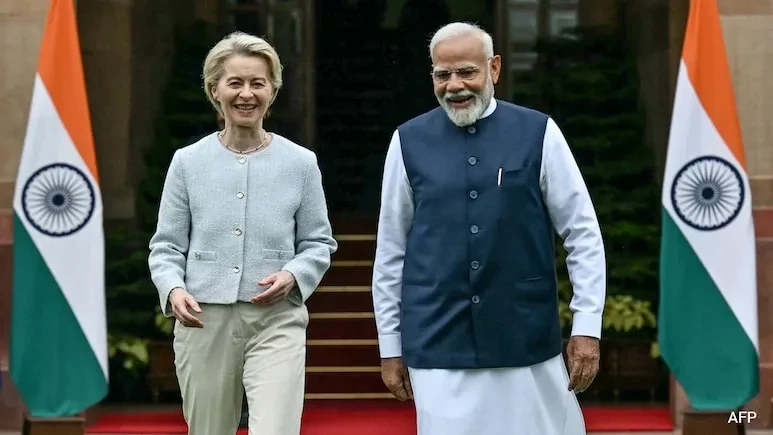
Against the backdrop of preparations for the 16th India-EU summit, which will take place on January 27, India and the European Union are actively discussing the possibility of concluding a Free Trade Agreement (FTA). This was reported by Ndtv.com.
In anticipation of the visit of high-ranking EU delegates to India, who will participate in the Republic Day celebrations and the summit, Kaja Kallas, the EU's High Representative for Foreign Affairs and Security Policy, delivered an important speech in the European Parliament. She outlined a new phase in the relationship between the EU and India.
Kallas characterized India as an "indispensable" partner for Europe's economic stability and expressed the EU's readiness to develop a broader agenda for cooperation with New Delhi, covering areas such as trade, security, technology, and humanitarian cooperation. This statement came amid active preparations for the summit, which is expected to conclude with the adoption of several important decisions.
She described the upcoming summit as a "turning point," emphasizing that both states must recognize their responsibility to support the international order, especially in light of current challenges such as wars and economic fragmentation. "The two largest democracies cannot afford to waver," she added.
One of the key topics of the summit will be the approval of a new joint strategic agenda that will define the vectors of partnership between the EU and India until 2030. Kallas emphasized that "concrete results" will be achieved at the meeting, which will help move from words to actions.
Three main initiatives are highlighted. The first is the conclusion of long-awaited negotiations on the Free Trade Agreement between the EU and India. Kallas noted that this agreement will eliminate trade barriers and strengthen important supply chains in strategically important sectors such as clean technologies, pharmaceuticals, and semiconductors.
The second initiative is related to the signing of a new Partnership in Security and Defense, which, according to Kallas, may be signed in New Delhi next week. This agreement will expand cooperation in maritime security, counter-terrorism, and cybersecurity, as well as initiate negotiations on information protection. "In the face of increasing threats, we will both benefit from closer interaction," she emphasized.
The third initiative involves the creation of a framework memorandum of cooperation in the field of mobility, which will simplify the movement of workers, students, and researchers between India and the EU, as well as promote joint efforts in research and innovation.
Kallas highlighted the economic significance of the relationship, noting that the EU is one of India's main trading partners, while India is becoming an important player for Europe's economic resilience. The partnership in clean energy and climate policy also contributes to the synergy of climate goals and industrial competitiveness.
In the field of technology and defense, cooperation covers areas such as artificial intelligence, semiconductors, cybersecurity, and digital infrastructure. Kallas emphasized that the strategic goal is to establish reliable standards for global markets, rather than simply reacting to them.
She also noted the importance of the Indo-Pacific dimension of the partnership, stating that the joint efforts of Europe and India can help strengthen stability and protect open sea routes.
Recognizing that aligning a joint statement and a new strategic agenda is not without difficulties, Kallas emphasized that work is ongoing, and cooperation with Indian partners remains productive, especially in the context of the rapidly changing geopolitical landscape.
As New Delhi prepares for a meeting with the EU's top leadership, Brussels is already aware that India is becoming a key element in Europe's strategic, economic, and defense plans.