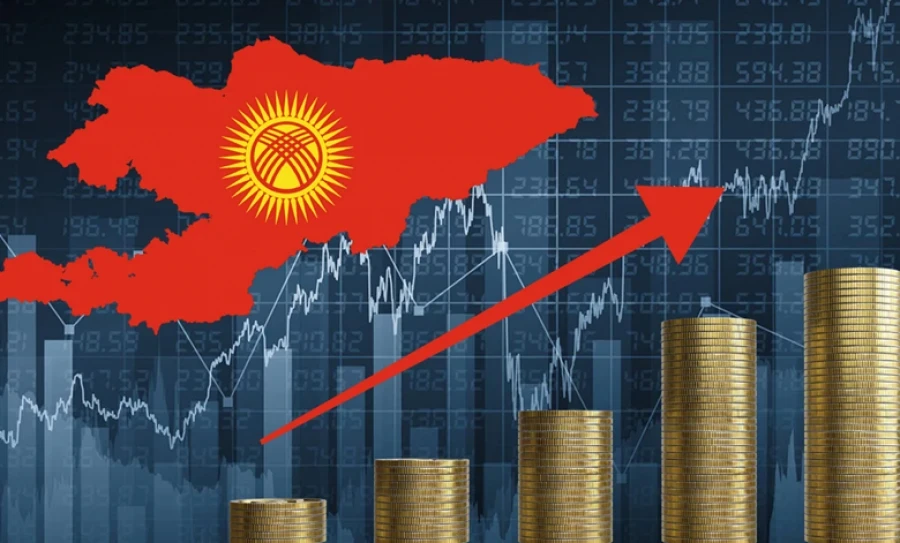
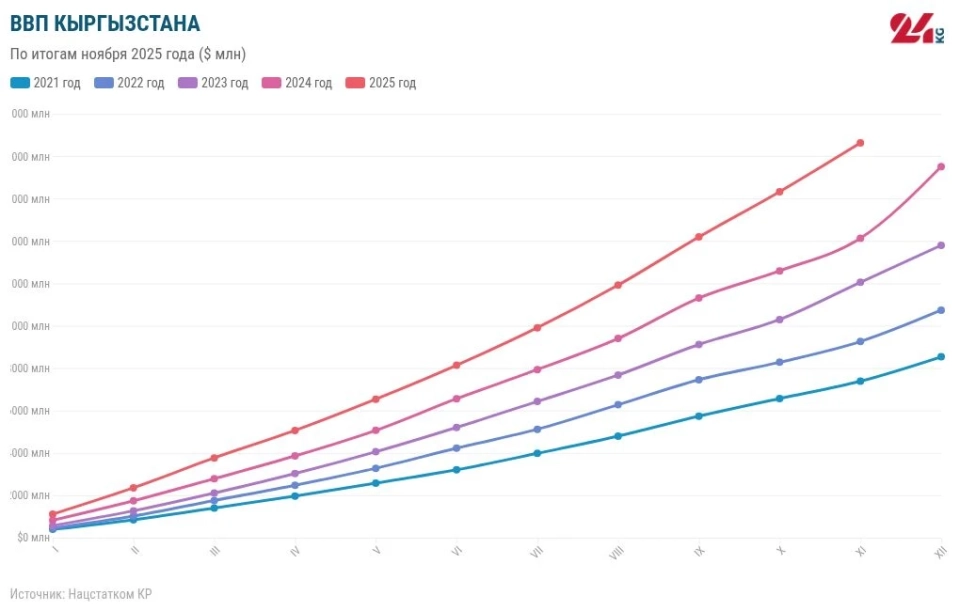
The main factors contributing to this growth are the development of tourism, the construction industry, increased domestic consumption, and the re-export of goods from China to neighboring countries. Additionally, geopolitical circumstances and international sanctions against Russia also influence the economic situation. Internal changes in the tax system and investment projects in various sectors have also impacted the year’s outcomes.
Kaktus.media summarizes the results of 2025 in collaboration with the country's business community.
Sergey Ponomarev, President of the Markets Association of the Kyrgyz Republic, Vice President of the Dordoi Association for Analytical Issues
- The year 2025 indeed demonstrated economic growth, with GDP exceeding 10%, and the consolidated budget surpassing 1 trillion soms. This undoubtedly has a positive effect on the macroeconomic statistics of the country.However, we are witnessing a decline in export potential, not only due to reduced gold sales (which is an expensive commodity) but also due to the traditional imbalance between exports and imports. In particular, since September, our garment industry has faced serious difficulties. A similar situation is observed among re-exporters, who play a crucial role in the economy and contribute to the state budget through both taxes and customs duties.
Currently, the government is taking measures to improve the situation in the textile and light industry, including exemption from insurance contributions. I believe this is the right direction, as it is necessary to support garment workshops that contribute to increasing the country's budget. Otherwise, they will not be able to purchase goods, pay taxes, and salaries.
In 2025, there was also a reduction in social insurance contributions for employers across various sectors, from 17.25% to 2.25%. An important step was the introduction of cashless salary payments, which we have long discussed, and we were finally heard. We expected an increase in social insurance collections, which, in turn, contributes to raising pensions.
With the tax reform, the situation became more transparent with the arrival of the new head, Almambet Shykmatov: the State Tax Service is transforming from a punitive body into a consultative and service-oriented one. Of course, we are still far from perfection, and it is too early to talk about a complete restructuring of the tax service. However, the unified tax, or "simplified system," has led to excellent results. This simplifies business operations for entrepreneurs and reduces the operational burden on tax authorities, decreasing direct interaction between inspectors and taxpayers. The number of tax representatives has decreased by 1,000 people, and if the reform continues successfully, it will develop further.
It is impossible not to mention the high inflation, which significantly affects the cost of goods and products. To address this issue, the Ministry of Finance and the National Bank must work together, as they have the tools to reduce it. If the interest rate rises to 11%, this will make loans more expensive and help prevent inflation.
We continue to work under these conditions and hope that our proposals resonate.
Zafar Sulaymanov, Head of the Fashion and Textile Association of the Kyrgyz Republic
- In the last five years, it has become clear that entrepreneurs are waiting for stability. Throughout the year, there were no significant fluctuations, but the end of 2025 was unexpected for us.Some companies that started their operations in 2020 after the pandemic were able to strengthen and expand. Many individual enterprises significantly increased their scale. Unfortunately, the situation in the industry by the end of the year brought many back. While this cannot be called a crisis, there was a transformation of working conditions, including tax, regulatory, and export changes, which led to some instability. Nevertheless, we are gradually emerging from this situation. November was tough, but work improved a bit in December.
Yes, there were closures of workshops, but work is recovering. Positive news is emerging, such as the president's decree on reducing VAT and income tax - this should revive the industry. The state is trying to act flexibly to avoid a crisis similar to the one a few years ago. I think it is necessary to consider market diversification for garment workers; it is time to earn in dollars and euros.
High Technology Park
- Speaking about the results of 2025 for the IT industry and the HTP, it was indeed a landmark year.2025 became a year of international recognition for the industry. Kyrgyzstan is increasingly mentioned on global platforms - at exhibitions, forums, and in international media. The IT sector has firmly established itself as one of the most dynamically developing export directions of the economy.
Particular attention should be paid to the political signal at the highest level. In 2025, President Sadyr Japarov publicly identified technology and IT as priority areas for the country during an international meeting with Donald Trump and expressed the key idea: to live in Kyrgyzstan and work with the whole world. This was a landmark moment for the industry, as IT entered the strategic agenda of the state not only declaratively but also publicly on the international stage.
One of the most significant steps of the year was the Digital Nomad project. In 2025, an online platform for applications was launched, and the program transitioned from concept to real implementation. This is an important tool for attracting foreign specialists, returning compatriots, and positioning Kyrgyzstan as a country convenient for global remote work.
Also noteworthy is the success of the KIT Forum - the largest IT event in the country. In 2025, the forum reached a new level: over 10 participating countries, about 2,500 guests, and 20 foreign speakers.
For the HTP, 2025 marked a transition from a tax regime to a full-fledged driver of the ecosystem - startups, exports, international ties, and human capital.
The startup ecosystem of the HTP reached a more mature stage in 2025. Several companies demonstrated results that were previously considered exceptional for Kyrgyzstan.
ArtSkin gained international recognition: in 2025, the startup entered the top 4 out of more than 400 projects at the regional selection stage of TechCrunch Disrupt and was selected to participate in the global program in Silicon Valley. The team develops deep technologies in the field of bionics and neurotechnologies and has become one of the most notable scientific startups from Kyrgyzstan on the world stage.
The startup Loadex AI attracted $1.5 million in investments in 2025 after participating in an American accelerator and continued its expansion in the US market, collaborating with logistics companies and B2B clients.
Enji AI strengthened its international presence in 2025: their product was selected for foreign acceleration programs, and the team expanded its work with international clients, occupying a niche in AI solutions for productivity analytics and team management.
Kani TTS, one of the strongest AI cases of the year, released an open-source text-to-speech model in 2025 that supports eight languages. The project attracted the attention of the international developer community and became an example of how startups from Kyrgyzstan can create competitive AI products of world-class.
DBillions is another indicator of a successful case. In 2025, the project continued its global growth: DBillions' content gathered billions of views on international platforms and earned the team several YouTube Play Buttons, solidifying the brand as one of the most recognizable digital products from Kyrgyzstan in the global children's content market.
Expectations for 2026 are related to further scaling: developing infrastructure, laboratories, deep technologies and science, increasing the number of technological products, and strengthening the role of IT as one of the key sectors of the country's digital economy.
Askar Sydykov, Head of the MDS
- Speaking about successes in entrepreneurship, one cannot overlook the economic growth that is being discussed everywhere. This clearly has a positive effect on business: trade volumes, sales, and production are increasing, opportunities are expanding, tax benefits are emerging, and sources of preferential financing under government programs are opening up.However, there is a narrowing of opportunities for the private sector, as several monopolies on certain types of activities have been introduced over the past year, affecting businesses in which many companies and entrepreneurs have invested significant resources, including small and medium-sized businesses as well as large companies. It turns out that some types of activities are carried out exclusively by state-owned companies.
The situation with the limitation of opportunities is concerning, as is the trend towards monopolization. We raised this issue last year, but this year this trend has continued, as have the inspection measures from law enforcement agencies. Businesses constantly report this to us.We hope that law enforcement's interference in business will cease and the situation will improve: there will be less undue pressure and inspections.
It is important to remember that inspections should be carried out by specialized agencies in a civil manner. All issues can be resolved within the framework of civil rights or in courts. When law enforcement gets involved, businesses have no choice but to comply with demands. However, they can challenge this in court to continue their activities.
We hope that businesses can focus on their activities rather than attending interrogations, as this disrupts the normal life of any company. For business, the main thing is predictability and proper application of laws.In conditions of uncertainty, businesses are revising their plans, reducing investments, changing locations, or postponing their intentions until better times.
In the outgoing year, there was also a problem when some initiatives became known post factum, which is related to the reduction of the discussion period to 15 days. Businesses simply did not have time to react. We should always have time to express our opinions.
Saida Nariman, Expert in Accounting and Finance
- The year 2025 was challenging but largely indicative for the tax and accounting sphere of Kyrgyzstan. It was a year when the system finally moved away from its "paper past" and required businesses and accountants not only knowledge but also flexibility, digital literacy, and continuous learning.The digitization of tax administration continued. Electronic offices, online reporting, electronic invoices, and QR payments are no longer innovations but everyday realities. For transparent businesses, this is a plus: less manual work, less subjectivity, faster interaction with tax authorities.
The tax culture has increased. Entrepreneurs are more frequently asking questions before, rather than after, fines. More and more businesspeople realize that an accountant is not just "someone to file reports" but a partner in managing risks and finances.
The dialogue between the state, banks, and the professional community has deepened. There are more clarifications, public discussions of changes, and educational formats. This is an important step towards making the tax system not punitive but understandable.
It is important to note a significant and, mainly, historical shift: perhaps for the first time in years of independence, we are witnessing the transformation of the tax service from a punitive body into a service structure that is more convenient, understandable, and open to dialogue with businesses and the professional community.Today, it is the tax service that demonstrates a level of openness, explanatory work, and readiness for feedback that, unfortunately, not all government agencies can boast of yet. This is an important signal for the market and a basis for forming more mature, partnership relationships between the state and taxpayers.
The main drawback of the year was the high frequency of changes and the increased burden on businesses. Changes in tax administration, payment requirements, new restrictions, and controls were introduced in a compressed timeframe. As a result, not all entrepreneurs managed to adapt to the new rules, and even professionals working in this field around the clock did not always have the opportunity to quickly study and implement all changes in practice.
It is important to understand: sustainable business growth is only possible in conditions of predictability and stable rules. This is not news or theory - it is the fundamental principle of any economy's development. The clearer and more transparent the requirements, the faster businesses invest, expand, and come out of the shadows.It is also worth noting the increase in the number of penalty situations related not to intentional violations but to insufficient awareness and the complexity of applying certain requirements. Many issues arose at the intersection of new rules and everyday operations.
The greatest impact of these changes was felt by small and micro businesses. At the same time, most entrepreneurs are initially oriented towards conscientious tax payment. Problems usually arise not from a desire to violate norms but from the complexity of tax procedures, and not everyone has the necessary skills or resources to seek professional help.
The third significant challenge of the year was the shortage of qualified accountants. The tax and financial systems are becoming more complex, while the requirements and expectations from specialists continue to grow. Today, an accountant is not only a specialist in transactions and reporting but also an expert who must understand banking services, digital platforms, tax risks, and key business processes.
At the same time, the high operational burden often leaves little time and resources for systematic professional development. As a result, professional growth often takes a back seat to current work, making the issue of training and supporting personnel one of the key factors for the sustainable development of the industry.
The year 2025 clearly showed: accounting has ceased to be a supporting function and has become a full-fledged element of business strategy. Accounting, taxes, and financial discipline now directly influence the stability of companies, their reputation, and access to banking instruments.
The demand for training, consultations, and professional support has significantly increased. More and more companies have begun to consciously invest in accounting, as it has become clear that tax errors, fines, and blockages cost businesses much more than the services of a qualified specialist.
It is also worth noting the broader effect. Many entrepreneurs have come to understand that the real growth point today lies on the "white" side of taxation. This has led to a gradual exit of businesses from the shadows, increased transparency of operations, and changes in approaches to conducting activities.
A separate point of attention is the reduction in the volumes of gray imports. Stricter controls and changes in rules have contributed to the regulation of the market and the creation of more equal conditions for domestic producers. As a result, domestic producers have been incentivized to work more systematically, legally, and with a long-term perspective.
For accountants themselves, this year has been a time of professional growth. Those who learned and adapted strengthened their positions. Those who remained loyal to old approaches faced burnout and loss of clients.
This year was a turning point. It was challenging, at times harsh, but necessary. The system is becoming more transparent, and businesses are becoming more responsible. The main conclusion of 2025 is simple: in the new conditions, it is not those who "save on taxes" that win, but those who know how to work with them wisely.
The material was prepared by Dilya Yusupova.