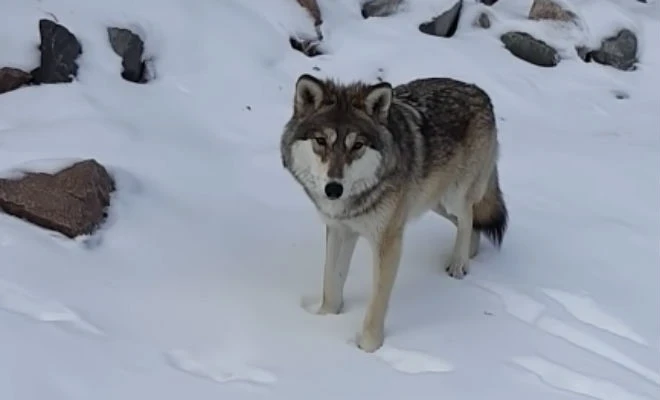
The situation with wolves in regions including Rimini and Cesena has become a concern for local residents, as dozens of cases of wild animals appearing in urban areas have been recorded in recent weeks.
Social media is filled with videos showing wolves roaming freely near homes; one video captures three wolves attacking a cat.
These events have sparked a wide discussion about the return of wildlife and the consequences this may have for people. The issue of coexistence between wild animals and humans has also become relevant in other European countries such as France, Germany, and Spain.
On January 6, Rimini Fellini Airport suspended all flights. The reason for this was a pack of four wolves spotted near the runway. Fortunately, only one flight was threatened, as the airport operates on a reduced schedule in winter. However, the question of why the animals appeared in this location remains open.
According to Pierre Claudio Arrigoni, a wildlife expert, the wolves that have been inhabiting this region for two years may have been attracted to the airport by rabbits that were displaced from their usual habitats by the snow.
Creation of a "wolf emergency" committee
Residents of Rimini are also concerned about the situation and have created a committee to address the "wolf emergency." A special service in the city is accepting reports on this issue.
Biologist Tani Baskucchi, who works in this service, noted that wolves are attracted to garbage bags, containers, and even dog food left in gardens. She emphasized that attacks on people are extremely rare and usually occur because wolves lose their natural fear of humans.
However, pets such as dogs, sheep, and goats become easy prey for wolves. "We recommend keeping animals in enclosed pens at night," she advises. "A standard 'anti-wolf' pen should have a slope of about 45 degrees so that animals cannot climb over."
Nevertheless, not everyone agrees with such recommendations.
The "wolf emergency" committee emphasizes that the growing wolf population is a serious problem. "We need to decide who owns this territory — the wolves or the people; coexistence is not possible," they stated.
“We know nothing about wolves, as they have been absent here for over 100 years. In the past, farmers had guns, and there were wolf hunters who were paid for their extermination.”
City dwellers express dissatisfaction with the authorities' recommendations to keep pets indoors or build safer pens. "Now we are being convinced that the problem lies with us. We will be forced to install fences two to three meters high, underground barriers, and electric enclosures, as well as keep dogs and cats locked up," their statement notes.
“But in the village, dogs are guard animals, and cats are needed to scare away mice and rats.”
The benefits of the presence of wolves
Despite the frequent appearances of wolves and cases of attacks on pets, conservation organizations emphasize that the return of wolves has its benefits.
According to the Rimini branch of WWF, the presence of wolves is a "valuable resource" that contributes to restoring balance in the ecosystem and controlling the population of wild boars, which has significantly increased.
Simplifying wolf hunting in EU countries
Local authorities believe that this approach contradicts pan-European trends. Last year, the European Parliament changed the conservation status of the wolf in the EU from "strictly protected" to "protected." This gives member states more freedom in managing wolf populations to improve coexistence with humans and minimize the impact of their numbers.
Now authorities will be able to adopt more tailored measures that correspond to local conditions. The authorities of Emilia-Romagna note that the national management plan that regions are required to follow has not been updated since 2002 and does not take into account the change in the wolf's status at the European level.
At the end of the month, local mayors and police representatives will gather to discuss new strategies for controlling the wolf population.