During the interview, he explained why practical experience cannot be replaced by either the internet or artificial intelligence.
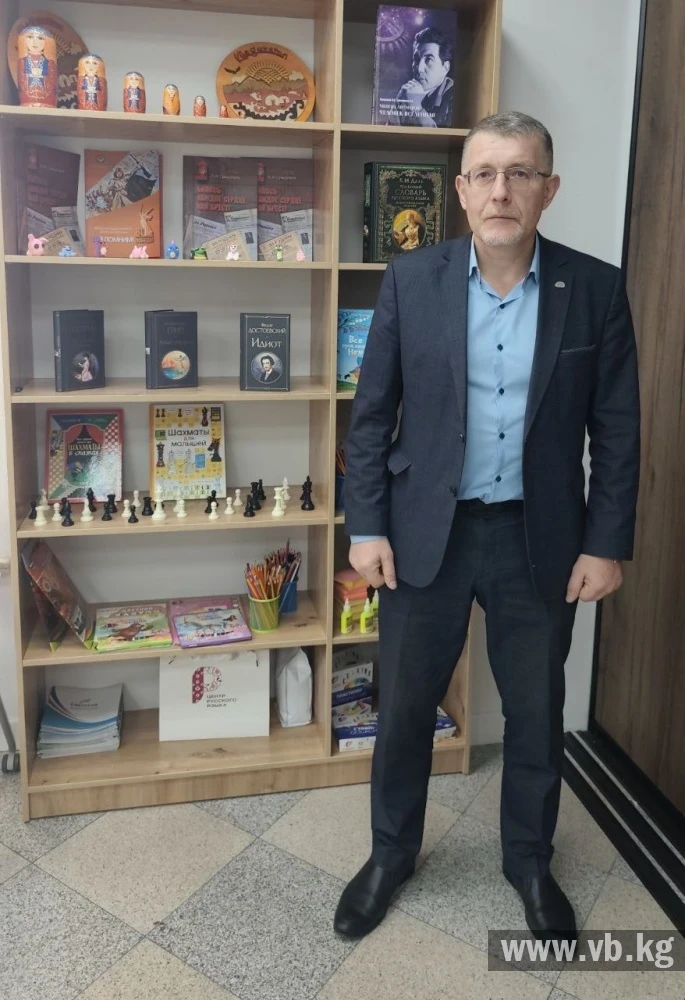
- Igor Vyacheslavovich Pershukov is a professor, Doctor of Medical Sciences, and holder of a PhD degree, head of the Department of Hospital Therapy with a course in Radiation Diagnostics and Oncology at Jalal-Abad State University. He is a fellow of the American College of Cardiology (FACC) and the American Society of Cardiovascular Angiography and Interventions (FSCAI).
- Why is it important for medical students to seek answers independently rather than relying on the internet? How did you come to the decision to become a professor, having significant practical experience as a physician?
- An article by my senior colleague and mentor Talantbek Abdullayevich Batyraliev made me reflect on my path, my "universities," and the teachers who influenced me.
Recently, during a practical class, when a 5th-year student grabbed his smartphone to look up the answer to a question, I asked him not to resort to "Google," but to try to solve the problem on his own. This made me think again about the importance of medical science and educational institutions in shaping a physician.
To illustrate my point, I shared a joke: "If you don't want to be a doctor that patients fear, seek answers yourself. Otherwise, like in the old joke, when a woman in labor brought a doctor to her phone and asked, 'Okay, Google, how to deliver a baby?' — I would panic and give birth myself in 10 minutes."
With my 31 years of medical experience and over 20 years in scientific and educational activities, I have been teaching for a long time. I first worked in Moscow at the Medical Center of the Presidential Administration of the Russian Federation, then since 2015, I have been teaching remotely at Osh State University, and since 2022, in Kazakhstan. Until 2025, I successfully combined clinical practice in four specialties with scientific and educational activities. Reflecting on T.A. Batyraliev's words about the importance of medical centers, I realized that answers to many questions do not come immediately.
- How should medical students be trained to become professional and thoughtful physicians?
- I recall my favorite classic, Mikhail Afanasyevich Bulgakov. He graduated from university in 1916 and received the title of "doctor with distinction." However, as he wrote in his autobiography, "fate turned out such that I had to use neither the title nor the distinction for long." A year and a half of working in the zemstvo hospital of the village of Nikolskoye in the Smolensk province became an important stage for him. If it weren't for this practice, we wouldn't have his remarkable book "Notes of a Young Doctor." Working in the village enriched Bulgakov with experiences that later reflected in his work.
In one of the best stories from the "Notes of a Young Doctor" cycle, a young doctor, recalling pages from his textbook, faces a hopeless case. Before his eyes, a girl caught in a flax scutching machine dies, and not knowing how to act, he is lost in thought: "Die. Die faster... What should I do with you?" In the end, his intuition and sense of responsibility suggest the right decisions at a critical moment. After completing the first amputation, he pleads with fate for the girl to survive: "Hold on a little longer... Don't die."
Professor Philip Filippovich Preobrazhensky, embodying an outstanding physician, proves that one can maintain professionalism and humor in any circumstances. His words: "I am a man of facts, a man of observation. I am an enemy of unfounded hypotheses" reflect the essence of an encyclopedic doctor who is not afraid of risky decisions and achieves success in his work.
He shows how the intervention of the surrounding world can disrupt the medical practice of even an outstanding specialist: "What is your devastation? A witch who extinguished all the lamps? She doesn't exist at all. The devastation is not in the toilets, but in the heads..."
M.A. Bulgakov placed Professor F.F. Preobrazhensky in the era immediately after the Revolution, which happened more than a century ago. Now we live in the 21st century.
Recalling Philip Filippovich, I thought about the talented people I encountered along my path, starting from the 9th grade in 1987 and ending with 6 years of study at medical university. I remembered my teachers and mentors who played a significant role in my development.
It turned out that there were quite a few such people: Professor B.G. Yermoshchenko, Professor Zh.K. Lopunova, Professor Ya.G. Timoshenko, and many others. In total, there were 17 people before I graduated, including 10 professors (of whom 7 were professors at that time, and 3 became them later).
Can the internet replace such a collective? In my opinion, hardly. At least not in 2026. No artificial intelligence will be able to answer all the questions that a medical student faces.
- How did your professional career develop?
- I had two fateful turns that happened beyond my will, and I am grateful for them. The first opened up outpatient cardiology and therapy for me; the second freed me from the illusion that only state medicine can effectively help people.
After graduating from medical school, many outstanding specialists helped me on my path to cardiology: Professor A.N. Samko, Professor Yu.A. Karpov, and others. These professionals provided invaluable assistance throughout my career.
- Which academics and professors had the greatest influence on your career?
- In the professional sphere, it was S.P. Golitsyn, I.V. Savelieva, and others. In the field of science and teaching — Yu.A. Karpov, T.A. Batyraliev, and others.
I am convinced that no artificial intelligence can replace the clinical discussions that were held at the National Medical Research Center of Cardiology in Moscow. These discussions, organized during the life of Academician E.I. Chazov, brought together all departments and services, where both clinical data and test results were discussed. Each department tried to present an interesting case, and the discussions were always accompanied by lively debates.
- How did you build your career across various fields of medicine and science?
- It was a long and continuous development. I always worked, studied, and mastered new things.
The Moscow schools of two academicians produced many doctors: the school of A.L. Myasnikov and the school of P.E. Lukomskiy, which left a significant mark in cardiology and therapy. I studied in residency and graduate school for 5.5 years.
After meeting Professor B.A. Sidenko, I became his dissertation student, which significantly enriched my knowledge and experience. I was also involved in the work of the journal "Cardiology," which gave me the opportunity to develop my skills and knowledge.
- Where did you gain practical experience after working at the Cardio Center?
- Working at the Sani Konukoglu Medical Center in Gaziantep became a significant milestone in my career. Talantbek Batyraliev attracted many talented doctors and scientists from Kyrgyzstan to Eastern Turkey, which contributed to the implementation of advanced technologies in cardiology and cardiovascular surgery.
The work of world-class surgeon Yu.V. Pya was innovative and bold for its time, and his methods later became the standard in leading clinics around the world.
My work in the X-ray operating room of the cardio center before defending my candidate dissertation and my acquaintance with angiographic technologies at the SanKo Medical Center allowed me to avoid fatal complications.
Many years in outpatient cardiology showed how significantly patient treatment outcomes can be improved. I also developed original methods for treating arrhythmias that showed better results than similar methods in the USA.
My knowledge in cardio-oncology helps manage cardiotoxic effects in patients undergoing chemotherapy or radiation therapy. These developments are patented in Kyrgyzstan and represent a significant contribution to medicine.
- How many years did you teach before coming to the city of Manas?
- Since 2004, I have been teaching at postgraduate training faculties, created a section in the Russian Society of Cardiology, and led educational programs for doctors. These activities allowed me to actively engage with the medical community and develop my skills.
Today, as the head of the clinical department in Manas, I continue to seek innovative approaches to student education and implement new methods in the scientific and educational process.