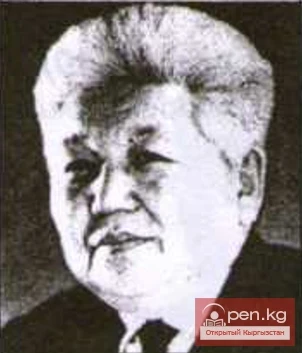
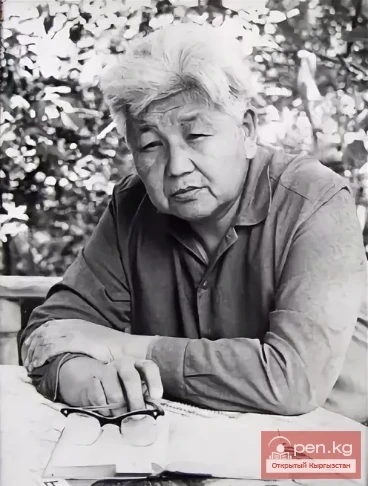
His son Tumonbay Sydykbekov, Sovet Sydykbekov, shares memories of the family, asserting that his parents indeed had that many children. "Many of them did not survive to adulthood due to illnesses. As a result, only two daughters and two sons remained in the family — Tumonbay and Tugolbay. Soon after that, Sydykbek chon ata passed away, and Aymankan apa was left alone with the children. She was a talented singer and had a gift for improvisation, which undoubtedly passed on to Tugolbay. He often went to the pasture, where he composed his works by the riverbank. When his health began to decline, he would come to the shores of Lake Issyk-Kul to rest. Tugolbay was a reserved person, while his wife Asylgul was known for her kindness. Together, they raised a daughter and three sons. Unfortunately, shortly after that, his wife passed away, and his uncle began to fall ill," says Sovet.
The home of the people's writer Tugolbay Sydykbekov, still standing in Ken-Suu, is cared for by his relatives. According to Erkingul Sydykbekova, Sovet's wife, this house was built before 1960. "We moved here in 1966 after our wedding. Initially, it was a four-room house built by my father-in-law Tumonbay Sydykbekov. Over time, additional rooms were added, creating a unified structure. Tugolbay often rested here when he came to the village, and we continue to maintain it in good condition, hosting guests in the summer. This house is important to us, and we do not intend to destroy it," she shares.
In 1962, Tugolbay Sydykbekov celebrated his 50th birthday in his hometown.
Tugolbay Sydykbekov was not only a people's writer and public figure but also a veterinarian by education. He began his studies at a primary school with four grades in Ken-Suu, where a school building had recently been constructed.
He then moved to Przhevalsk (modern-day Karakol), where he lived with a local resident, Korovin, and continued his education at the A.P. Chekhov Russian school, which allowed him to master the Russian language.
Family circumstances forced him to switch schools to those named after Krupskaya and Lenin. From 1928 to 1931, he studied at the Frunze Agricultural Technical School, and in 1931, he continued his education at the Central Asian Veterinary Institute in Ashgabat.
Gulsun Kasabolotova recounts how her husband Iman Mergenbaev and Tugolbay Sydykbekov were born in the same village and belong to the same clan. "During the events of 1916 (Urkun), they were forced to leave Kyrgyzstan and went to Tekes, which is in China. In 1962, they returned, and that same year Tugolbay celebrated his 50th birthday in Ken-Suu. Later, my husband received an invitation from Tugolbay in Frunze, where they spent a month discussing the lives of those who survived Urkun. As a result of this communication, the autobiographical work 'Zhol' was created," says Kasabolotova.
At the T. Sydykbekov Secondary School in Ken-Suu, awards, personal belongings, and photographs of the writer have been preserved. According to the teachers, in 2012, in honor of Tugolbay's 100th anniversary, a museum was opened at the school, where items such as a "chepken," headwear, a telephone, and other belongings of the writer are kept. The school also organized an exhibition of archival photographs and corners dedicated to his life and work. Students participate in competitions, with awards presented by the "Tugolbay ata" fund.
The works of Sydykbekov have been translated into many languages, including Russian, Ukrainian, Uzbek, Kazakh, Tajik, and others. He was one of the founders of Kyrgyz written literature, the creator of the first national novel, and the first Kyrgyz writer to be awarded the State Prize.
Tugolbay Sydykbekov passed away on July 19, 1997.