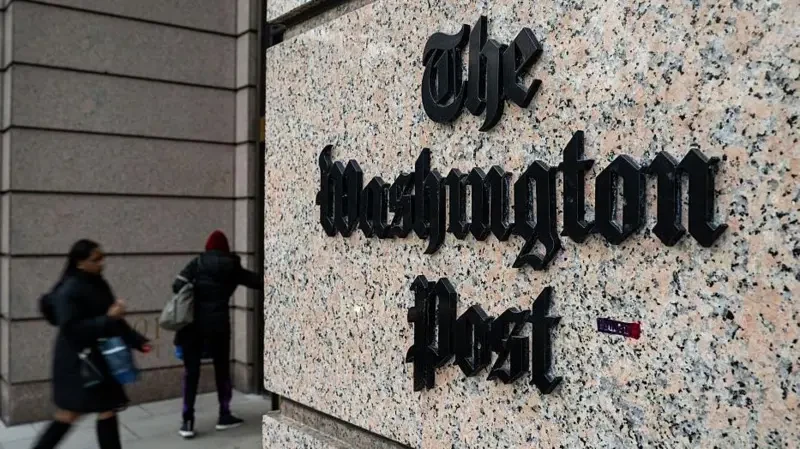
On Wednesday, the American Washington Post announced significant layoffs that will affect several of its divisions. The largest number of job cuts will impact the sports, local news, and international correspondent departments, as reported by the BBC.
The WP newspaper is one of the oldest and most well-known publications in the United States. In 2013, it was acquired by Amazon founder and billionaire Jeff Bezos. Since Donald Trump’s presidency began in 2017, the Washington Post has used the slogan Democracy Dies in Darkness.
According to executive editor Matt Murray, the goal of the layoffs is to ensure the stability of the publication.
“Today’s news is painful. These are difficult decisions,” Murray noted in his address to the team. “If we want not just to survive but to grow, we need to change both our journalism and our business model, adding new ambitions,” he added.
However, many employees and some former leaders sharply criticized this decision.
Marty Baron, editor-in-chief from 2013 to 2021, described the current events as “one of the darkest days in the history of one of the greatest news organizations in the world.”
Murray explained that a sharp decline in internet traffic over the past three years, against the backdrop of rapid developments in artificial intelligence, has been one of the reasons for the layoffs.
“We too often write from one point of view — for a narrow segment of the audience,” he added, specifying that the Washington Post will now focus on politics, national security, investigations, and health and welfare issues.
On the eve of the announcement of the layoffs, foreign and local reporters appealed to Bezos to save their jobs.
After the layoffs, journalists began actively sharing their feelings on social media, with many expressing dissatisfaction over the reduction of international news coverage.
One former editor of the Cairo bureau reported that she was laid off along with “the entire staff” of correspondents working in the Middle East, while a correspondent from Ukraine noted that she lost her job “in the midst of war.”
Another journalist pointed out that most employees in the Metro department, which covers events in Washington and the suburbs, were also laid off.
The exact number of employees being laid off has not been officially disclosed. According to two sources from the New York Times, the Washington Post may cut about 30% of its staff, including commercial divisions. Of the 800 journalists, more than 300 may lose their jobs, according to the NYT.
The BBC sent a request to the Washington Post for comment on the scale of the layoffs.
Marty Baron, the former editor, reminded that when Bezos bought the newspaper for $250 million in 2013, he “actively and convincingly advocated for press freedom” while Baron led the editorial team, including during Donald Trump’s first term.
“But now,” Baron added, “I don’t see that same spirit. It’s just not there,” he concluded.
Disappointed Subscribers
These layoffs are another stage in the process of staff reduction and encouraging voluntary departures among employees, which is taking place across various divisions of the Washington Post amid criticism of several editorial decisions.
The newspaper's workers' union, the Washington Post Guild, stated on Wednesday: “Constant layoffs only weaken the newspaper, alienate readers, and undermine the Post’s mission.”
After the newspaper announced that it would not support any candidate in the 2024 U.S. presidential elections, it quickly lost tens of thousands of subscribers. This decision was made by the publication's owner, Jeff Bezos.
This decision breaks a long-standing tradition, as since the 1970s, the newspaper has consistently supported Democratic Party candidates in presidential elections.
Bezos’s decision last year to change the direction of opinion columns to topics of “personal freedoms and free markets” led to the resignation of the editor of that section.
The financial difficulties of the Washington Post and the decline in subscriber numbers sharply contrast with the situation at the New York Times, which reported on Wednesday that it attracted about 450,000 new subscribers to its online version just in the last quarter of 2025.