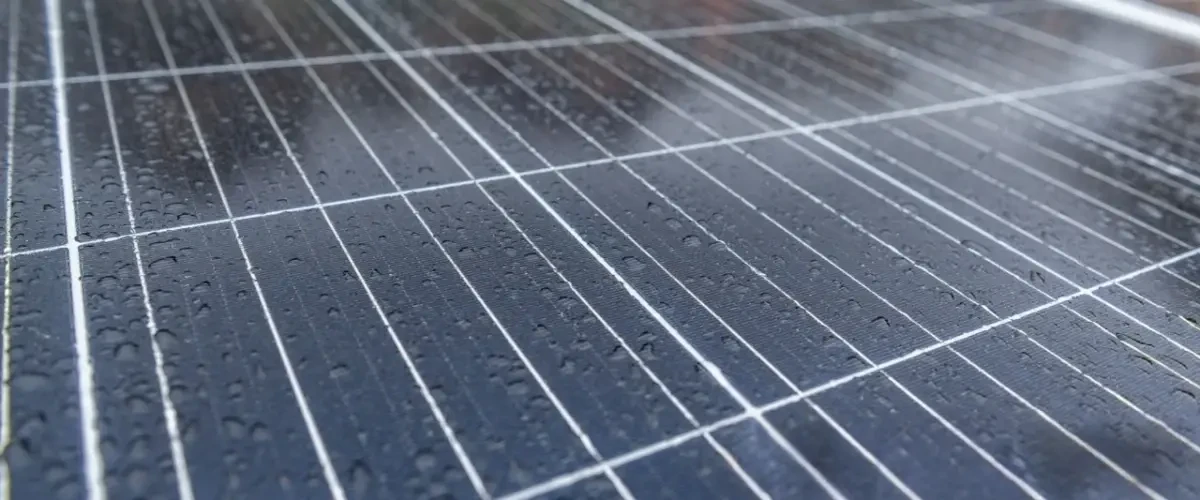
The efficiency of solar panels significantly decreases in cloudy weather. Scientists from Spain have proposed an original solution to this problem by developing a hybrid device based on perovskite, capable of generating electricity from both sunlight and raindrops. This innovation opens new horizons for powering Internet of Things devices and various external sensors.
Researchers from the Institute of Materials Science in Seville used plasma technology to create an ultra-thin film, with a thickness of less than 100 nanometers (for comparison: a human hair has a diameter of about 80,000 nm). This film serves two functions: it protects the chemical structure of the perovskite cell and simultaneously enhances light absorption, while also functioning as a triboelectric surface that converts the kinetic energy of raindrops into electricity.
During experiments, it was found that a single raindrop can create a potential difference of up to 110 volts, which is quite sufficient to power small portable devices. This development is particularly useful in regions with long rainy seasons, where traditional solar panels lose their efficiency. The device can power LED circuits even under complete immersion in water and withstand fluctuations in temperature and humidity, as reported by IE.
“Our research shows that it is possible to combine perovskite solar cells with triboelectric nanogenerators in a thin-film configuration,” comments Carmen Lopez.
The film not only protects the sensitive elements of perovskite but also facilitates energy harvesting from various environmental sources. This opens new prospects for creating hybrid solar-rain panels. Potential applications include powering sensors on large structures such as bridges, meteorological sensors for precision agriculture, as well as Internet of Things devices.