About 570 million years ago, life was confined to the seas. Large, bizarre invertebrates attached themselves to the sea floor, their fleshy appendages gathering nutrients that flowed past. These strange life forms, known as the Ediacaran biota, eventually disappeared. However, researchers have long debated whether their extinction was catastrophic.
A new study published in January in the journal Geology offers a reevaluation of the extinction that claimed many of these creatures, known as the Avalon crisis, and shows that it may have been much more extensive than previously thought, wiping out roughly the same percentage of species as the asteroid-induced catastrophe that killed the dinosaurs 66 million years ago.
Although the Avalon crisis destroyed fewer organisms overall than the Great Extinction, the mass extinction that wiped out life on Earth about 252 million years ago, “this extinction, in terms of the percentage of extinct animals, is comparable to its [later and more famous] counterparts,” says Shuhai Xiao, a paleobiologist at Virginia Tech who was not involved in the study. This finding helps clarify our tangled and incomplete understanding of the rare Ediacaran biota.
The new study focuses on Ediacaran creatures from a fossil collection known as the Avalon assemblage, which contains the earliest complex and large organisms ever found in the fossil record. First discovered on the Avalon Peninsula in Newfoundland in 1958, these strange soft-bodied creatures lived in deep-sea areas from 574 to 560 million years ago.
These early communities included everything from lichens and giant clusters of bacteria “to a completely extinct kingdom of life that no longer exists on Earth,” says Lydia Tarhan, a paleontologist at Yale University who was not involved in the study. “There is still debate about what type of animals they should be classified as.”
Fossil evidence suggests that around 560 million years ago, a minor extinction occurred in the Avalon community. This extinction paved the way for a more diverse group of organisms known as the White Sea community, which subsequently experienced its own, more extensive extinction about 10 million years later, known as the Avalon crisis.
The Avalon crisis “is the first significant mass extinction event that animals ever experienced,” says Duncan MacIlroy, a paleontologist at Memorial University of Newfoundland and the lead author of the new study. Previous research indicates that about 65% of all species went extinct as a result of it, he adds.
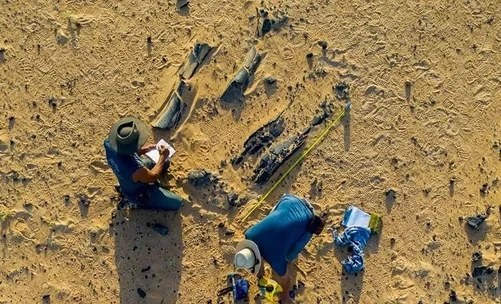
In the new study, MacIlroy and his colleagues describe recently discovered fossils from a site in Newfoundland called the Inner Meadow. This site has preserved in exquisite detail at least 19 genera of Ediacaran creatures, including many branching filter feeders that are also found in other well-known exposures of Avalon.
“When we removed the moss and soil on the first day, it became clear that this was a very special place,” says MacIlroy. “The fossils are beautifully preserved, and many of them have not been weathered.”
Using small fragments of uranium-rich zircon deposited from ancient ash sediments, MacIlroy and his colleagues applied uranium dating methods to assert that the new fossils are about 551 million years old. “This is significantly younger than most previous estimates,” says Tarhan.
This discovery suggests that the animals found in the Avalon assemblage lived 10 million years longer than previously thought and went extinct during the Avalon crisis, rather than earlier due to their own, less extensive extinction.
Data indicate that the Avalon crisis, which occurred 550 million years ago, was much worse than previously assumed. According to MacIlroy, instead of the extinction of 65% of species, additional biodiversity loss points to an extinction of about 80% of species—enough to qualify the crisis as a mass extinction. In other words, the Avalon crisis was “a very significant event in the history of the animal world,” he says.
“I was shocked,” says MacIlroy upon seeing the new dates. “In science, sometimes an idea or new data has such far-reaching implications that it makes your head spin; I’m not sure I slept much that first night.”
MacIlroy suggests that future excavations in the Inner Meadow and other locations in Newfoundland may uncover new victims of the Avalon crisis. “There are a number of new genera and species that are still waiting to be published,” he says.
Tarhan welcomes the “exciting” new data. “Fossil assemblages of Ediacaran biota are relatively rare in the world,” she says, and the reevaluation provides another important clue in the history of the Ediacaran period.
The causes of animal deaths during the Avalon crisis remain a mystery. According to MacIlroy, the most likely cause was some ecological crisis, although there are hypotheses ranging from a sudden drop in ocean oxygen levels to high predation activity by early cnidarians—distant ancestors of modern jellyfish. “We will only be able to figure this out through further research.”
The record of the First Major Extinction on Earth turned out to be worse than we thought first appeared on K-News.