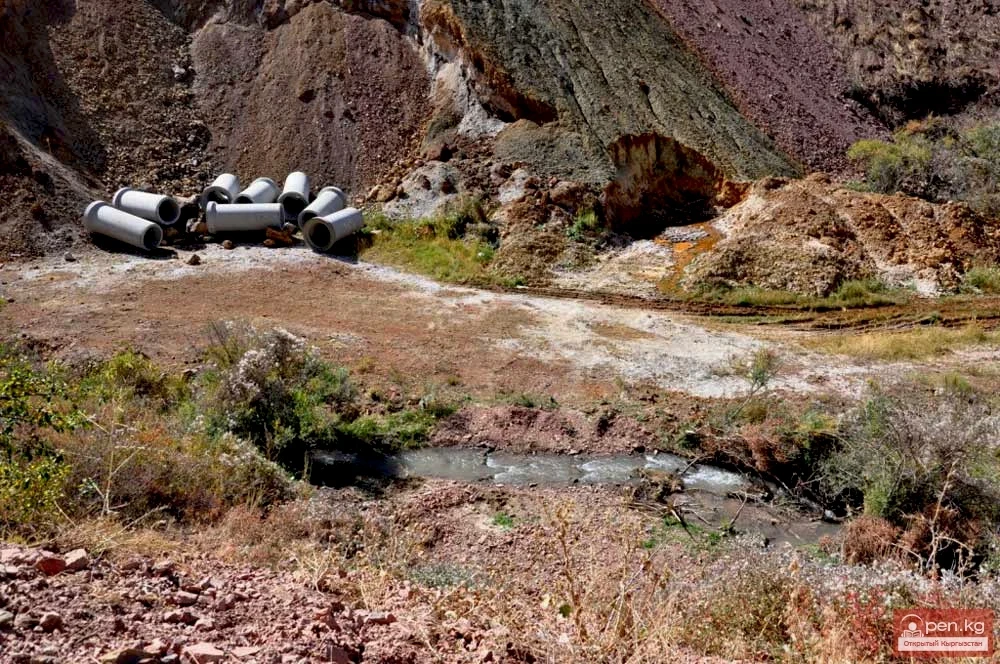
It has been noted above that a significant part of the territory of the republic is subject to erosion processes. The problem of combating water erosion of soils can be solved through a set of anti-erosion measures, taking into account the characteristics of the terrain, agro-physical properties, and mechanical composition of the soils.
The soil and meliorative condition of the lands in the Chui Valley indicates that measures are needed to carry out a set of meliorative activities aimed at soil stratification.
Land is considered the mother-nourisher. That is why every conscious person should cherish it, protect it as the apple of their eye from any harmful influences, and treat it with filial respect. For in the case of negligent treatment, the land loses its fertility, reduces productivity, which leads to the loss of national wealth.
The data presented above indicate that our land is already depleted, infested with weeds, poisoned with pesticides, subject to salinization, waterlogging, severely eroded, and losing its fertility. In such a situation, if we do not fundamentally change our attitude towards the land, it will catastrophically lose its fertile powers, for which our descendants will condemn us /Mamyotov A.M., 1996, p.208/.
Here, one cannot help but recall the well-known sad legend about the violation of the oath between the land and man. Faithful to its grateful duty, the Earth showed man the path to abundance, entrusted him with the key to its treasury. But he broke the oath, did not repay her kindness, but caused harm.
Then the Earth said: "I generously revealed my treasures to you, suggested what to do to taste my gifts. But you turned out to be ungrateful and merciless; you cut off my nourishing heaps, you stripped my skin, you severed my life-giving arteries, and you threw dust into my deep eyes. My misfortune is to take revenge on you." Unfortunately, these words of the legend are becoming a reality in our days. That is why now, more than ever, it is necessary to awaken the sense of responsibility of land users towards the fate of the land.
It is clear that a person cannot cancel the laws of nature, but he must understand and reveal the objectively existing patterns of phenomena. Knowing the laws of soil formation and the role of individual natural factors, one can limit or prevent many undesirable consequences when developing and using soils as a reserve of land resources of the biosphere. For this, it is necessary to take into account the properties of soils - thickness, humus content, nutrient elements, stoniness, slope of the terrain, etc.
We must carefully protect the soils from destruction, rationally use every hectare of land, avoiding ecological violations due to irrational land use technologies. To prevent negative phenomena, every land user must know their land as well as any skilled worker knows their machine. Currently, almost all land users in the Chui Valley have received materials from large-scale land mapping. These contain detailed information not only about the soil cover of the farm but also about the properties of the lands, their soil and meliorative condition, as well as about ways of rational use and increasing their productivity.
The main part of the agricultural land in the Chui Valley consists of natural pastures. All types of seasonal pastures are to varying degrees infested and subject to erosion. Currently, there is a strong overload of the most accessible foothill areas of the pastures and underutilization of the less convenient distant summer pastures. The claims of some specialists that with a decrease in livestock numbers, pastures have begun to gradually revive are unfounded. Negative erosion processes for pastures continue to gain strength.
The basis for the rational use of the Chui Valley regarding pasture rotations must be approached cautiously and differentially. Here, due to the altitudinal zonation of the terrain and the location of pasture lands of land users at great distances (tens of kilometers), it is practically impossible to mechanically transfer the principles of pasture rotations applied in compact plain areas. It can only be about reasonable and strictly rational use of the pastures of the Chui Valley by seasons of the year. Pasture rotations can be implemented on artificial pastures.
In the Chui Valley, the need for strict rational use of land resources has already been recognized, as all the best lands are practically developed. Now, more than ever, the most correct way to solve economic and ecological problems related to territorial resources lies in increasing the rationality of land use (establishing optimal relationships between humans and landscapes). Hence arises a set of ecological requirements when developing various projects, plans, schemes related to agricultural and non-agricultural use of land resources. The main geoecological requirement in the field of protection and rational use of land resources is to maintain land-landscape balance in the Chui Valley. This means establishing and preserving the optimal ratio of areas of arable land, pastures, forests, populated areas, etc.
It is also necessary to comply with all current regulatory requirements in the field of land protection: to combat adverse natural phenomena (water, wind erosion, salinization, mudflows, etc.), for land reclamation, regulation of land use, protection of soils from pollution, and others.
From the content of the main geoecological requirement for the protection of land resources in the Chui Valley, a number of basic provisions for rational land use follow. Productive agricultural lands must be preserved as much as possible. It is necessary to exclude the practice of allocating arable lands and valuable hayfields for non-agricultural purposes. In addition, maximum attention should be paid to increasing soil fertility and including previously unproductive lands in agricultural circulation, even if the costs of their restoration are not economically profitable but ecologically reasonable.
Particularly relevant, for example, is the fight against land pollution from industrial, household waste, and technological emissions that cause significant changes in the chemical and physical characteristics of soils, reducing their fertility. The preservation of valuable agricultural lands during the development of cities and large settlements in the Chui Valley has become increasingly important. Here, attention should be paid to the possibilities of densifying existing buildings, utilizing areas with complex terrain. In all cases of land allocation for non-agricultural use, a cost assessment of the expropriated land for 1 hectare should be made, taking into account its landscape-anthropogenic category.