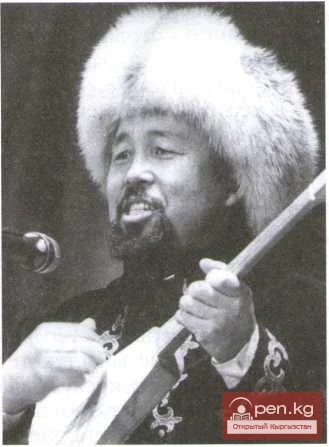
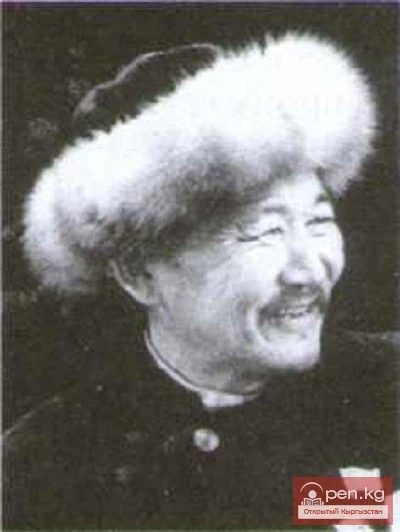
This was shared by the artist in an interview with a Turmush correspondent.
To date, he has authored over 100 melodies, of which nearly 50 songs have gained popularity and become part of the national repertoire.
Kochkorov started his musical education in 1971, enrolling in the Tokmok Cultural and Educational College, which he successfully graduated from in 1974.
According to him, the creation of a melody is always connected with the content of the text. For songs with short lines, he prefers to write light and cheerful melodies, while for longer lines, he chooses something more restrained and profound.
“The melody always serves as support for the text. If the words lack deep feeling, a true melody cannot arise,” he noted.
The Creation of the Song “Kimibizde”
One of Janyshbek's well-known works is the song “Kimibizde,” written to the words of poet Dooronbek Sadyrbaev. The process of working on the melody took almost a whole year, during which the composer experienced a multitude of emotions.
“This composition reflects the inner sufferings of the poet, his deep feelings for his spouse. In the lines:
“Until my feelings are covered with ice (Köngüldörüm muz tör ördöp bara elek)
Until my tears have not spilled into a lake (Köz jashtarım köl shal bolup aga elek)
My light, let my feelings flow like water, (Jarkyńym suu koe kör sezimderge)
Until their roots have not completely dried up…” (Tamırı takyr kurğap kala elek) deep psychology is expressed. The melody was meant to convey this sorrow,” the composer recalls.
Janyshbek emphasizes that the long vocal runs in the song are not just decorative elements, but a musical image of the inner cry characteristic of the Kyrgyz mentality, where pain is experienced internally. That is, the prolonged “ekh iyiy,” “akh iy-iy-iy” are the cries of Dooronbek's soul. The song is filled with tragedy and sorrow.
Before writing the music for another song by Dooronbek, “Kusalik,” the composer contacted the poet and asked to replace the title with a line from the last verse “Kıyalda birge jürölük,” to which he received consent. This was due to the fact that the song “Kusalik” by A. Kerimbaev was already popular among the people.
However, Dooronbek Sadyrbaev never got to hear the melodies written to his verses. According to Janyshbek, when the People's Artist came to Kara-Kul as a deputy and stayed in one of the hotels, the composer was unable to meet him due to the large influx of people.
“Zheneme” — a Song Born from a Joke and Became Folk
The song “Zheneme,” written in 1987, emerged from the joking words of daughters-in-law from the Aksy district (“zheneler”). Both the words and the melody fully belong to Janyshbek Kochkorov.
“When I performed a concert in my native village of Malgaldy, the daughters-in-law jokingly said, ‘Why haven’t you written a song for us? You write for the girls of Kara-Kul!’ I immediately started humming the lines:
“The name of my native land is Malgaldy, (Jerimdin aty Malgaldy)
There is no strength left to reach it. (Jetuüge darmán kalbady)
Among all the zheneshki (Zheneler din ichinen)
How is my Zhezmonchok zhenе?” (Zhezmonchok zhenem amanby?)
They asked me to continue the song. Returning to Kara-Kul, sitting along the rivers Kara-Suu and Kayyndy, I completed the full text, and the melody was born by itself,” he recounts.
Interestingly, this song was later translated into English and performed with an orchestra.
A Song About the City of Kara-Kul
The composition about Kara-Kul appeared during the Soviet period by social order. At that time, the composer worked at the “Energetik” House of Culture.
“The first secretary of the city invited me and suggested writing a song about Kara-Kul. I quickly composed the first verse, but then stopped. Acquaintances advised me to show the text to a teacher named Dosov. He read it, praised the first verse, and suggested adding images of the Toktogul Hydroelectric Station, the Naryn River, and also mentioning the people who grow old here. Following his advice, in three days I completed both the text and the melody,” recalls Kochkorov.
This song was performed at a significant event of the Naryn hydroelectric construction and shown on the Moscow television program “Vremya.”
// Turmush
“Ömür Dayra” — From Coincidence to Classic
This song became one of the most popular among the people, with lyrics by the poet from Bazar-Korgon, Karybek Begimkulov.
“The composition appeared during a trip to Bishkek. One night I stayed overnight at Shamsybek Ötöböev's place. Late at night, they returned with guests from Bazar-Korgon and woke me up, asking me to sing. During the performance, one of the guests, a sister named Kurmanjan, handed me a poem written by her friend and asked me to write music for it. I put it in my pocket, and later, while at the “Pishpek” hotel, sitting with Narynbek Moldobaev, we started humming and laughing, and without even realizing it, the melody was born,” Janyshbek said.
The next day, Dinara Akulova and Mergen Turgan came asking for new songs. I got confused and remembered yesterday's song. Not having recorded it, I poorly remembered the melody. But they gave me a komuz, and I tried to recall it. I started playing and singing, and Dinara really liked the song. She immediately asked for permission to perform it with the komuz and was the first to bring it to the people,” the composer added.
Later, Kochkorov met with the author of the lyrics, Karybek Begimkulov, who expressed gratitude and noted that his songs are indeed magnificent.
About Time and Music
Janyshbek Kochkorov asserts that over time, listeners' tastes change. Many old melodies are now being updated in modern arrangements to suit the current audience. Nevertheless, despite changes in form, the inner meaning and spiritual depth of the music must remain unchanged.
“Music develops according to the era, but the novelty of the words and the emotional fullness of the melody must be preserved,” he concluded.
Objects
Satellite
⛶